
It could be called a memorial’s memorial, or an antimemorial. In his exhibition Funa, artist Bernardo Oyarzún erects a monument to ignominy and infamy in Chilean history. An artist who works for the national dignitaries, not with the intention of turning them into heroes, but the opposite: to degrade them, to expose them, to cut their heads off.
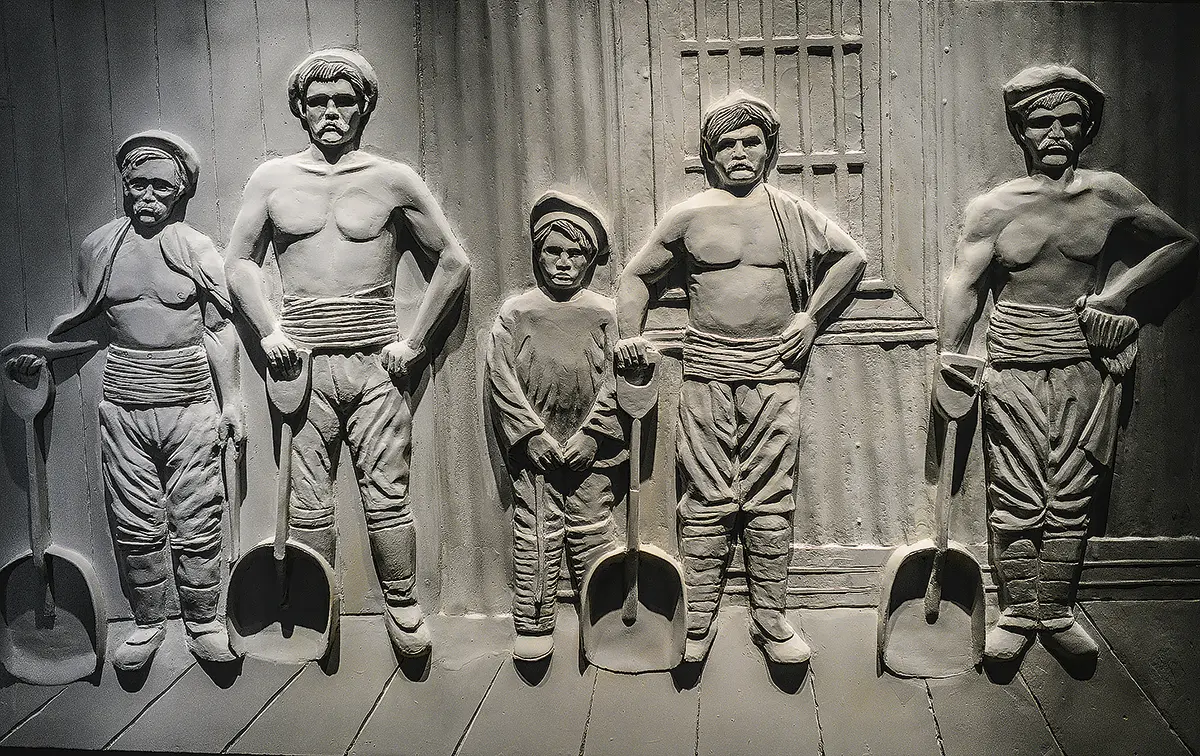
The show is divided into two spaces: one reserved for Funa, the other for the installation Lapidarium. The former comprises a series of bas-reliefs that imitate a high-quality material and represent scenes of human rights violations at the hands of the State, such as the massacre of striking workers in Santa María de Iquique, the Selknam genocide in Tierra del Fuego, the several massacres that took place in saltpeter mines in the early Nineteenth Century; the Seguro Obrero massacre of 1838; the Plaza Bulnes massacre of 1946; the José María Caro Township massacre of 1962; scenes of repression after the 1973 coup d’état; and the current oppression of the Mapuche people. Six episodes that Oyarzún treats as Roman friezes, playing with the antonyms lowliness/greatness and with the erasure of the marginalization of these historical events in favor of others, whose glory is rather doubtful. The latter, with a title also classical in origin, features a jumble of broken, headless statues of natural heroes. Viewers are able to walk around these pedestal-less monuments, a collection of arms, torsos, and headless equestrian figures as Manuel Baquedano or Bernardo O’Higgins, both of whom have monuments around the country, and both of whom have histories written in the blood of their fellow Chileans.
The title chosen by Oyarzún is clear and decisive. Funa expresses repudiation of someone whose bad conduct one wants to underscore. In the mapudungún (Mapuche) language, it also means “ruin” and “manure”, words that give a different tenor to the works on exhibit. Bernardo Oyarzún, who has a Mapuche background, has referred before to the continued degradation of indigenous peoples, as is clearly the case in his work for the Chilean Pavilion at this year’s Venice Biennale. The fact that Fondart, the public fund for cultural activities, subsidized this initiative at Museo de la Memoria, speaks well of the freedom enjoyed by Chilean artists.
It is difficult to avert one’s eyes from Oyarzún’s raw, tough exercise in these two works, with their forcefulness and the literalism. A clear desire to be categorical and to “settle scores” in space—this museum—devoted to memorializing the victims of the dictatorship. In a country still filled with hundreds of streets, plazas, and monuments celebrating generals, commanders, and presidents who repressed the people, ordered massacres and mistreated their citizenry, it is important to show, even if only once in a while, that “other history,” a non-official reading of their supposed achievements and exploits. There are, however, two aspects of Oyarzún’s artistic funa that could have been projected in a more didactic and creative way. On the one hand, the metaphorical work of both works is exceedingly basic. The inclusion of some elements of the biography of each subject, or a sharper allegorization of their public punishment, would have made the works more biting. On the other hand, the absence of a direct textual explanation in both cases deprives visitors of tools for judgment, which is, in the end, the goal of the whole enterprise.
JUAN JOSÉ SANTOS