
“Art has now debased itself and become not more than the desire to take part in the very system that it once struggled against. The failure of art is not an absolutely closured.” This message comes in an eagle’s beak. Standing atop a bronze-cast structure, it also features the caption “Wish you succeed.” The pedestal seems to keep its balance only thanks to a network of cables anchored to the wall, which also creates lines of tension inside the dim space of the gallery’s basement. The eagle is not just any bird; it seems to contain, in the fullness of its meaning, the artist’s spirit—or, specifically, the spirit of a painter in flight. Its plumage is covered in a mixture of pigments similar to those that makeup Capelán’s palette, and there are brushes on the tips of its extended wings, held in place by plastic zip ties of the kind used to secure baggage. On the floor towards the back of the exhibition space are a series of bottles lining up like a small army. Their contents are unknown to us, yet these glass containers are the only signifies that clearly identifies familiar elements of Carlos Capelán’s language; all the others turn the installation into an unusual “aesthetic declaration.” Without this identifying gesture, the installation absorbs us into its totality, with its epiphany of mystery and beauty, despite the recurrence and superposition of traditionally symbolic visual elements. Our gaze begins to interrogate the work only after we have read the text brought to us by the eagle. If we add to this the “epistemological prologue” that accompanies the exhibition as part of its ontological interpretation, we find yet another one of the language puns that Capelán often deploys ironically to interrogate both narratives—texts and visual signs. The prologue tells the story, in a Mexico City dialect, of the artist’s adventures in San Diego and Tijuana, where he and a friend exchanged Coca-Cola cans across the border and drank from them. We begin to understand the complexity of the work and the levels of meaning it involves, especially the debates that the historical avant-garde inaugurated with its aesthetic posture and that today—given the ambivalence with which the arts take part in the play of institutions and markets—are fully inscribed within the very system they critiqued at different historical moments throughout the Twentieth Century.
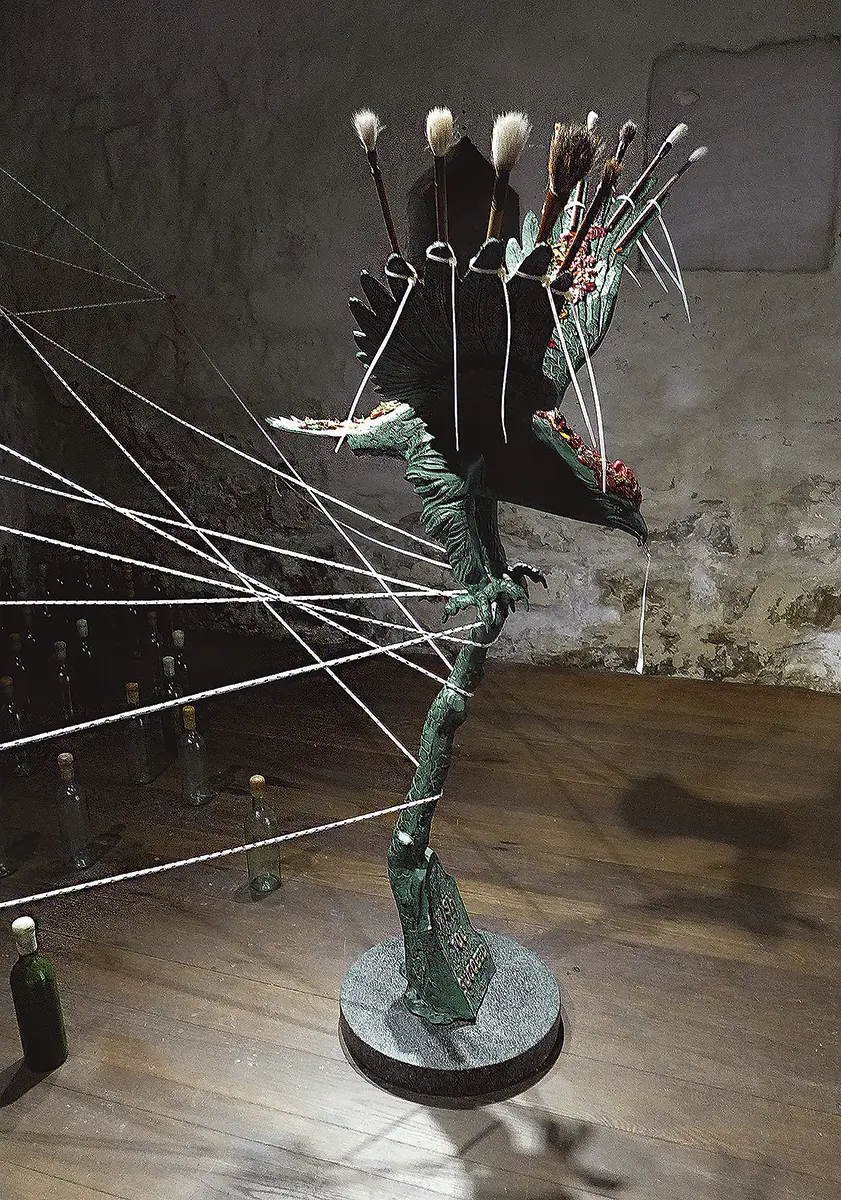
The installation was part of a larger show that occupied every room in one of the oldest houses in Lund, a small city in southern Sweden that has welcomed the Uruguayan artist in his sojourns between the northern regions of Europe and the southern and central regions of the Americas. This exhibition is especially meaningful, since it summarizes, in the manner of a declaration of artistic principles, Capelán’s work of recent years. Condensed into this selection of works were the versatility that has characterized him as a draftsman well versed in printmaking and engraving traditions, his use of graphic elements, and his drawings on canvases and gallery walls demarcated by thick black outlines. And, later, his exploration of the blotch as a perceived map of mental landscapes—as in psychological tests—that can work at different levels: "as a cultural and a psychological landscape of the test subject." The result was Capelán’s well-known series of psychometric drawings exploring, from their position on the walls, modes of the perception of figures, as observers moved in space; in this exhibition, those drawings are combined with graphic elements and thick outlines of bodies and faces, abundantly overprinted on China silk and paper. Also, there is a sense of camouflage in the motley green-hued paintings of rainforests with hidden figures. In other works, distorted anatomies and faces are represented as syntheses, or superimposed on monochrome surfaces, or on geometric planes in different colors that resemble abstract paintings, similar to the textile art of some South American native cultures.
In one wall in the same gallery, Capelán explored different modes of “classification” of bird species, presenting appropriated objects from various origins and with different materialities. Coexisting there we found diverse “artistic” modes of representation, from kitsch objects to handcrafts, like the feathers purchased in Paraguay, that are given artistic value by virtue of being framed. The collection represented in these shapes probed the very notion of the artistic object and the arbitrary classification of representations of a single subject (also the central subject of the installation mentioned above).
Capelán’s exhibition extended into the Martin Bryder Gallery, where works of a much more private character and less “museum-like” complemented it. It was accompanied by a volume containing ten short stories written by the artist, in three languages, titled Water: The Moon, The Bucket, and the Cloud. From the exploration of the extended book to the drawing or intervention on the wall, the dominant model was the personal portrait and variable alter egos, all in an ironic and burlesque tone.
In order to understand the position of one of the essential artists of the late Twentieth Century Latin American scene, one must specify his practice and his production in the context of the complexities of global art, defined both by their exposure of diverse cultural experiences and by the processes of knowledge de-colonization as a migrant subject. The work of Carlos Capelán has been and is a complex exercise in language and subtexts—if not writing—understood as a linguistic signifying structure in a predetermined cultural context. In that sense, the idea of porosity is essential to understand the complexity of many of the visual elements Capelán brings into his work and sets in tension, assimilated to the “aesthetics” that characterizes him. In that sense, his “labor” puts into playfields of polyvalent semantic meanings and zones of interference of polyphonic languages, immersed in a specific life experience, constantly questioning and exploring the space of the artistic.
DERMIS PÉREZ LEÓN