
In 2015, Chilean artist Claudia Müller (Santiago, Chile, 1984) began her research Water Cadasters on the Ría de Bilbao, Spain, and later on the Maipo River, in Chile, which led to the exhibition titled Nobody Can Push the River. Both the experience in Bilbao and the one in Santiago resulted in material studies that combined mockups, videos, and photographs.
In 2016, Nature Communications magazine published a discovery: most of the water in the moon came from asteroids and comets that impacted its surface at some point between 4,500 and 4,300 million years ago.
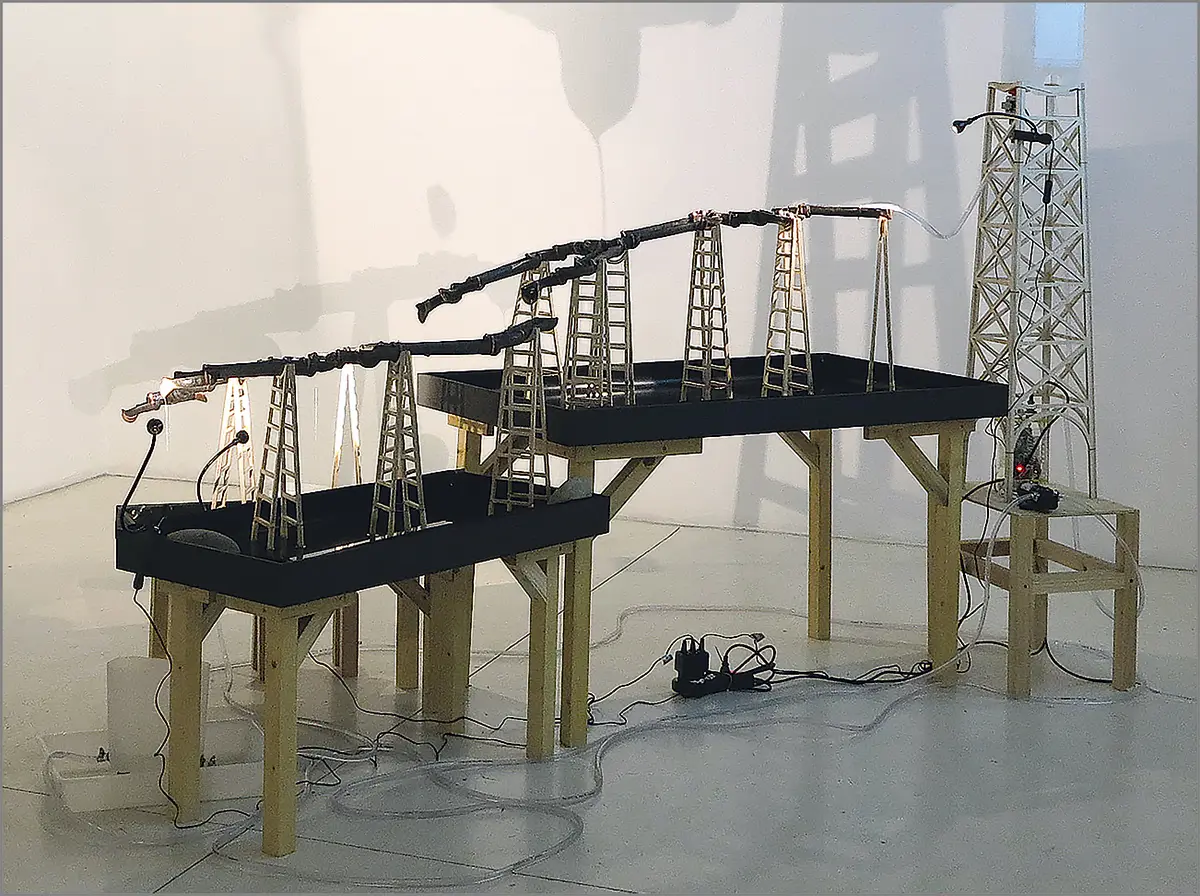
Water Returned to Earth in Meteorites and to the Moon in Comets is a sort of convergence of gazes between Müller’s artistic inquiries and the life trying to reach our natural satellite. The result touches on artistic, artisanal, and industrial conventions. Upon entering the gallery Die Ecke Arte Contemporáneo, time appears to move counterclockwise or, at the very least, seems to be altered. We are not in a scientific laboratory, nor are we in the miniaturized recreations of aquatic roller coasters. Relying on ceramic, wood, and bronze, Müller has constructed a network of ceramic tubes that carry water through the Arduino system, which controls water valves and pumps. The preset times allow for the constant flow of liquid through this hydraulic system, recreating in this manner a small-scale version of a work of engineering whose purpose or function remains a mystery.
Shadows represent another element used by Müller in an intervention in which both the visible and the invisible play a role. The mockups cast their shadows onto the walls; something that, in combination with the closed-circuit video recording of a small volcanic rock hanging from a thread in the exhibition room, confers the space a ghostly atmosphere. The video titled Salto al vacío (Jump Into the Void) also contributes to the confusion and to the subversion of reality. A waterproof camera captures images under and above water, simulating, more than an immersion, an inversion of the surfaces that effectively submerge viewers into an aquatic environment and into the tides that, as we well know, are influenced by the moon. We are not quite sure whether we are out, in, or escaping through the jump into the void proposed by this visual piece. In addition to the mockups, the video projection, and the game of shadows, the exhibition includes a photographic series of underwater images that also blur the lines between liquid and solid.
With just a few elements and confined to limited space, this exhibition successfully conveys a great number of sensations that are hard to identify. Temporal distension, the manipulation of speed, density, and circulation—the video showing time capsules in slow motion, the real-time video recording of the hanging rock, the timed aquatic circuit in the mockups, the casting of shadows that also generate a visualization of the temporal effect—gravity and the lack thereof, as well as the measurable and the unmeasurable components. There will be others who may use this opportunity to add other layers of meaning that are closer to political and economic themes, like the environmental conflicts with hydroelectric companies in Chile; or more esoteric ones, like the biological regeneration at a time of widespread exploitation of natural resources. But, perhaps, the most gratifying way to experience the exhibition is to let the flow of its current take you through those weird discoveries framed by the chaotic arrangement of their elements.
JUAN JOSÉ SANTOS