
To arrive at the corner where the Government Palace and the Cathedral meet to form a triangle with Mexico City’s central plaza, the zócalo, right after turning off Moneda Street, is to start a path where the past expresses itself as a present. The august palace where the Museo de la Secretaría de Hacienda y Crédito Público is located imposes its presence. The museum’s ample and solid wooden gateway enhances this circumstance. The perfect scene is thus set for a tour of Mexico City’s beautiful historic downtown. La escena perfecta (The Perfect Scene) is the title of Darío Ortiz’s exhibition in this museum, featuring a selection of the Colombian-Mexican artist’s monumental, emotional paintings: thirty-nine works itemizing The Perfect Scene in formats that range from 25 x 30 cm through 200 x 300 cm. (It is difficult to label as 300 Centimeters an oil-on-canvas one encounters, forcefully, like 2 x 3 meters; although these different ways of enunciating the work’s dimensions are mere conventions, it is worth mentioning this to situate readers who have not visited the exhibition in the proper context, rather substantial in our times.)
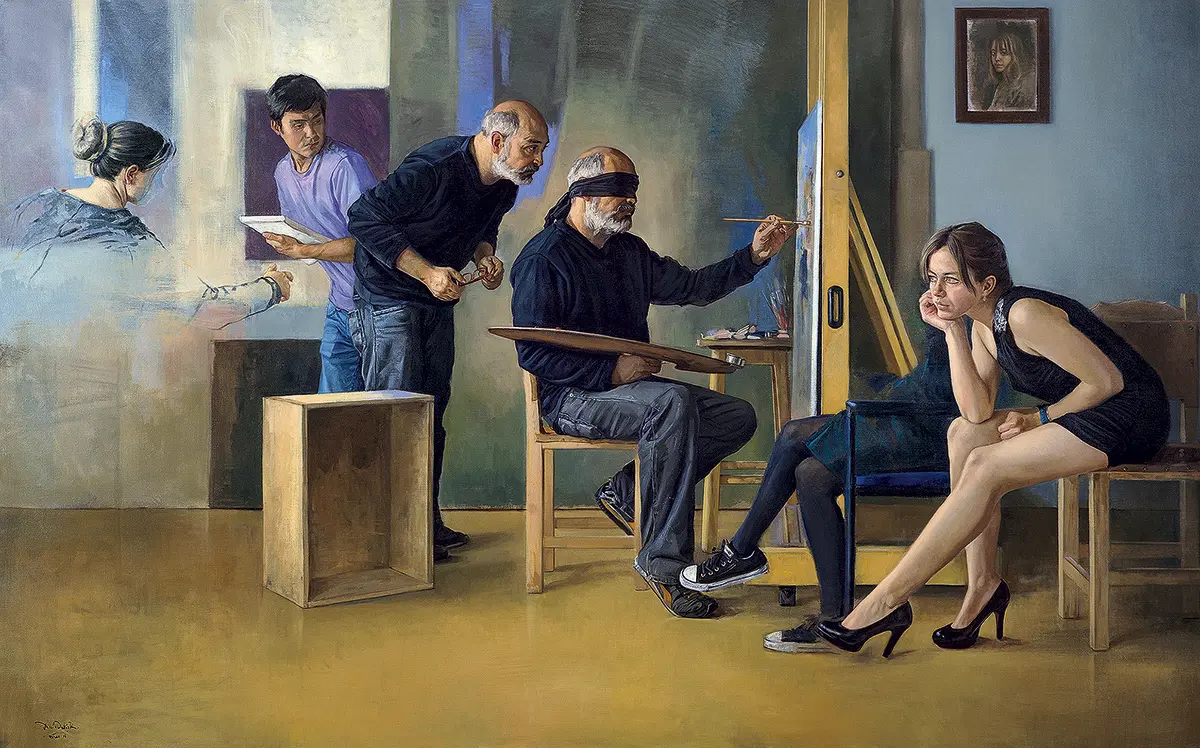
Ortiz’s paintings are presented in ample galleries. Vigor and contrasts come in succession in the endless theater of the Baroque. Ortiz occasionally uses objects with geometric shapes, but the organic dominate the selection. This is figurative painting, where actions congeal for a variety of time periods: be it from yesterday to today, from the Renaissance to the postmodern, or from the countryside to migration. Elderly people from the past and elderly people from the present populate Ortiz’s works, as in Apóstoles de carne (Apostles of the Flesh) and Los sensores del miedo (The Sensors of Fear). Cited here are those men who try to flee from old age, a characteristic of this era. There is no lack of youth or of middle-aged men. The artist treats women by showing them that they are ever-current figures. His female nudes are of full-bodied women. Some might describe them as obese, but no, they are not disgusting or abandoned to the passage of time and to excessive eating. They are and reflect the times and the ways of life that have successively inhabited them. They are the opposite of today’s breast-enhanced women. All of these are the women that Darío Ortiz paints.
“I speak of fear, of shame, and of terror; I speak of the body and of sex.” The artist’s intention is not to pile themes up. “For years I’ve critiqued contemporary art, but I do it from the standpoint of a painterly vision.” Inside the exhibition, viewers are confronted with all of this, mentioned by the artist in a recent phone conversation. Our walking slows down instinctively; it is impossible not to notice the foreshortenings, the scenes with many characters as well as those populated by just one, two, or three figures. The expressions on the faces provide ample information and compete with folds of the clothing and the occasional environmental adornments. Given the dimensions of the paintings, a visitor standing at some distance from them will be able to take in the scene while being engulfed by it, attracted by it, swallowed by it. The composition is authorial, which is to say
Darío Ortiz is a masterful painter who executes his works in full knowledge of cause and effect. In terms of composition, Ortiz displaces the situation towards the periphery of the frame as often as he creates works with a central node. He creates scenes with diagonal depth—like Fábula del pintor ciego (Fable of the Blind Painter), which includes as its background two well-matched abstract pieces and a portrait—or stages constructive situations based on the superposition of planes (with bodies and objects) as in Los aprendices (The Apprentices). The later work allows us to visualize an empty foreground that extends towards the back and the sides. One imagines a grid in which Ortiz has traced the lines of flight until they meet at a distant central point, as indicated by the developments in the study of perspective during the Renaissance. In turn, Ortiz populates this space with sitting and standing characters at different heights, in profile, in three-quarter profile, and forward-facing directly towards the viewer. In Los aprendices we find one of Ortiz’s favorite games: to interweave historical eras by means of costumes, furniture, compositions, use of solid paint, and anatomical or three-dimensional treatments, without forgetting the vehemence of light and shadows.
Both in dark paintings and in well-illuminated ones, Darío Ortiz contrasts a palette from the past with one from the present. In terms of fabric and its motion around the characters, the magnificent garments of the past that Ortiz depicts hide bodies, whereas the scantier clothes of our times he also includes reveal them and are adapted to the mobility required by contemporary life. In Ortiz’s work, we also find quotations and subtle references to great masters from different chapters in the history of art. His paintings are not static in the least (except for some operatic exceptions). They express a pictorial will and reveal that the artist is his own model, the one that results in the fewest costs and complications, and also the one most at hand.
GRACIELA KARTOFEL