
US-based Brazilian artist Eduardo Kac (Rio de Janeiro, 1962) has just presented his second exhibition at the Galerie Charlot in Paris. The show consisted of a group of recent works that reflect Kac’s intention of continuously renovating his visual language. Since his first performances and installations, he has explored digital media to combine complex expressions of the senses.
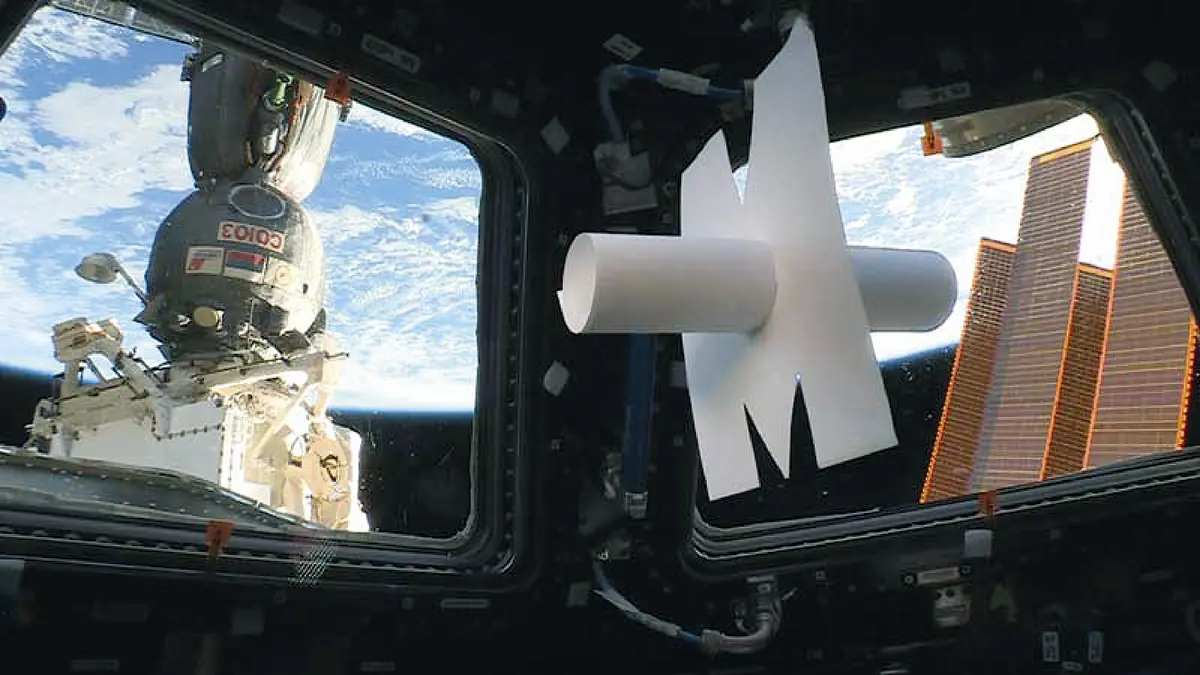
The group of works exhibited is sober. Its main section centers around a video created in collaboration with the European Space Agency of the International Space Station (ISS), where French astronaut Thomas Pesquet creates a form in outer space following Kac’s instructions. Shown in a 12-minute long video, the take shows the process from the beginning and until the created structure becomes independent, floating in all directions across the environment. With a pair of scissors and two sheets of paper, the astronaut creates an assembly shaped to render the word MOI (“me” in French). The video records the intervention and the manner in which the creation moves around (inside a compartment of the ISS) the seemingly weightless space as the outer atmospheric layers of earth can be seen in the background.
In another piece, an installation titled Inner Telescope, Kac makes advances in his own field as he answers the challenge of technological innovations by creating new and provocative inventions.
On the top floor of the gallery, a short version serves as an introduction and it is there where the exhibition concentrates. A dozen pieces spin around this event.
The theme is articulated with photographic prints describing what Kac regards as his first attempts or studies of the form. An element in analytical psychology or in the exploration of the ego, this MOI rendered in the paper can also be regarded as a fragile structure, and this is how it is presented alongside the other structures: as an object.
In other drawings, Kac himself appears to be floating in a zero-gravity environment. In this last motif, he is also an object made of pieces in which superimposed silhouettes sewn on linen induce an abstraction of forms. The schematic nature of the message is referential and intended to attract the viewer’s attention towards an unknown realm.
A pioneer in the creation of works that communicate through circuits—which became fashionable with the emergence of the Internet and electronic installations—Eduardo Kac enthrones several methods of the artistic language. His approach is more subtle than representative and almost goes beyond the notion of upgrading.
Eduardo Kac is known for his incursions into telepresence, reflections on the state of production in the digital era, the induction of original states of perception, and the troubling notion of the “exotic,” like in his installation titled Rara Avis (1996). Since his first experiments during the mid-1980s, Kac’s strong suit has been his research on the communicational process.
The appearance and dissemination of new technologies to the very space of viewers generated a change in the reading and practice of the work of art. And it is possible that large-scale knowledge sharing contradicts or accentuates the relationship between art, entertainment, and biotechnology. The pioneers of the biological field from the 1980s introduced several criticisms to the system. They presented structures that contradicted the prevailing operational systems of the time. Biotechnology functions and acts like a sophisticated element within the artistic language.
For the sake of clarifying a few things, it is necessary to mention certain background information about these artistic forms of expression. As far as space art is concerned, we could mention Pierre Comte as the artist who successfully installed a work of art in outer space.
The first encounter of artists in the advanced field of genetics and technology occurred in 1995 and culminated, in September-October of 1997, with an exhibition, several interventions, and conferences between scientists and experts in the special halls of the Cochin Institute of Molecular Genetics (ICGM) in Paris. This event was also showcased online on their official homepage.
The reach and dilution of the boundaries between the known and the unknown advance with a new step—to paraphrase the Leap into Space—not only in terms of awareness about humanity but also in connection to the frontiers of the universe. Art participates in the various approaches to the visible.
SUSANA SULIC