
Every time I see an installation that tries to make multiple social and political connections I think of my grandfather’s favorite saying: "don’t reach around your elbow to get to your back." But that’s exactly what Erick Meyenberg has done in his synecdochically titled installation, The Wheel Bears no Resemblance to a Leg, a figure of speech that has an early European modernist pedigree through figures such as Apollinaire, Erik Satie, Jean Cocteau, and Francis Picabia, all implicated here in Mexican modernism. And this is only the beginning of the complex array of interconnections attempted through multiple layers of images, sounds, and sentiments.
The mere description of his two-year-long collaborations, a strategy at the heart of the enterprise, is complex enough: a teenage high school marching band (Banda de Guerra Lobos at the Colegio Hispanoamericano in Mexico City), composers, guest musicians, costume designers, several curators, and a video production team. Then add the claims made for their relationships to Mexican modernism, issues of structural efficiency by the administered state through its symbolic and pedagogical trappings, such as militarism, uniforms, and even education, to produce a modernist machine-body. Such breadth ironically produces a very thin edge on which to balance, not all of which is successful.
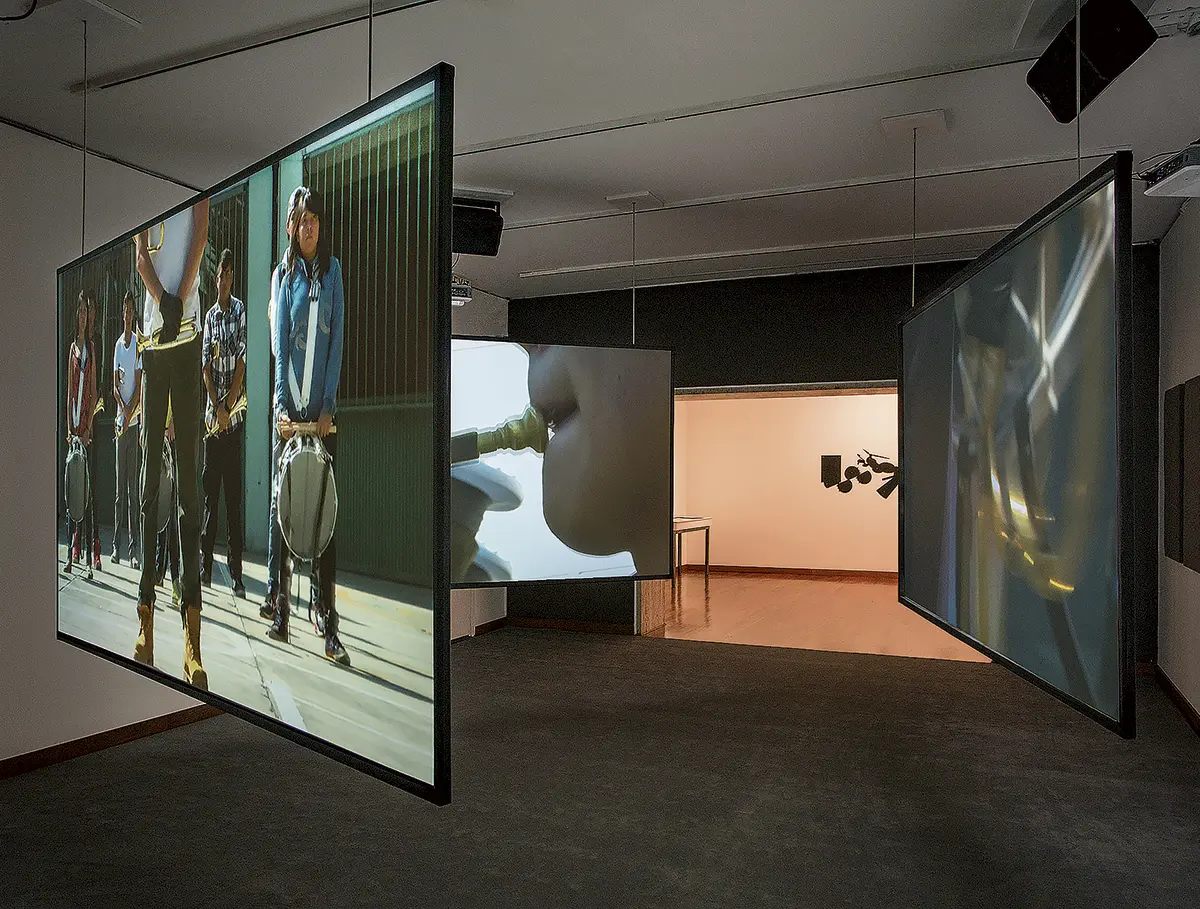
Most such peripatetic wanderings, especially by younger artists (by which we usually mean the mid-30s), fail in their attempt to invent forms that have a clear relation to the claims of cultural and (especially) socio-political relevancy. Of course, the opposite side of the coin of creativity is also true: art transforms into a documentary if too literal. But the overall sentiment – and like it or not, sentiment (not sentimentality) is the basis for culture – is successfully established in his video, the central part of the installation.
Literalism comes through filming at the three locations chosen for the marching band performances. Two are clearly marked by their known political overtones in Mexico City: the Monument to the Mexican Revolution of 1910 and the Plaza de Tlatelolco, best known from the 1968 Tlatelocolo massacre of student protestors and innocent bystanders. The third is the modern (2007) shopping center, Forum Buenavista, used by the age group of the teenage band with its rather obvious connections to global internationalism of markets and capital. My guess is that the irony of the posters and kitsch statues of Mexican revolutionary figures in the mall was not missed by Meyenberg.
But this is local knowledge, all the more powerful when specifics are known, none of which is provided within the explicit terms of the installation. While I might disagree, I understand the assumption that for artists such literalness would dissolve or detract from the creative expression. And here is where most projects falter because the connections are claimed but no corresponding sense of them is sufficiently developed. Meyenberg’s video overcomes that.
The three-channel video projection, each with its own hanging monitor and speaker, is gathered into a small triangular enclosure that forces the viewer into competing yet quite calculated sights and sounds. Again, such sensory overloads usually fail, but this one leaves the viewer with an overriding sense of things. And the general sense of the “things” proves to be more important than the things themselves. And that is the key.
At all sites, the marching band played an original militaristically toned composition by Alejandro Castaños in its varying tempos, from soft to overbearing. Its crescendos were exciting yet rueful due to the sense that patriotism was being converted to nationalism as a form of musical propaganda.
The band and their director were filmed at different times, both marching and assembling as a flash mob (in the shopping center), and dressed in and out of uniforms, which Meyenberg combined with much video cross-cutting and intercuts to establish a chaotic sense that evoked and yet opposed the precision of militarism and organization. The net result is that the viewer “gets it,” the sense of things, with all its equivocations. This is the strength of the visual, at a time when, for better or worse, we recognize the greater power is in sentiment rather than in facts. Good art shows that the two are not exclusionary.
I wish I could say the same for the other elements, such as flags (the Banderos series) and a few artifacts and documentation, but currently, they seem not so much useful “legs” as extra appendages. Most provocative are the many references in another room to Francis Picabia’s biomechanical forms (La Grand Machine, 2015) intended to evoke Meyenberg’s arguments for “the body as a machine” within the context of Dada and Surrealism’s ideas of “part-objects.” The strings of attachment and future development are here, if not yet at the strength needed.
The two years (2014-2016) required to think, collaborate and gather so much was provided Meyenberg through in/Site’s new project space at Casa Gallina in Mexico City, where the residency is provided to socially committed agent-artists to work through group processes in the public domain. The installation, Meyenberg’s first one-person in the US, was actively constructed between the artist, and the two curators, Lucía Sanromán, the Visual Arts Director at San Francisco’s Yerba Buena Center (YBCA) – a self-described “creative center for social action” that uses art for social transformation - and Gabriela Rangel, the Chief Curator for the America’s Society whose mission is to promote social dialogue on a global level. Meyenberg fulfills the faith in him by all three institutions.
RICH LESLIE