
Before being decapitated during the French Revolution, French chemist Antoine Lavoisier formulated the law of conservation of mass: “In an ordinary chemical reaction, mass is always conserved; in other words, the total mass consumed by the reactants is equal to the total mass obtained from the products.” In addition to overriding the phlogiston theory—according to which a mysterious substance emanated from bodies during combustion—this new law, more importantly, rethought the order of things through the basic premise “nothing is lost, everything is transformed.”
The exhibition titled Addition and Subtraction by Gabriel Antolínez at the Galería Liberia appears to be following such premise. It consists of a series of works created during the last fifteen years by Antolínez and arranged in different ways to achieve new compositions. While the term “new” could not be applied here—given the premise that there is nothing really new under the sun—according to Gabriel Antolínez that which yesterday appeared to be lifeless, today is part of the living world and vice versa. In sum, particles move from one body to another as they go through a complete transformation while nonetheless remaining the same. Only the illusion of time makes us perceive things as specific things.
In this manner, several works on the main floor of the gallery have been superimposed to resemble some sort of gigantic electronic circuit. Like in other exhibitions by Antolínez, the pieces are characterized by a universe of textures. In fact, it is hard to resist the temptation to touch every single one of them, and, therefore, viewers must be careful to do so without being caught. Everything demands to be experienced through touch. The gaze surveys the surfaces like an accomplice of touch, the sense that ultimately leads the exploration of objects that range from soft, rough and deep, to padded, plush, smooth, etcetera. Attesting to this is a series of artificial turf squares, the size of small tiles, which hang on the main wall: each square has a different green tone that has been achieved, not through the application of “real” color, but as a result of the direction given to the green fibers. In this manner, color stops being a visual element to become a tactile one: the orientation of the fibers.
But there is more. Created with tiles and mats, these squares are a contradiction in terms: if they are mats, then they should be on the floor and not on the wall, and, if they are tiles, then they should not be plush but smooth. A plush tile is by its own definition an anti-tile. An anti-tile that bends at the line where two walls meet reveals its condition of being a piece of fabric. And contemplating these flexible tiles is very pleasurable.
From there, we move towards the circles, also with artificial turf, where the spirit of Roberto Burle-Marx is palpable (it is no accident that Antolínez spent a period of time in Brazil); Bulky wool bodies on the floor; embroidered objects in which sequins act as scales, geometric wires sticking out of the wall containing beads made of various materials and entrusted with conferring the installation a “led” appearance. And, lastly, small circles made with hanging threads—already emblematic in the artistic production of this artist from Bogota—created precisely with the material used during the 1980s to decorate the public buses. These articles transform according to their position in the space; if hanging from the ceiling, the expanded threads form bodies; on the wall, they become graphics; and, on the floor, stains. Whether they are sculptures, drawings, or paintings, everything is defined by the gravity that rules them. If, as Antolínez says “the artist listens to the materials and only obeys,” then the materials listen to gravity and only follow it.
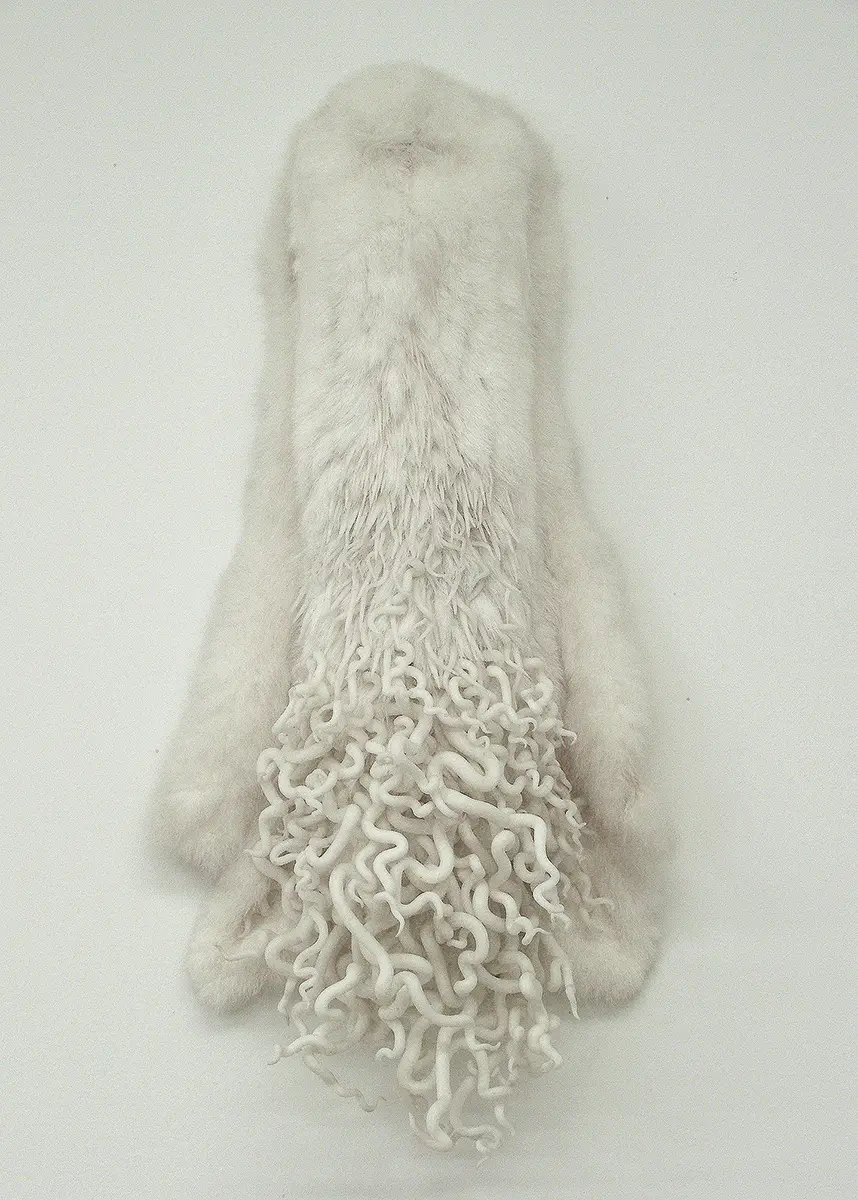
Going upstairs to the exhibition room called NaCIO—named given to the Sodium Hypochlorite chemical compound—viewers find themselves before several types of white objects. Swiss linguist Ferdinand de Saussure wrote in his Cours de linguistique générale (Course in General Linguistics) that there are endless shades of white. So that which looks white to us may look like a specific shade of color to an Eskimo. There, a net made with little balls of expanded polystyrene, woven for more than one year, is presented as a display of unexpected lightness. On the other side of the room, a rabbit skin with small pieces of cold porcelain once again offer a juxtaposition, in this case, between something extremely soft and something sharp. Confronted with this work, the eye impels us to touch it despite running the risk of being cut.
In the staircase that leads viewers from one exhibition room to the other, there is a mummified pig’s heart covered in cloves. A pink ribbon that sticks out of the heart reaches all the way to a beam in the ceiling and falls to the floor with a feather attached to its end. Gabriel Antolínez tells us that the Book of Dead contains a method to weigh the heart of the departed to determine his good or bad actions: if its weight equals that of a feather, then the deceased did not perform any bad actions. The embalmed heart is beautiful and, oddly enough, smells wonderful because of the cloves. It appears to be as light as the feather that is part of the piece. As in many other works in the exhibition, this piece includes the three interests that, according to Antolínez, drive his artistic endeavor. They are three different passions that, when combined, shape this type of exhibition experience: the natural sciences, archeology and history (more so the former than the latter), and the decorative arts.
Lastly, a sort of cushion made with golden calfskin and stitched with blue thread is displayed on the lateral wall. It is difficult to describe: all the threads that were once stars protrude from the skin’s interior, fashioned like a cushion; and then—since nothing is lost but rather everything is transformed—drawing becomes a sculptural body, two-dimensional renderings become three-dimensional, and the things that were static before, the stars, are now moved by the wind that flows across the exhibition space.
JULIA BUENAVENTURA