
Music Is My Home was an unusual exhibition by Argentinean artist and graphic designer Gastón Pérsico (Buenos Aires, 1972) that, among other things, alluded to and explored disco culture. Those who visited the show modified it just by being there with their own experiences. The perception of Music Is My Home not only depended on the cultural baggage of visitors but also on the date on which they went to the Museo de Arte Latinoamericano de Buenos Aires (MALBA). This is because the exhibition changed on five occasions as a result of the series Featuring, which consisted of different presentations by Lucio Capece, Djs Pareja, David Lamelas, Miguel Mitlag, and Pablo Schanton.
Music Is My Home was curated by Madrid-based Argentinean Mariano Mayer. The relevance of this sound and visual proposal, along with the participation of prominent guests, undoubtedly helped to attract a new public to the museum. It was presented on the main floor and admission was free. While some children had fun chasing the lights of different colors across the room, the more traditional observers were a little perplexed and the younger crowd—many of whom saw it several times—clearly appeared to enjoy it.
The exhibition functioned like a social space that favored experiences over the mere contemplation of objects. It suggested the atmosphere of a discotheque with the help of dim lighting in combination with flashing lights. But the glitter and the architecture did not exactly match the look of a disco. The installation invited to a sort of dislocated sensorial experience. Lights, walls, illumination columns—in various stages of construction, destruction—emitted and created abstract forms, with an emphasis on geometry. In this manner, visitors entered a dimly-lighted space that looked like a nightclub halfway finished/unfinished. What about the music? Only a DJ-set of House music (dancing electronic music) translated to Spanish could be heard. The static lyrics played over and over, at times sounding intimate, out-of-sync, or emotional.
According to Mariano Mayer, the work by Gastón Pérsico “is characterized by scenes in which various personal interests meet. […] Music, literature, countercultures, nightlife, friendship, and its network of influences are artistic materials to Pérsico. He explores the archives of contemporary culture to establish connections between different themes and areas in which several disciplines can converge.” Indeed, this exhibition conveys this artist’s personal preoccupations and encourages the same type of intersections between different disciplines offered by the SCRIPT magazine (a Madrid-Buenos Aires publication), which Pérsico has been editing since 2007 alongside Mayer and Cecilia Szalkowicz. They curated the publishing project by the Fundación Proa Isla at arteBA 2017, which included books by independent publications and labels associated with contemporary art.
The guests invited by Pérsico shone. A musician who plays several instruments, Lucio Capece performed two of his compositions. Relying on just a few elements and slow delivery of sound, Capece created the rhythmic structure titled RX22. The musician surprised viewers with his use of excerpts from texts by Maurice Merleau-Ponty and Keith Rowe in Cosas y Lenguaje (Things and Language), centered on the same research. The sound installation La música es mi casa (Djs Pareja Remix) [Sound Is My Home (Djs Pareja Remix)] by Djs Pareja—a Buenos Aires-based duo essential to define the new school of Latin techno—resumed the proposal by Pérsico and broadened the spectrum of the discourse and enthusiasm of the house lyrics translated in Spanish.
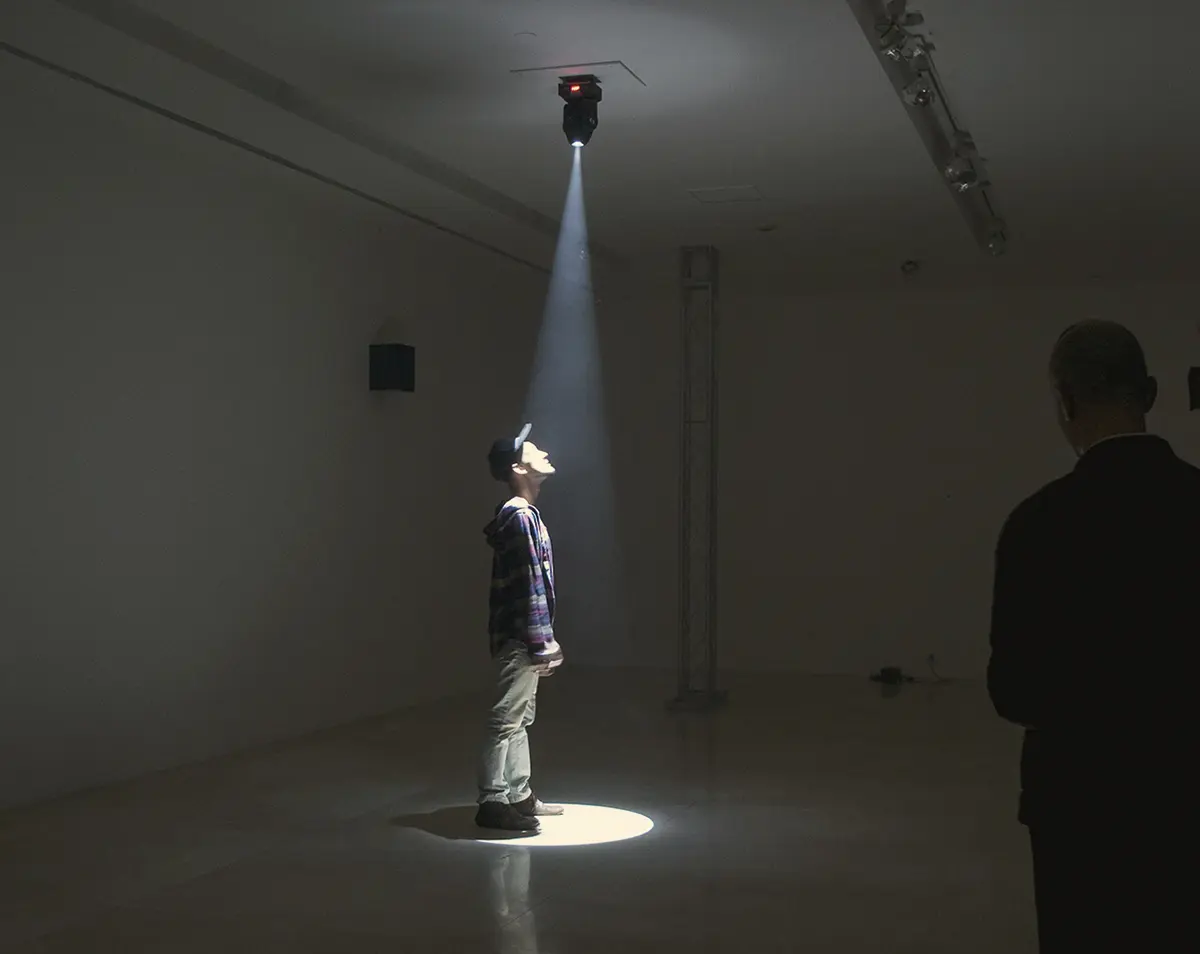
About the lights fluttering around the space: Pérsico incorporated Límite de una proyección (Limit of a Projection, 1967) by renowned Argentinean artist David Lamelas (consisting of “a spotlight projected from the ceiling onto the floor amid a dark space, producing a well-defined white light circle”). This same lighting setup was installed for a single day and was equally presented as a mechanism to establish boundaries). The visitors that stopped under the bright beam of light tried its imaginativeness and finite boundaries.
Miguel Mitlag modified the access to the exhibition area containing Music Is My Home for the period of one day, and according to his delight, with minimal gestures that underscored the protagonist role of insignificant elements: black rugs, stools, and an ashtray with sand neatly presented. Researcher specialized in rock and electronic music, Pablo Schanton made everyone think. He offered a “performance talk” that posed new questions about time that were inspired by Pérsico’s work: Is there going to be a party, is it already over, has it not yet started? The music critic then associated the hashtags #discoteca and #muerte to discover disquisitions that led him from the Middle Ages to today.
The experience was accompanied by two printed publications: La música es mi casa (Music Is My Home)—which included lyrics that are part of the sound piece—and Featuring, with theoretical writings pertaining to the central aspects addressed by the installation, authored by Mariano Mayer, Pablo Schanton, María Salgado, Marina Zuccon, and a talk by Yves Bonnefoy. The closing of the exhibition—which included girls dancing in the museum’s common areas and a waiting line to enter the space, after being “tattooed” by the staff monitoring the access to the exhibition area—was performance-oriented as the interventions by the contributing guests. Pérsico was happy, and he was not acting.
VICTORIA VERLICHAK