
People Emerge from the Shadows is the title of the solo show by Brazilian artist Gustavo Speridião (Rio de Janeiro, 1978) presented during the months of May and June at the Mercedes Viegas Galeria in Rio de Janeiro. The title of this exhibition is named after one of the pieces included in it: A gente surge da sombra (People Emerge from the Shadows, 2017), a large vertical canvas with that phrase rendered in red and placed off-center. The work’s format is not very traditional because of its rather narrow width. The way in which the phrase has been rendered oscillates somewhere between an immediate apparition and expressivity that overtly exposes the importance of the content. The words in the image are surrounded by a strong black line and charcoal stains, suggesting visibility that appears to support the semantic aspect of the word “shadow” contained in the phrase.
With an artistic career that spans more than ten years, Speridião has participated in several solo and group exhibitions. Last year, he was one of the four finalists of the PIPA Award, a traditional competition for Brazilian visual artists that is organized by the Museu de Arte Moderna do Rio de Janeiro (MAM). The pieces in this current exhibition share a constant element of his production that has adopted different forms throughout his career: the relationship between images and words; from large paintings to artist’s books, photographic exploration as static narratives, to the formulation of titles suggestive of elements indirectly connected to the image as well as their literal manifestations—as is the case of A gente surge da sombra. While encouraging lectures from the public, words are also used by Speridião to unsettle the images composed around them.
This approach by the Brazilian artist could be felt during the walk through the exhibition because of the works included. The show consisted of only eleven pieces displayed in such a way as to allow them to establish a dialogue with the architecture of the gallery. At a time in art when the overuse of images is common practice and (perhaps because of it) the inability of many artists to edit their work in solo shows is obvious, the precision demonstrated in the selection of the pieces for this exhibition is certainly remarkable. As is recurrent in Speridião’s production, the dimensions of the canvases (always frameless) ranged from large-scale pieces, sometimes over two meters high, to smaller works, some of them without any rectilinear boundaries and a presentation that suggests a certain degree of precariousness.
Nine of the eleven works have words in them. The phrases point in several directions. Surrounding A gente surge da sombra there are other works like Fora do plano tudo é ilusão (Outside the Plane Everything Is an Illusion, 2017) and Estas linhas não param mais aqui (This Line No Longer Stops Here, 2014). Their titles comment on the materiality and theory of the image in painting and beyond. This reading is supported by the apparent dialogue between non-verbal visual elements and those proposed by the phrases. In other words, it works like Estas linhas não param mais aqui, for instance, the large black blurred horizontal section below refers to the line insinuated there.
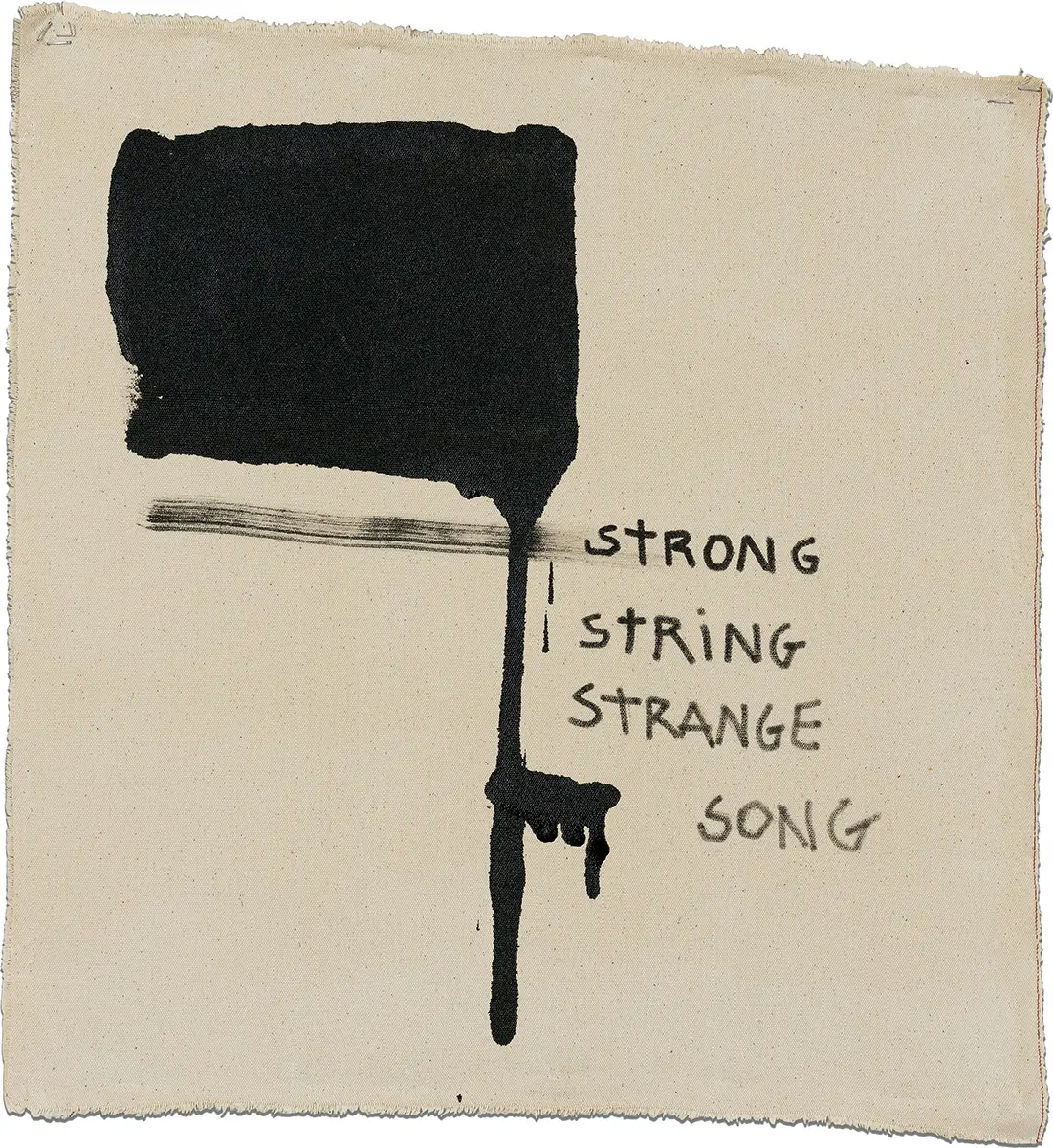
On the other hand, other phrases generate among viewers doubts about the actual message and the general vision of the exhibition as a whole. They encourage us to question any denotative certainties about Speridião’s proposals. In Caixa da saudade (Box of Saudade, 2017), for example, a repetition of rectangular forms refers us to the cubic geometry of a box. Inserted in parts of these forms, the head alludes to a humanoid component while other geometric forms invite us to question the realm of representation. The same thing occurs in works like E os (And the, 2017)—where Speridião repeats the phrase “But, and the…” until his handwriting breaks into asymmetric traces—and other pieces in which the content alludes to his interest in the relationship between writing and political reflection. In Poema (Poem, 2017), English words are gradually transformed in cascades. In this manner, “strong” turns into “string,” “strange” and “song.” The work Cartaz (Poster, 2017) offers a more narrative content that proclaims in Portuguese, “In the historic morning of the beginning of glory,” and further down, “Distorted victory of the masses.”
An element shared by all these works with words in them is Speridião’s compelling ability to encourage creativity in the minds of viewers. Even when formal elements refute the proposals, at no point the articulation between images and texts is merely illustrative, shallow, or basic. No matter how rushed his approach appears to be and how formally akin it may seem to expressionist pictorial traditions that include stains, drips, and other types of action painting, the layers of interpretation offered by the words allow us to connect his work to the concrete poetry of important works in Brazilian art by artists like Mira Schendel and Hélio Oiticica, masters in their ability to unsettle the gaze of the reader/observer.
Precisely because of Speridião’s experience in the research field, perhaps the works that most attract the viewer’s attention in this exhibition are two pieces with no words in them: Calle (Street, 2017) and Sem Título (Untitled, 2017). They represent vast areas for exploring the use of black and white and evidence the expressive qualities of his work as well as the experimentation with materials like India ink, charcoal, and acrylic. While Sem Título showed something resembling a geometric pattern with vertical lines, Calle described the outline of a human figure common in children's drawings and works by artists that explore a certain massification and informality in the themes approached in painting. Absent are the voids that allowed his words to breathe in the other works. They have been replaced by a dramatism encouraged by the use of black and the irregularity of the brushstrokes.
People Emerge from the Shadows is a small exhibition that showcases Gustavo Speridião’s recent artistic production and encourages the curiosity of those familiar with his inquiries into the creation of new forms of painting. And there is also the unavoidable curiosity about the innovative ways in which Speridião presents the written word by looking beyond the formats commonly used in the visual arts—books, who could tell? And, of course, Gustavo Speridião’s curiosity will lead to new phrases written with distorted lines.
RAPHAEL FONSECA