
It is a true privilege to be able to admire the exceptional selection of works by Jacques Bedel (Buenos Aires, 1947) featured in his show at Maman Fine Art gallery in Miami.
In Ad Infinitum, artist and architect Bedel presents a complete panoramic of his fifty-year career. The proposal stands out for its atmosphere and the adjustment of the works to space. A panorama of symbolically dominant elements—air, earth, and fire—concentrated under the magnifying lens of a historical meditation. The technical details add mystery to the already poignant and inscrutable content of the 65 works on exhibit.
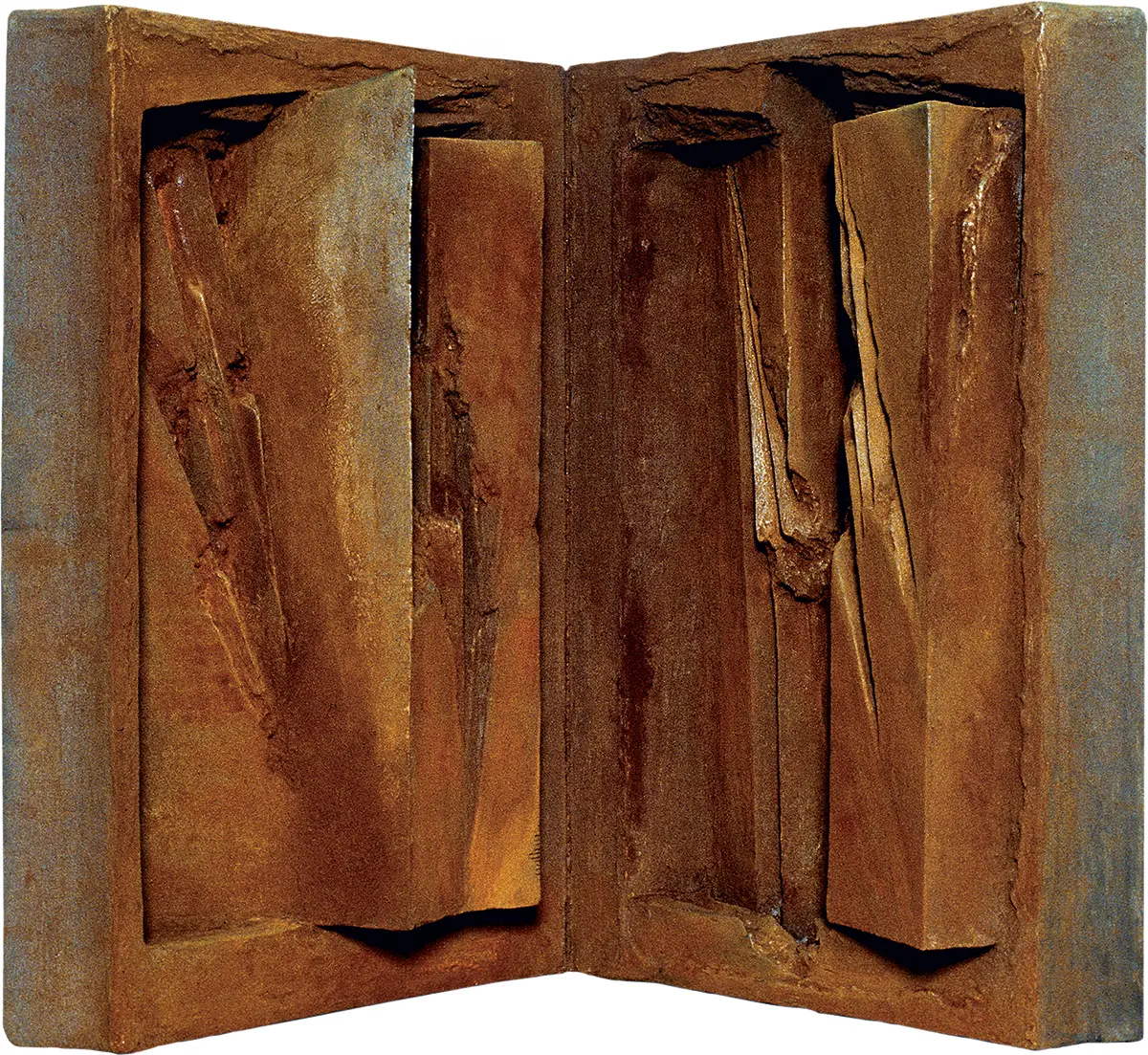
Trained as an architect, Bedel takes on a variety of artistic techniques to reconvert the alchemy that erases borders and has objects, paintings, sculptures, or reliefs intermix into a new configuration. Outside the conventions that dominate the era in art and commerce, his practice is based on a profound introspection and social critique. Jacques Bedel transfigures the elements in the process of doing.
Under the subject line of Political Crimes, Bedel introduces the technique of photomontage on engraving; in other versions, he produces digital prints on a diversity of plastic surfaces. In recent years his work has focused on photography, always reinventing supports and presentation structures. The description that the artist inscribes upon his materials is as rich as the range of techniques and practices at his disposal. From his earliest works of the 1970s to his most recent productions, Bedel gives viewers the possibility of recreating new contents as they read: a personal imaginary that connects with the collective.
And it is in this alternation that Bedel’s message produces its most powerful effect on the viewer. From the monumental to the private, the parade includes Alter ego, in acrylic and mirror, from 1968-2017, and Fulgur VI, in electrolytic iron on synthetic material, from 1991. Some of his titles enclose imaginative messages that add intrigue to the works, as in Hipótesis para la definición de una sombra (Hypothesis for the Definition of a Shadow), in granite and photographic paper print, from 1973; Objeto paradojal (Paradoxical Object), folded iron sheet, from 1971; and Argos, iron and parabolic mirrors with magnets, from 1970, all of which are closer to a kind of manufactured nature.
From the start of his career, Bedel has sharply impugned dogmas and abuses of power, albeit outside the habitual models. He gives a lumpy aspect to his solid elements; he opposes power by ridiculing its hieratic face; he pushes the image away from its norms.
A graduate of the School of Architecture and Urban Planning of Universidad de Buenos Aires, Bedel developed his interdisciplinary career on an autodidactic parallel path. In 1972 he became a member of the CAYC group, established by Jorge Glusberg, alongside Luis F. Benedit, Víctor Grippo, Alfredo Portillos, and Clorindo Testa, among others. It is important to note in his work a demystification of the artist, the interrogation of the object, a new aesthetic concept, the consciousness of praxis, and a critique of functionalism. Bedel played a central role in the group and worked with the most renowned artists of the period.
In the same way that he carves and trims content into the work, Jacques Bedel finds a dual meaning in the reality of what exists; a paradoxical element highlights the essence of the human perhaps under a patina, a matter-like camouflage, a shadow-like form, and characters under the spotlights’ artificial illumination: the limits of a consecrated vanity.
SUSANA SULIC