
All origin stories, with no exception, have taken the absolute value of gold as a given. East and the West, be it in the Northern or the Southern Hemisphere, have agreed on one thing since the very origin of civilization: goods and services could be exchanged for tokens of this noble, soft material the color of the Sun, highly resistant to corrosion and thus a unique resource for the manufacture of all manner of ornaments and accessories. Draftsman, painter, and sculptor Jeison Sierra (Colombia, 1986) is passionately interested in this mineral and others that are equally burdened with meaning, such as silver; his exceptional situation, and a life history that has kept him in close proximity to gold extraction operations in his native Zaragoza, have driven his most recent work to train a magnifying glass on the scourges of poverty, inequality, and war afflicting many of mineral-rich territories.
Very few things have been able, beyond their real-world usefulness, to generate consensus within the nations: to bring various interests into agreement around something that might well lack any meaning when considered on its own. The very origins of the economy can be traced back to the worship of a metal that gained a meaning different from mere decoration, the hoarding of treasure, displays of power, and the exchange of goods only a hundred years ago, with the domestication of electricity, despite the fact that alchemists in the Middle Ages thought that ingesting gold dust would cure ailments like the Black Death and that eating from gilded plates would prolong life. Today, gold has found a niche as an essential resource in avionics, medicine, and electronics, yet it continues to be used mostly for the accumulation of symbolic power by the elites. Gold extraction has expanded in recent years. Gold Fever, as the intemperate desire for the metal, has come to be known, has undermined the equilibrium of our countries; Latin America, especially the Andean region, bears witness to the way in which the extraction of this resource destroys the natural environment as the equipment and machinery used in the process eats away at the soil, the vegetation, and the waterways, and turns all greenery to dross.
Golden calves, chalices, crosses, amphorae, bread, crowns, barges, temples, cities, and suns have been bridges between the human and the divine, but also tunnels connecting earthly life with the underworld; the misery and the ruination of men seem to spring from the same source as the fever for this metal, at once godly and mundane.
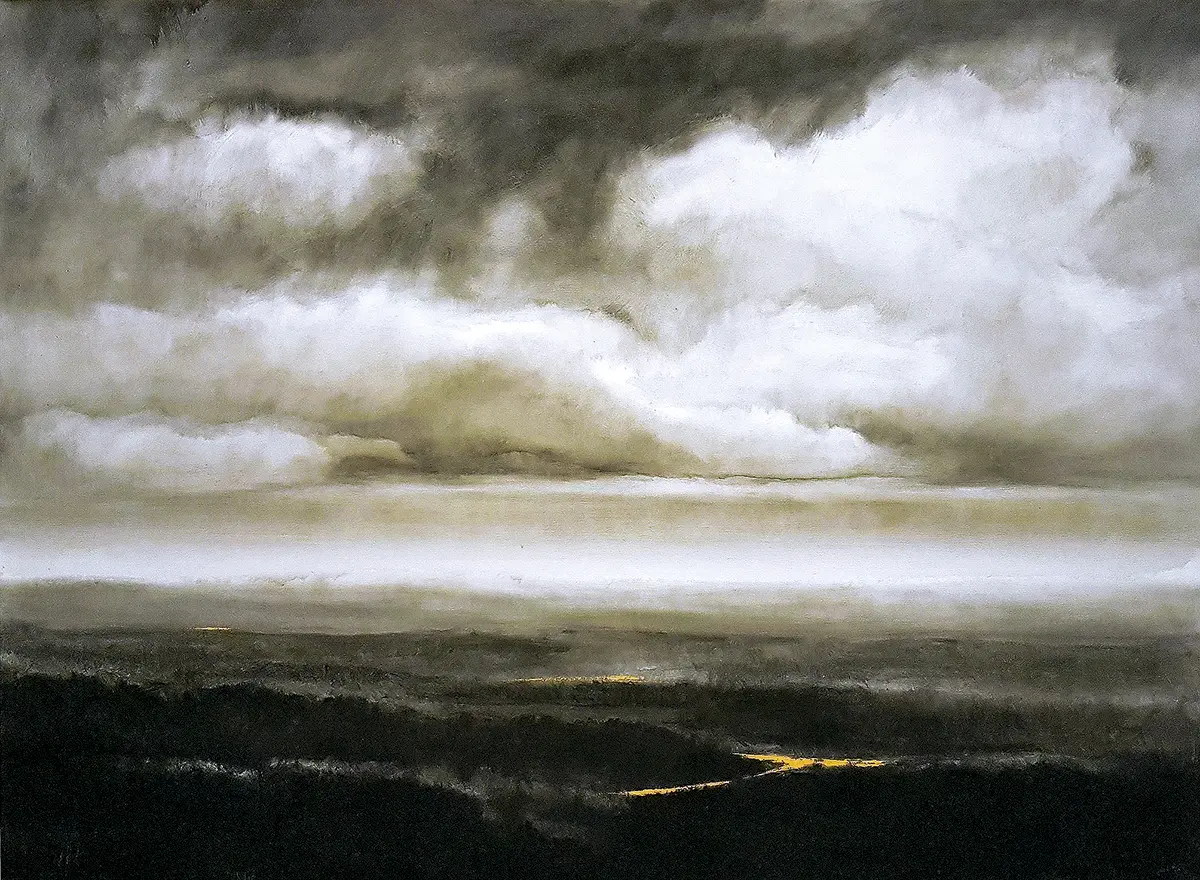
Sierra’s work depicts the dismal reality facing us, from which we so often prefer to avert our gaze, by means of desolate expanses bathed in an unsettling light that seems to emerge from the very center of the image, where blotches representing golden or silver watercourses steal our attention. This series of drawings on canvas, made using mineral charcoal and acrylic paint, reiterates art’s testimonial spirit and at the same time reminds us, with its macabre form of beauty, that the wealth of some depends on the tragedy of many. Bogotá’s SGR Gallery was filled with windows from which we could see gold and silver traversing desolate, ghostly territories. Bleak spaces stunned by an inconceivable absence of life; places carved against the grain of logic, their vegetation superseded by the aridity of a blackish soil so that the veins would become metal.
According to legend, the mythical city of El Dorado was located somewhere in the Colombian Andes. Research tells us that in order to obtain 4.6 grams of gold (a castellano) through the practice of alluvial mining, 30 cubic meters of riverbeds must be removed. This is the most complex paradox in the contemporary reality of a country rich in natural resources that allows itself the luxury of washing out its nutrients and damaging its life source in its quest for gold.
Ríos de oro y plata (Rivers of Gold and Silver) is more than the title of an exhibition of drawings; in truth, it is a testimony based on the life of its author: Jeison Sierra, a young artist who grew up watching how mining hollowed the rivers of his native town out, on the banks of the Nechí, in the northeastern region of the department on Antioquia—a region greatly experienced in this kind of resource exploitation that is yet to understand that while some count their fortune in gold nuggets, others have enough if they have the Sun.
OSCAR ROLDÁN-ALZATE