
The exhibition titled Neither Heroes nor Martyrs by Colombian artist Juan Fernando Herrán (Bogota, 1963) is an invitation to analyze political-economic phenomena and social decay in Colombia from the perspective of a sensory experience. In addition, it is a critical distancing from the official history of the country, used as a device of power, and a reflection that also applies to other countries in Latin America.
In the creations and processes carried out between 1996 and 2015 for the production of the works included in this exhibition, Herrán places the marginal in the foreground, underscoring losses, absences, silencings, and untold stories through several visual strategies in order to question hegemonic discourses of Colombia’s history and to denounce in this manner the narrative and rhetorical-fictional use of the monumental and the ritual, to perpetuate heroic stereotypes, political-economic corruption, and unscrupulous advertising. Pointing to these phenomena within the works, Herrán sets them against antidotes from genuine humanistic perspectives in struggles like those apparent in the introductory text written by the curators of the exhibition Albertine de Galbert, Elena Lespes-Muñoz, and Ananay Arango—who also offer other lucid texts throughout the exhibition that explain and explore the nature of all the works on display.
Juan Fernando Herrán performs actions that could very well be considered emblematic of art that resignifies the material and visual culture of the various historical processes analyzed in this exhibition. He does so without begging the question and by emphasizing the capacity of the contemporary artistic practices that he favors, in order to sensorially stimulate the mind operations of viewers as they explore the events evoked in the pieces.
This is articulated through a wealth of information contained in works like Cajas Fucsia (Fuchsia Boxes, 1996–2008), about the failed prosecution of several politicians and President Ernesto Samper, accused of financing his 1994 presidential campaign with drug money; Armedes II (2017, based on a first version from around 1990, will a pistol that belonged to the artist’s grandfather) questions the use of arms in the history of violence of Colombia; Tríptico Judicial (Judicial Triptych, 1999), consists of two images of puppy pods—already cut and intervened to recreate indigenous ornaments and the extraction of the opiate gum—one at each side of a photograph of captured illegal poppy growers; Campo Santo (Holy Field, 2016), a photographic record of the proliferation of improvised crosses and graves for farmers killed as result of confrontations between the population and paramilitary groups in several rural areas; the video projection tilted La Vuelta (The Turn, 2012–2013), interviews with motorized contract killers who were part of the drug trafficking culture in Medellin during the 1980s and 1990s; or the video Ecos tutelares (Tutelary Echoes, 2015), about the delivery, first by boat and then by train, of European-produced monuments of national heroes to several cities across Colombia, as part of the celebrations of its Independence in 1910.
Pausing to observe these events is to reach beyond the merely formal aspects of Juan Fernando Herrán’s expressive discourses: research-creation, drawings on walls and in video sequences and, also in the videos, fixed planes, and voice-overs, piles of boxes, or the destruction of a relative’s object with sculptural motifs; the exploration of photography’s connotative potential, whether through intertextuality or through framing as a whole. All tools employed to encourage the central reflective axes of this exhibition.
It is important to pay special attention to two highly expressive and powerful projects that almost entirely cover the artistic periods in Herrán’s career pertaining to this exhibition.
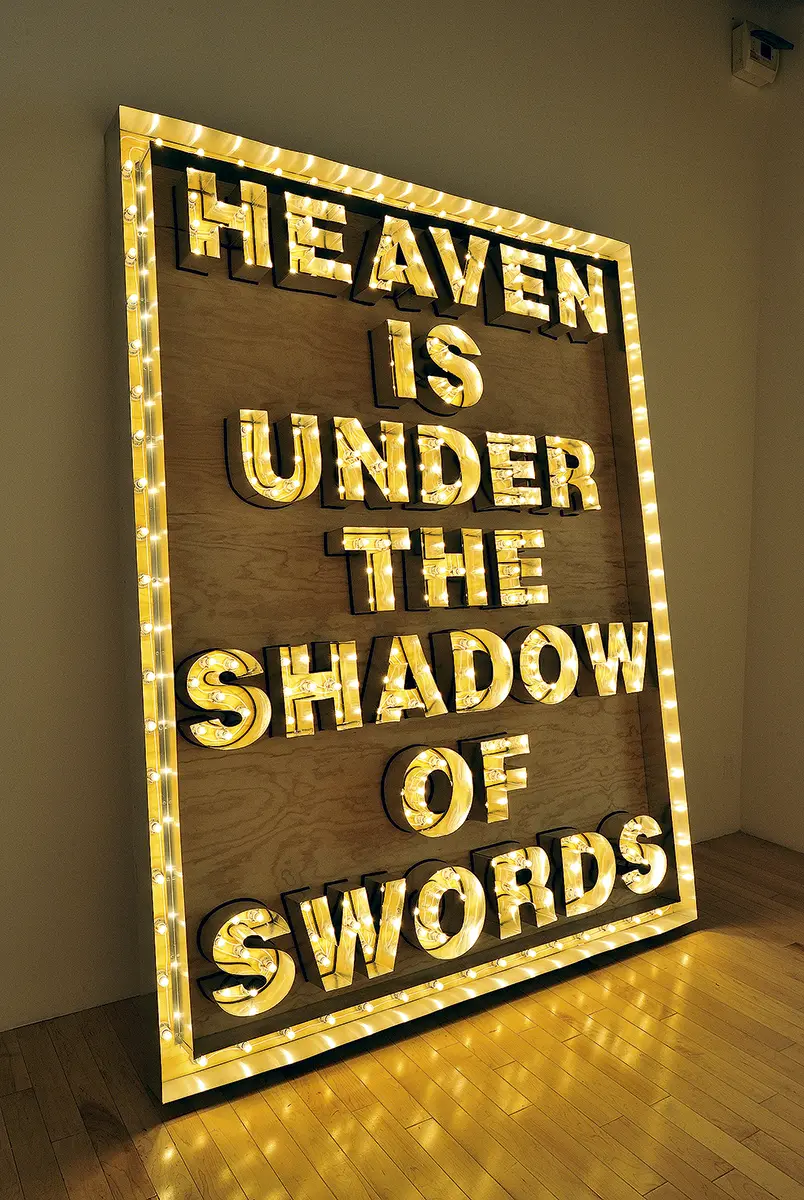
Heaven Is Under the Shadow of Swords (1997), is an installation created with wood, aluminum, and light bulbs that participated in the Fifth International Istanbul Biennial. The phrase used in the title is taken from a hadith—report not included in the Quran that relates the words, actions, or habits of the prophet Muhammad. Its transfer to a visual medium borrowed from advertising plays with the non-canonical nature of the phrase within its tradition and lends itself to a variety of uses in Islam that are as ambiguous, ostentatious, and manipulative as the persuasive approaches employed in advertising.
Héroes mil (Thousand Heroes, 2015) is a sculptural wood installation that partially borrows from the pedestals of sculptures of Colombian heroes created during the celebrations of the first one hundred years of Colombia’s Independence in 1910. Its materiality—different from the petrous ways of perpetuating hegemonies, seemingly structural solutions, and the lack of supported sculptures that ironically emphasize the basic secondary element— confirms a continuous resource used in this exhibition and in the career of Juan Fernando Herrán: a willingness to unmask the mechanisms of power, understood as the intention of influencing, from a hegemonic position, the construction of a sense of that which is historically and socially significant. The assemblies exhibited along with the characteristics of other projects included in the exhibition are a metaphor for the constant encouragement by this artist to question anything that is presented to us as fact, as something legitimate and naturalized.
EUGENIA MACÍAS