
The exhibition Umbrales (Thresholds) brings together a selection of works by Colombian artist Lydia Azoud that situate viewers in two different contexts with regards to their relationship with the work of art. Let’s begin there. Because discussions of Azoud’s work always start with her relish in form, plot, volumes, lines, and time; but on this occasion, these subjects—which permeate her work to the point of defining its identity—share the central role with the viewers.
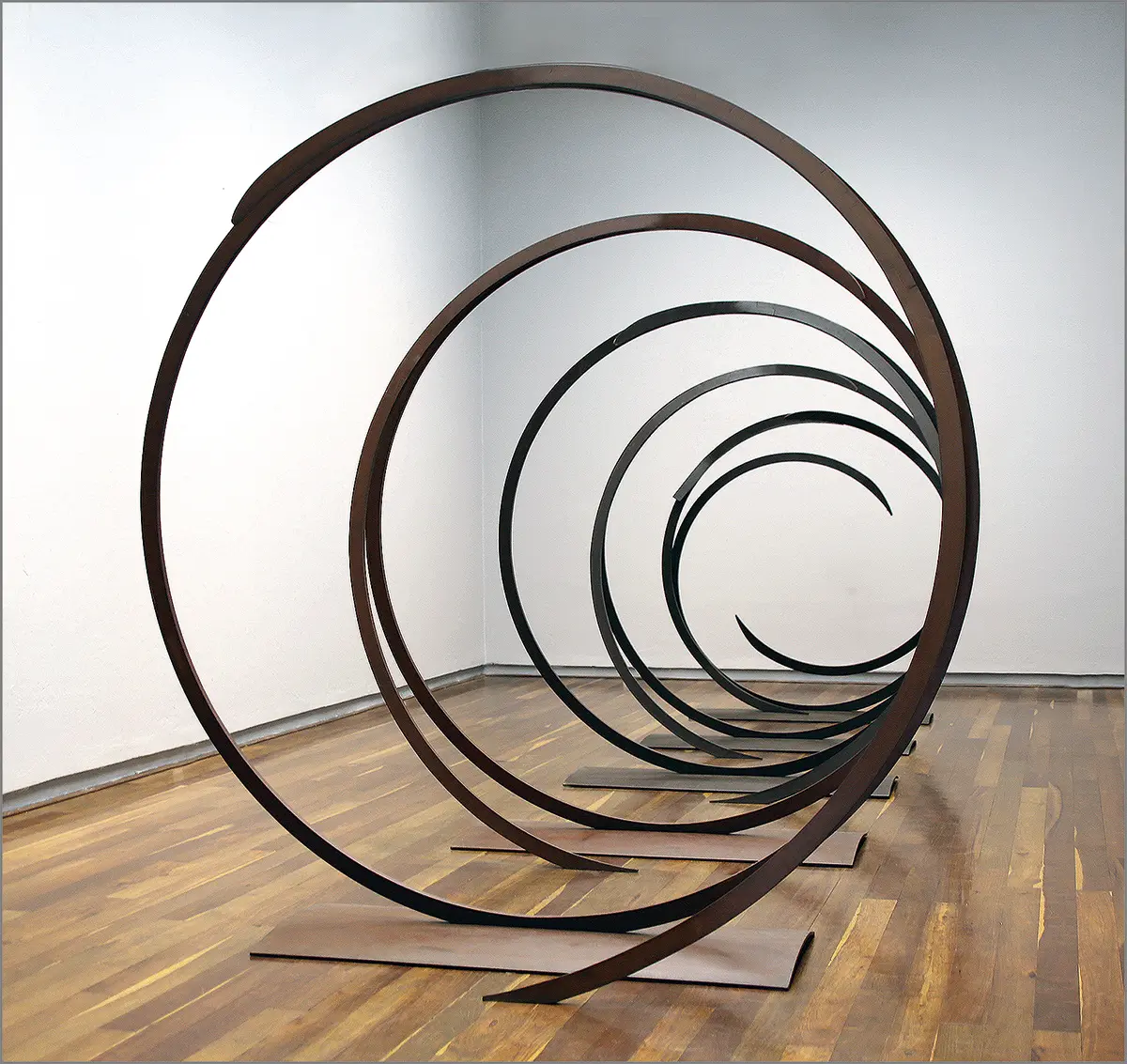
The exhibition is divided into two spaces: the gallery’s big room, where we encounter three large-format works, and the small room, on the same floor, featuring—as a compendium of the body of work that Azoud has been creating for forty years—small-format works that invite visitors to walk between them repeatedly, going back again and again along paths that are not predetermined and are dominated by our gaze over the artwork. This walking around favors analysis, reflection, and a certain abandon to the forms in the works. These are the works and the structures—which for Azoud are pathways of communication—that have always interested the artist: those that evoke the feminine, the masculine, the energy and force of geometries dissected and reinterpreted on the basis of personal concerns. Through these structures, the artist renders the invisible visible, revealing a potentially almost unnamable mystery. This is a gambit for viewers who walk around the space and works with a degree of control over their role as such. It is in the large room that viewers find themselves engulfed by the art, especially by Umbral I (Threshold I) and Umbral II (Threshold II), which turns the visit into an experience that demands our surrender. Umbral I is like a spiral in oxidized iron traversing the gallery floor. It allows our eyes to reconstruct something that is not visible, as if the iron penetrated into the ground inside the space. We step on the work to cover it from the inside and see somewhat more distantly from outside. We situate ourselves at their ends and, standing over each of them, gain a different perspective. The dynamic space and participative of Umbral I is preliminary, a transit hallway between one essence and the other, a connection between two worlds that shifts something in those who see it. Able to go in and out of the work, feeling swallowed by it, we lose the control we had in the other section. Or perhaps in this section, we gain the control we did not have in the larger room. Whatever the case, the scales change and we are transformed for a moment into Gulliver: one moment we are subjects, the next we are objects. This section carries Azoud’s investigation into form and the energy or the forces that forms evoke, to great effect. It is as though one had a chance to enter one of the smaller works to feel from inside what Azoud wants us to see from outside. If communication is often suggested between the geometric grids, in this case a communication channel opens between the scales, between the very ideas Azoud has developed over the course of decades. After exploring this work, another threshold opens—a more uncomfortable and challenging one—with Umbral II. What is important here is the gesture of crossing under the work—the viewers are cornered, almost against the wall—that introduces asymmetry into an exhibition that would otherwise convince us that harmony has proportionate and equidistant points. Umbral II and Trazo (Line, the third work in this section, which “traces” a path that throws a series of curves as we move along it) add something to the discourse of the small-format works. Understanding the diagonal and asymmetry as perfection in Japanese aesthetics, here we are reminded that this concept, perfection, can be interpreted in different ways, which opens a variety of possibilities beyond those posited by the artist. In this case, we find that the exhibition itself functions as a kind of threshold, as it situates us between two worlds, two paths that become endless for the many times we can traverse them. On the one hand, we are invited to leave reason behind and let ourselves be carried away by the experience and the unknown, in a trajectory guided much more by our bodies and the place they occupy in the large format-works that slowly change us; on the other hand, we are presented with a seemingly measurable world that contains ancestral energies between its hatchings and angles. Ultimately, Umbrales is an exercise in sincerity and introspection in which we participate as spectators.
CARIDAD BOTELLA