
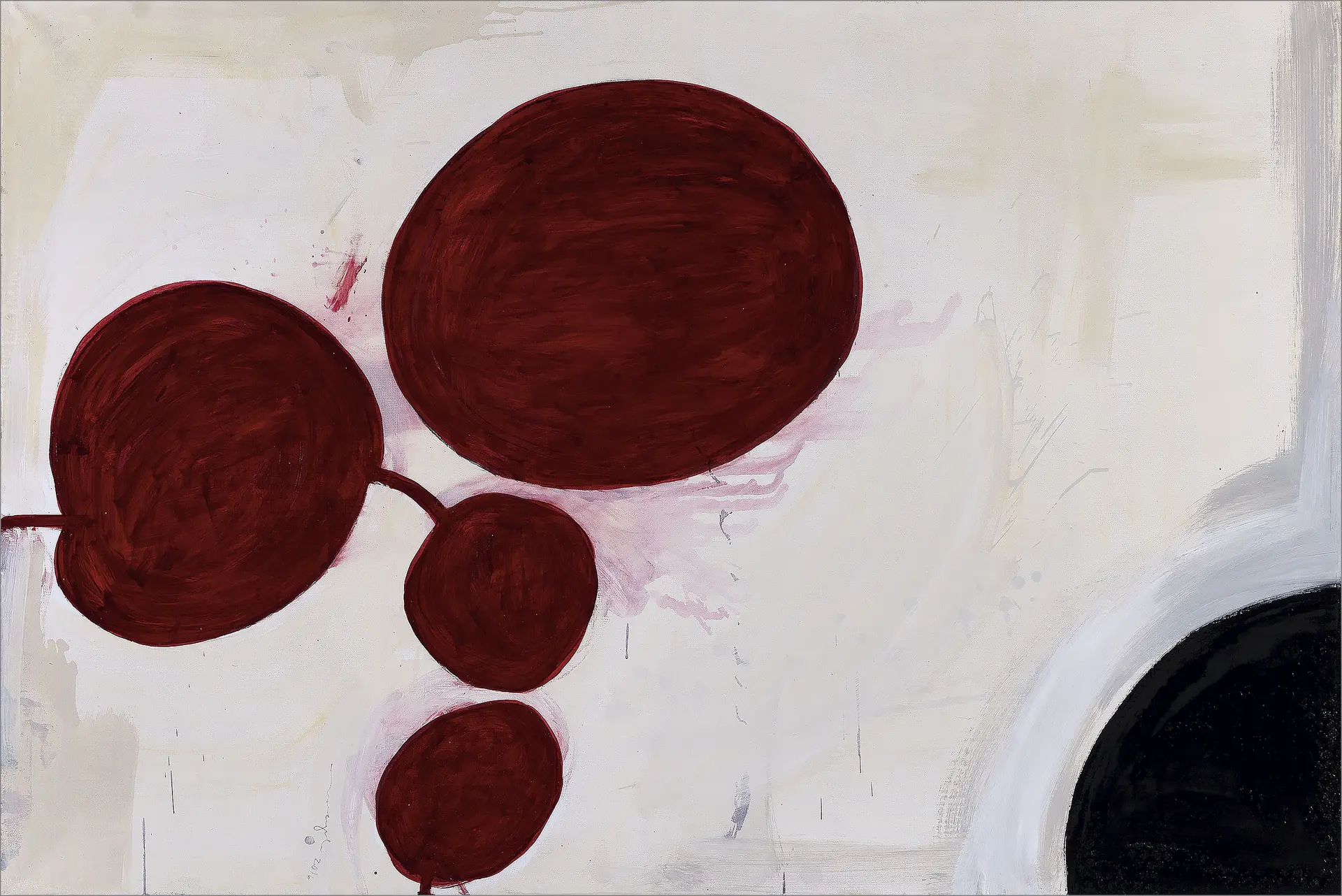
The retrospective exhibition Intimidad del Jardín1 (The Intimacy of the Garden) opened on May 6 at Jardín Borda Cultural Center. It features some forty medium- and large-format paintings by Magali Lara, covering a three-decade period. Formerly the vacation home of a rich mining potentate from Taxco, the site is now named after the large garden it contains, designed in the late Eighteenth Century. Today, the Jardín Borda Cultural Center is a dependency of the Culture Secretary of the State of Morelos, which uses it to present glossy art exhibitions. The spatial topography of this colonial-era building, with its rows of small, often high-ceilinged rooms, forces visitors into a narrow and rather a labyrinthine route. In those constrained spaces—whose “intimacy” embraces in a symbiotic way the one that Magali Lara offers in her exhibition—curator Carlos Palacios created a loose museography emphasizing paintings that punctuate the itinerary against the grain of a chronological understanding of the artist’s work. At first glance, the sequence imposed on the works could be confounding, since, in general, we seek chronological references in order to comprehend evolution and change with greater ease. Yet, this museographic concept opens up new proposals and makes unsuspected framings possible both for the exhibition as such and for the works it comprises, as well as for the infinitude of approaches that simplify their differences.
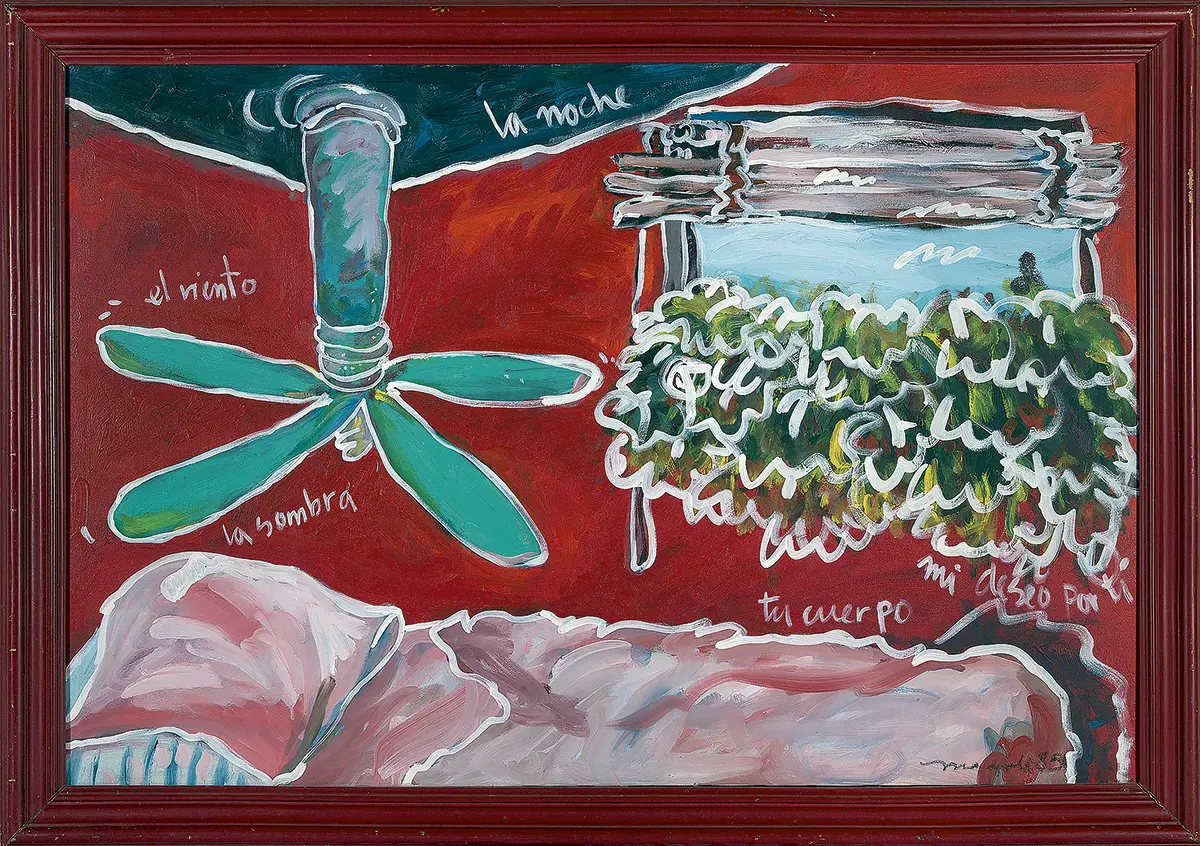
Indeed, Palacios’ decision not to respect the chronology of the works and to play instead with the correspondences between them, with their shared elements and identity markers such as lines, colors, objects, echoes, and subtle connections that sort them into groups, can disrupt the viewer’s aesthetic reception and understanding. Nevertheless, it brings to each one of Lara’s paintings a supplement of meaning in the particular resonance, the dialog, and even the complicity that is established with the work closest to it. Magali Lara’s artistic project, where lines are tied and untied, where controlled shifts in color find their relationship to space, is able to withstand associations that would at first glance seem contradictory. Indeed, the aesthetic-sensible and intellectual line that traverses Lara’s work, as well as the dynamism that characterizes her career and confirms the evidence of her evolution in time, gives structure to a personal posture to which the artist remains faithful and which reasserts the rigor of her relationship to artistic creation. Intimacy in her work echoes a desire to transgress the boundaries of the pictorial and of aesthetics, corroborating challenges that are conceptual, visual, and existential as well as material and technical.
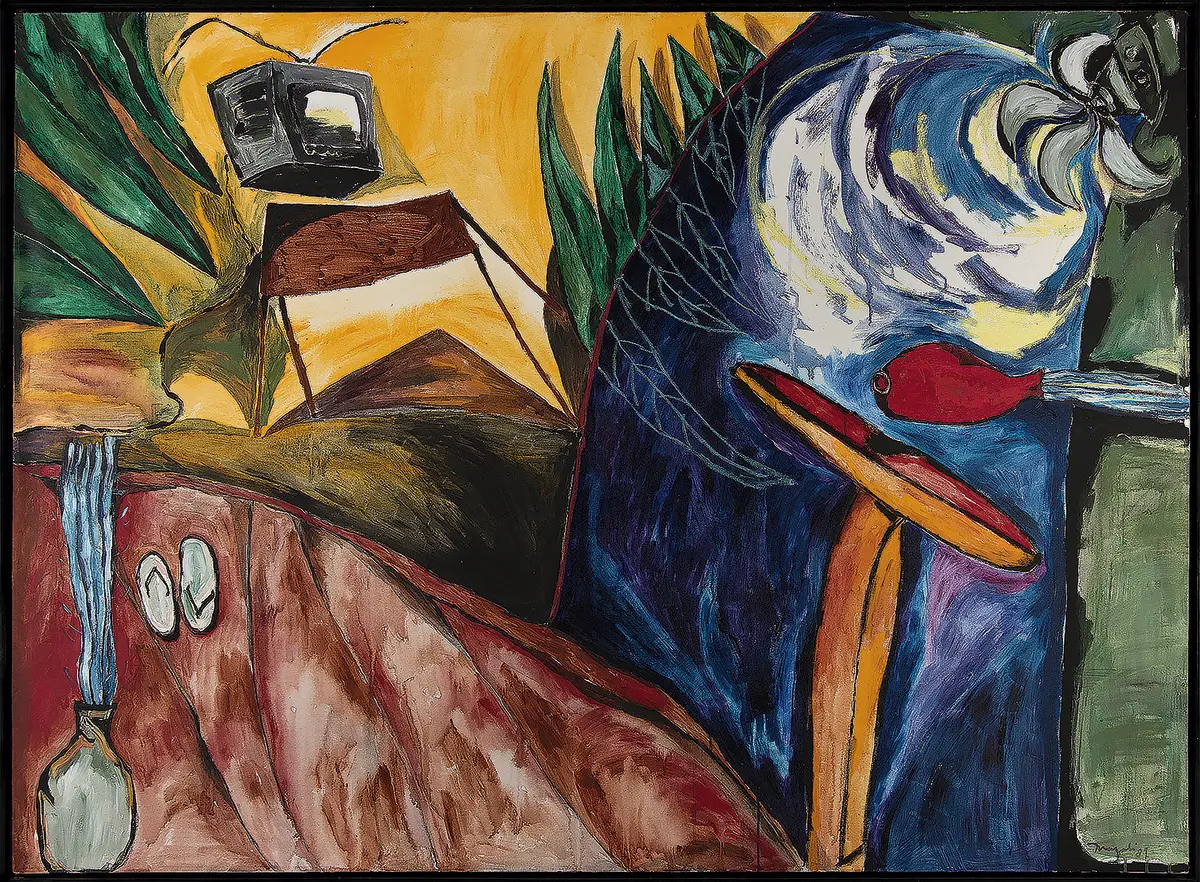
In Mexico, since the mid-Twentieth century, a number of women were able to excel in a hostile environment monopolized by dominant male figures. With painters like Frida Kahlo, María Izquierdo and Lilia Carrillo; photographers like Tina Modotti, and Lola Álvarez Bravo; patrons of the arts like María Asúnsolo, Dolores Olmedo, Guadalupe Marín, and Inés Amor (who in 1935 established the Galería de Arte Mexicano), women capture a measure of power and blaze a trail for a generation that will become established after 1968 and in the 70s and 80s, as is the case of Helen Escobedo. Two artists, Mónica Mayer and Maris Bustamante, literally exploded the barriers between the sexes and challenged the taboos of pornography and eroticism with their provocative performances. The weapons of Dulce María Núñez are caricature, wit, and humor, while other painters appropriated plant life and flowers, turning them into emblems of gender, as in the case of Georgina Quintana, Rocío Maldonado, and especially Magali Lara, in the trail of American artist Georgia O’Keeffe, who began to paint flowers and gave rise to many psychoanalytical interpretations.
The title Lara chose for this exhibition, Intimidad del jardín, brings to mind Voltaire’s metaphorical precept. Indeed, the French philosopher’s famous story Candide (published in 1759) ends with an exhortation to “cultivate your garden.” In our case, the “garden” is, obviously, the natural encasement of the building hosting an exhibition that can, in a general sense, be seen as a search for a lost paradise. For Magali Lara (as for Voltaire), the garden is the metaphor for a secret that the subconscious cultivates in its deepest recesses: the revelation or invocation/enchantment of our intimate spaces, a female terrain that intimates both demureness and explosiveness, the solicitation and interpellation of every one of our senses. “restlessness” and “rebelliousness” traverse Lara’s artistic reflection and form the axis of her pictorial history.
The first gallery presents us with plenty to read and to see. Indeed, a selection of texts about Magali Lara’s work, by a number of different authors, welcomes visitors in an entire wall. Across from it, several paintings from the 1980s put on display three beds Sin título (Untitled, 1985), Cama New York (New York Bed, 1985), and 19 de abril (April 19, 1986). The reference to intimacy is present here, albeit softened, somewhat in the subversive style of Lucian Freud, who depicted unmade beds open to a risible obscenity and to broken hopes.
In this exhibition, iconography, space, colors, and shapes can be engaged by the observer like the interconnected landmarks of a single aesthetic discourse. Lara’s everyday objects, represented in a rather more static way in works made between 1985 and 1990 (table, lamp chair, TV screen, sink), are now featured in paintings where, far from disappearing, they coexist side by side with branches, leaves, and fruits, in a space that opens up and becomes lighter and ever more dynamic as in Territorio (Territory), from the series of the same name (1990). The object truly becomes an actor in a choreography that has no other boundaries than those imposed by the frame. Motion is reinforced as a key element that provides the artist with the freedom to build and unbuild her forms, under no pressure and with complete autonomy of execution: Aire (Air) and Café II (Coffee II), from the series Café (Coffee, 2001). Already at the beginning of the exhibition, nature comes to dominate a work characterized by an interesting compositional arrangement in two parts: Animación (Animation), from the series El azar y la Fe (Chance and Faith, 1988), as well as in Agua doméstica (Domestic Water), from the series Miedo (Fear, 1987-1988), or even, somewhat farther away and in an “airier” weave, Cactus (1992).
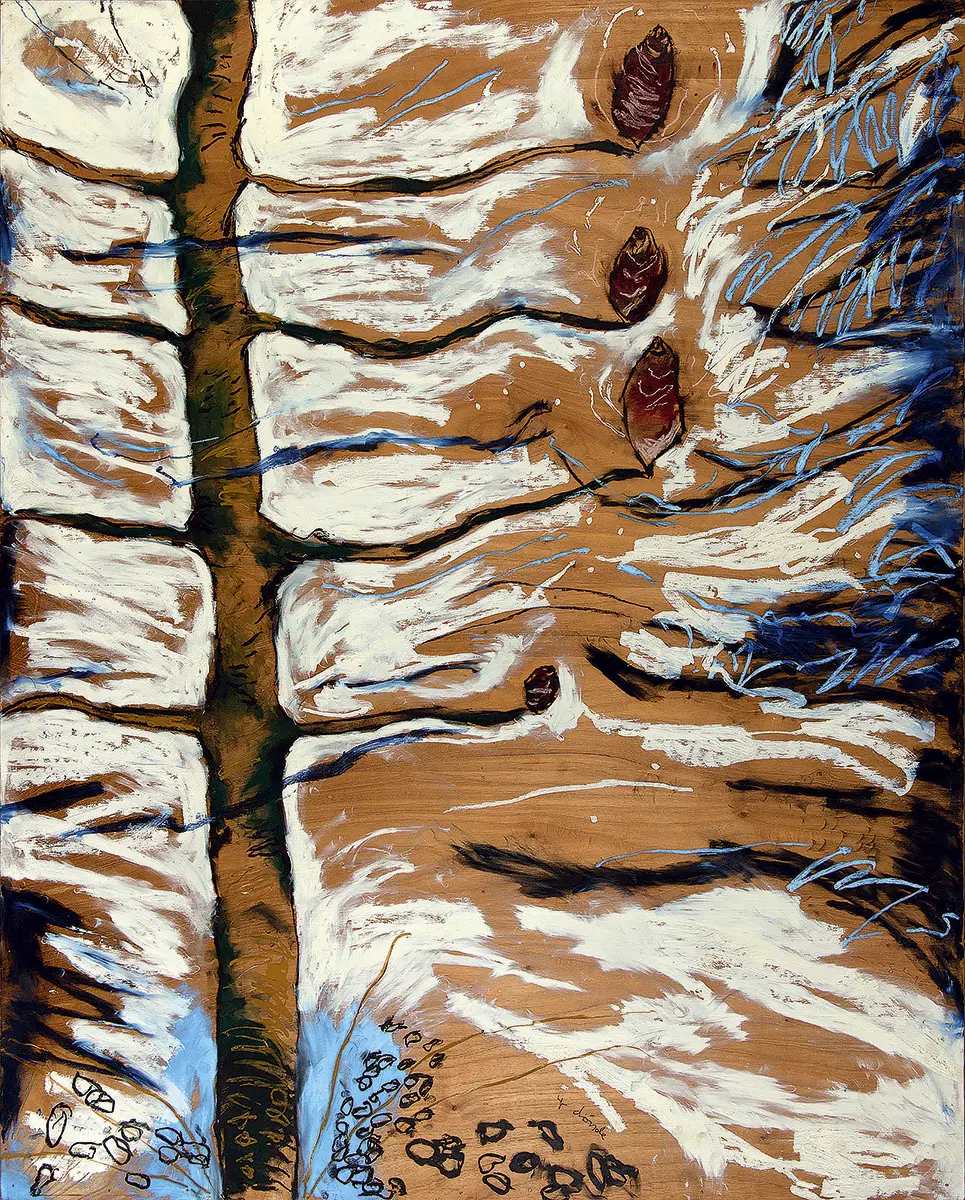
Like many artists, Magali Lara works in series. Since the early 1990s, with her series El árbol del cuerpo (The Tree of the Body) and Ramificaciones (Branchings), she has used trees as a metaphor for the body, and this relationship with space, which articulates her aesthetic and sensible ideas, shed notable light on her future evolutions. In El árbol de la intuición (The Tree of Intuition), from the series El árbol del cuerpo (1993), for example, the tree is an element among many, still immature, while the same tree flames triumphantly in Fe (Faith), from the Ramificaciones series (1995). The verticality of the tree that the artist identifies as “the tree of the body” launches a new proposal, where Magali Lara reaffirms the “staging” of an intimate. Having abandoned since 2013 that persistent and obsessive verticality, Magali Lara’s space opens to round and circular shapes (the shapes of maturity or plenitude?) to form constellations that are joined together by a kind of filament. That tree, which is a rather male symbol, evokes both life and death, both good and evil. In that way, it structures in many aspects the issue of consciousness and the artist’s existential interrogations, and its place at the center of her pictorial space is thus rendered even more significant.
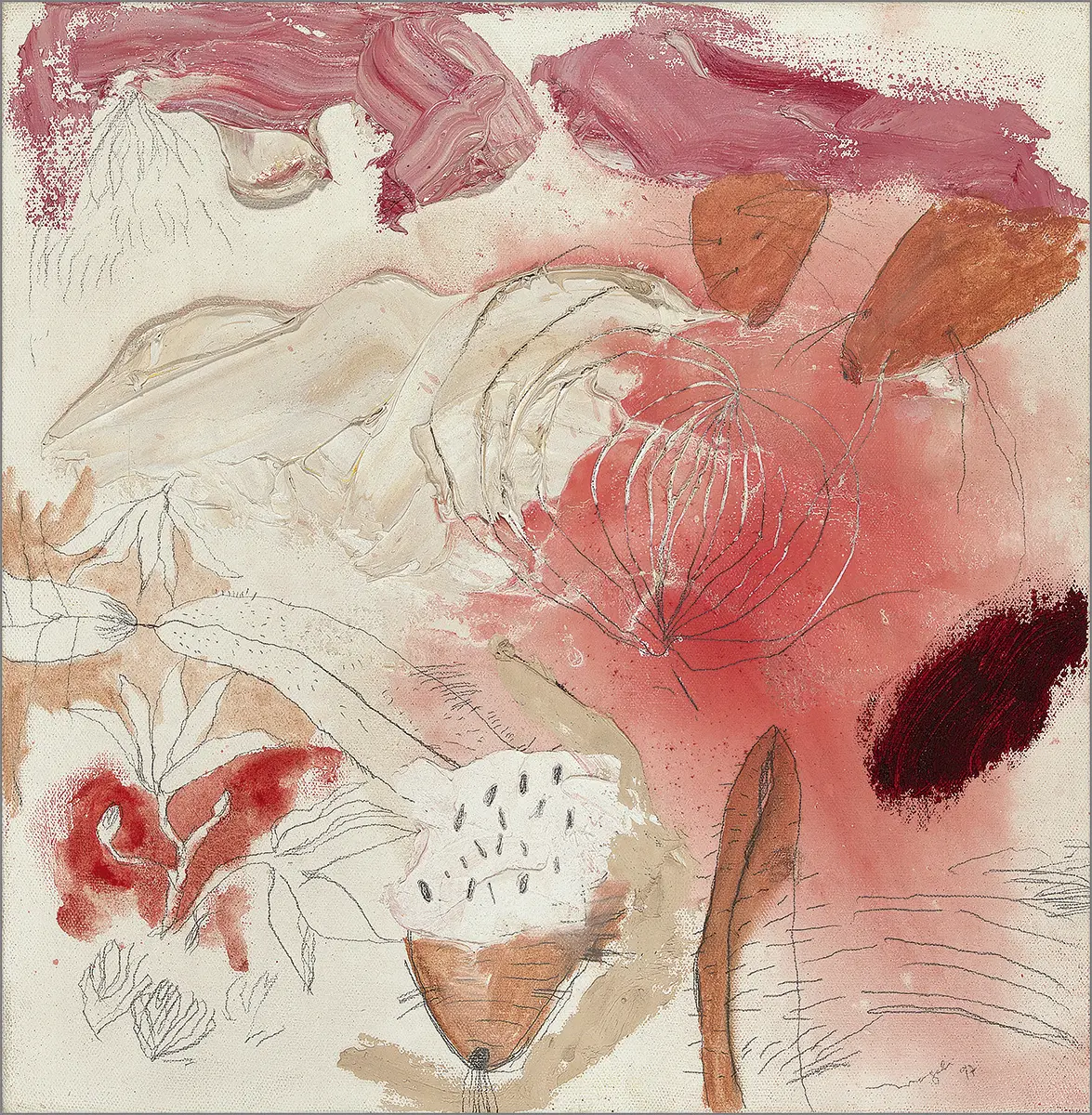
With Como una papilla (Like Porridge), from the series Repetir (1997), Lara frees herself from objectual representation and moves towards pure sensuality/sexualization on the basis of flowers and plants, a metaphorical resource that is to become generalized in her oeuvre (open corolla and sex-pistil, spermatic pulses, phallic shapes, erect or penetrating). The figurative dimension fades in favor of blotches, lines, and shapes, and the emphasis is placed on the primacy of color. Be it the intense blue of El futuro 2 (The Future 2), from the series El futuro (The Future, 2014), or the black and red of Sin título 2 y 5 (Untitled 2 and 5), from the series Intemperie (Outdoors, 2016), solid colors are both those of love and of suffering, as well as those of vindication and insurrection. A fire sun and a black sun thus invite us, passionately, painfully, with melancholy, to Magali Lara’s “garden”, which, like the mythical garden of the Hesperides, is the garden of abundance and immortality.
NOTE
1. Cuernavaca, Mexico, May-September, 2017. Another Magali Lara exhibition complements her show at the Jardín Borda Cultural Center. Del verbo estar (Of the Verb To Be) features 230 drawings, prints, artist books, videos, and paintings. Museo del Chopo, Mexico, May-September, 2017.
* Photos: Gabriel Batiz.
CHRISTINE FRÉROT
Art Historian, School Of Advanced Studies in Social Science (Ehess, Paris), art critic, and a member of AICA.