
The thought-provoking creative process of Brazilian artist Nelson Felix (Rio de Janeiro, 1954) was more present than ever in the exhibition titled Variations for Cythera and Santa Rosa presented at the Galeria Millan, in São Paulo.
Displayed in two exhibition spaces—the gallery and its annexed space—the exhibition consisted of seven sculptures and eighteen drawings in aesthetic dialogue that proposed a series of initiatives by Felix for the creation of an environment conducive to research processes, something similar to an incomplete travel guide.
During the walk through the exhibition and by getting closer to the pieces—which formed a poetic method of notions recurrent in the artistic production by Felix that began in the late 1980s—visitors were exposed once again to the visual explorations of a restless mind.
Un coup de des jamais n’abolira le hazard (A Roll of the Dice Will Never Abolish Chance), a poem by French poet and critic Stéphane Mallarmé that was seminal for the substantiation of aesthetic experimentations that solidified decades of research—and fundamental for the structuring of Felix’s visual thought—also inspired the decision to initiate a process that finds no univocal answers and that led to the discovery of two places: the Greek island of Cythera, and Santa Rosa, a city in the Argentinean Pampa, as result of another understanding of the notion of place.
In this manner, we learn that the mention of Cythera and Santa Rosa in the exhibition’s title stemmed from two convictions by Nelson Felix. By literally rolling the dice on a world map, with the number six engraved on all its six sides, Felix created a situation that disrupted the general meaning of chance and admitted another type of randomness for the creation of the works.
With two dice strategically rolled at a planned day and time in order to intensify the complexity of his poetic act, Felix would establish the position of two geographical points for future journeys.
These dislocations experienced in real life by Felix in two different situations would materialize the two itineraries of an experiential project in each of the regions, “discovered” through the aleatory nature of each gesture, and established a cartographic journey, drawn and also sculpted, a product of a traveling gaze that roams freely.
An unavoidable presence in the exhibition, the piece titled Cubo (Cube, 2017), an onyx and iron sculpture that consisted of two large, slanted, and highly polished stone cubes, light in color and with very evident white veining, which rested on the floor over iron bars. Central to the exhibition project, the creation of this three-dimensional piece intensified the experience of visitors.
Placed on the gallery floor and immediately attracting the attention of viewers, the two objects were reminders of the central key of the exhibition, the role of the dice as an important strategy conceived by Felix to sensitize the gaze towards the geographical coordinates of Cythera and Santa Rosa.
Felix purposefully once again resorted to Mallarmé’s poem here to launch his own hypothetical what-ifs over the surface of a world map printed on paper; substantiation and active body that has accompanied Felix’s visual research for over two decades as the operational basis for the location of his perplexities.
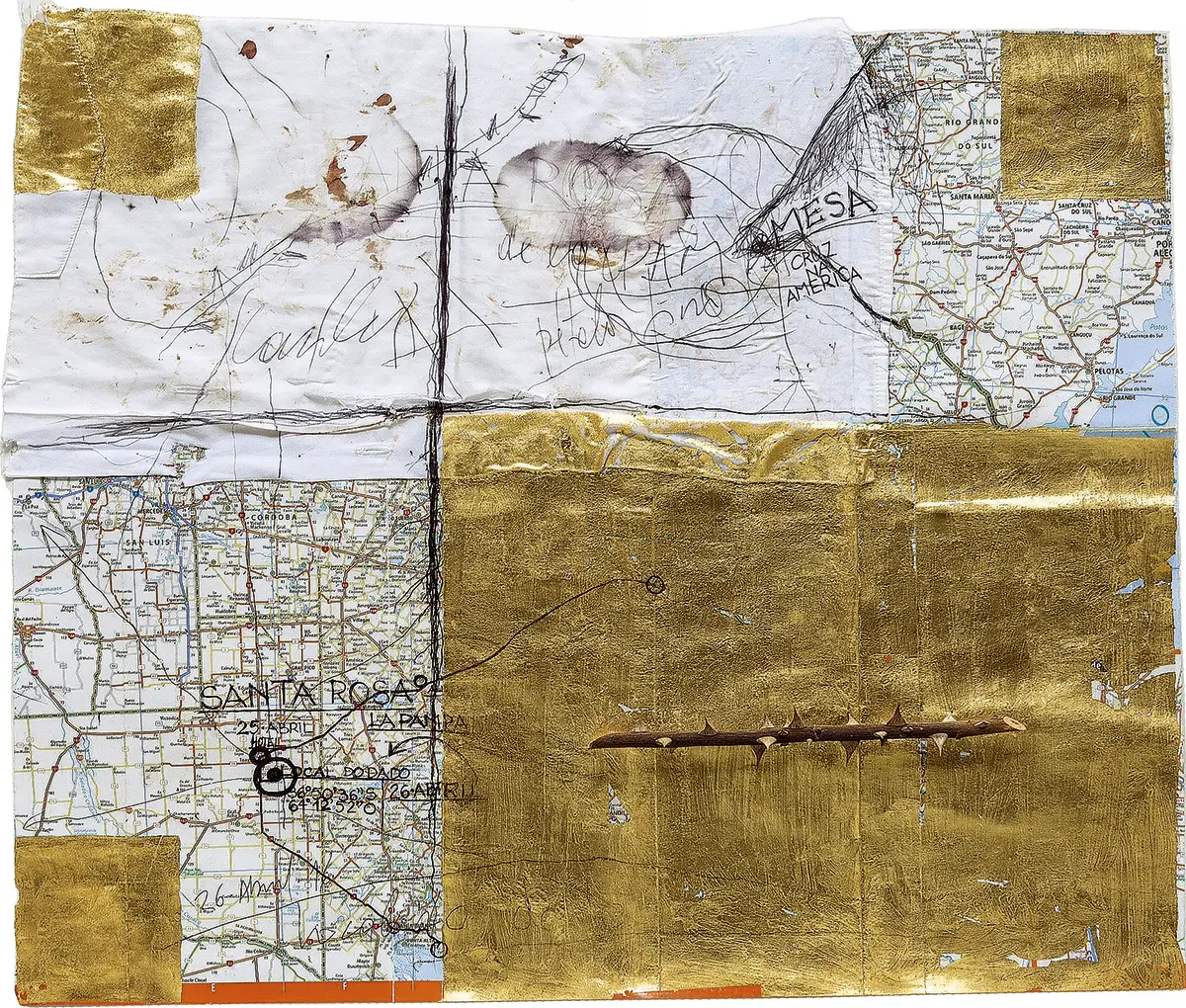
A two-dimensional composition created with a ballpoint pen on a world map that included vegetal elements, bronze, and linen, the work titled Mapa para Citera y Santa Rosa (Map for Cythera and Santa Rosa, 2016) translated the record of two situations, two rolls of the dice that, by rejecting the numeric value that usually appears on every side, created unexpected, and meaningful, geographical coordinates.
The coordinates found, both for the Greek island of Cythera and for Santa Rosa, the capital of the Argentinean Pampa, merged into the experiences of the ethnologist and artist in his journey towards the unknown.
Another prominent work in the exhibition is the creation titled Mapa Sta. Rosa (Santa Rosa Map, 2016) from the two-dimensional series. Signs made with a ballpoint pen on a map of the Argentinean province Santa Rosa pointed to the movements of the artist through the Latin American space. Like a sort of recognition of the territory, Felix reaffirmed the dimensions of the vast Patagonian region.
Also worth mentioning from the group of works is the piece titled Pista para dos lugares y pista para dos lugares (Track for Two Places and Track for Two Places, 2017), a video activated by the dense traffic experienced by Felix during his incursions through the cities and regions that were part of his visual exercise on chance.
As we were able to confirm, the exhibition resumed the itinerary of a poetic methodology of movement created by Felix to disrupt consecrated notions of space and time, and inaugurated a new chapter in his attempts to create other notions of place.
In this manner, we observed that the context for Variations for Cythera and Santa Rosa worked for Nelson Felix as a sort of visual form of expression with which to confront the provocations contained in Mallarmé’s poem, with a chance as the poetic path towards an intervention always implicated in mental constructs.
Through this poetic method, through a narrative proposed as an expression of the gaze as a defining factor in the creation of a real and imaginary field of latitudes and longitudes, the work by Nelson Felix embodies a density of decisions fueled by the critical thought of a journey clearly established on unstable grounds.
CLAUDIA FAZZOLARI