
The work titled O anjo exterminador (The Exterminating Angel, 1984–2014) by São Paulo-born artist Nelson Leirner was shown at the Pinacoteca do Estado de São Paulo under the curatorships of José Augusto Ribeiro. The installation was adapted to the Octógono section located on the second floor of the museum.
The work consisted of nearly 2,500 pieces including statuettes and bibelots that formed two groups aligned in front of each other and separated by a bridge. The number of pieces in each group was approximately the same, but not exactly; they were organized in two triangular formations, each on one side of the bridge.
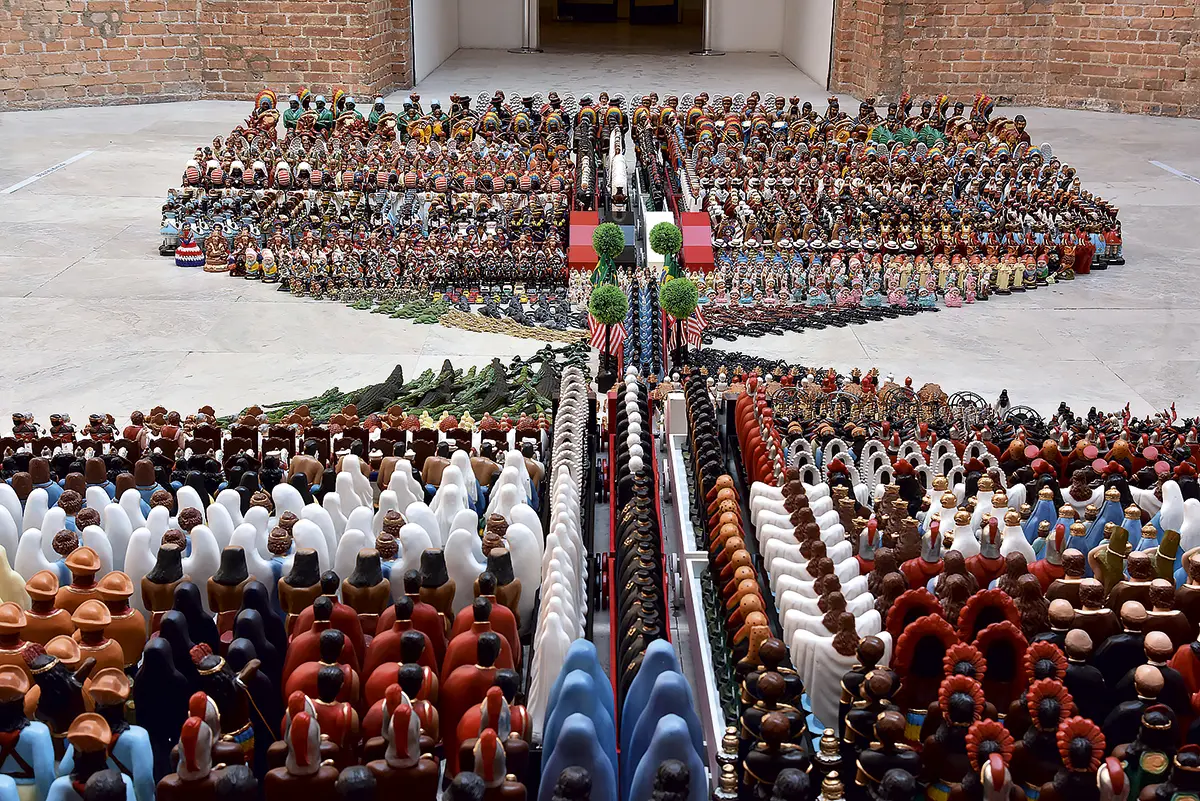
Beyond a mathematical or geometric relationship, O anjo exterminador aims at the creation of a sort of board, a battlefield with two opposing factions, like in a chess match, for instance. Criticism of consumption has been a distinctive element in the work of Nelson Leirner since the 1960s.
To compose the piece, Leirner relied on mass-produced objects sold in popular markets or stores. This approach particularly reflects an artistic practice by a creator focused on questioning the art system. Parody and the appropriation of images and mundane objects, mass culture materials, and decorative items—paintings, statuettes, and adhesive stamps—are some of the elements used in his artistic creation. The works often allude to other works of art, schools, and styles canonized by the history of art, ranging from Miguel Ángel to Fontana’s baroque images to the Young British Artists, Duchamp, Beuys’s Neoplasticism and conceptual art. All of these combined with a repertoire that includes advertisement material, Mickey Mouse, the prominent soccer team Corinthians, etc.
In this manner, like in O anjo exterminador the use of those objects is connected to an iconoclastic and ironic approach towards the hierarchies of taste, the predilection for high-quality materials, and even to the notions of authorship and originality.
“The idea of a society reluctant to redefine its own boundaries or one that increases the differences between groups or individuals is a recurrent theme in both the film by Luis Buñuel and the work by Leirner. This installation is also one of Leirner’s first works to resort to this process of accumulation and distribution of small sculptures in a scene reminiscent of a procession,” explains José Augusto Ribero, curator of the Pinacoteca.
The initial conception of this work was developed in 1984 and presented at the Museu de Arte Moderna do Rio de Janeiro (MAM-RIO). At that time the piece was titled O grande desfile (The Big Parade, 1984); it contained a much smaller group of statuettes, sculptures, and objects than its current version. The installation was reassembled in subsequent years with new configurations and under other titles: O grande combate (The Great Combat, 1984–1985), and O grande enterro (The Great Burial, 1984–1986), among others. In 2011, in the exhibition titled Nelson Leirner: 2011–1961 Plus 50 Years, Leirner resumed the grouping of objects, this time organizing them in two equal triangular blocs connected through a small Japanese garden bridge. That version was called Paulista à vista (View to Paulista, 1984–2011) and added elements that later reappeared in the 2014 installation named after the title of the 1962 film El ángel exterminador by Luis Buñuel.
The reference to the theme of the film El ángel exterminador incorporates the notion of a confrontation between individuals to the group of objects. Each individual piece is different from the others and has been placed in its own particular place within the specific social and cultural group to which it belongs. The bridge between the two groups and the Brazilian and US flags, each on its respective side of the bridge, also suggests an encounter or even cultural combat that underscores the notion of play suggested by the installation’s layout.
The process developed by Nelson Leirner involves key issues in contemporary art, such as the hierarchization of good and bad taste, the relationships concerning authorship, the criteria behind the validation of works of art, the participation of viewers, the utilization of non-traditional materials, in addition to the use of a wide range of elements associated with mass culture and mass consumption. The selection of the Octógono space for the mounting of the installation establishes connections between the aforementioned aspects, which was decisive for the curatorship. Showing the installation in a large and central space of the museum offers the opportunity for critical reading in connection with the other exhibitions at the museum; it allows for deep reflection on the work by Leirner contextualized through the collection of the Pinacoteca in São Paulo.
O anjo exterminador is a work already inscribed in the history of Brazilian art. It dialogues with the collection of the Pinacoteca, even with another work by Leirner titled O porco (The Pork, 1967), presented during the exhibition titled Brazilian Vanguard of the 1960s: Collection of Roger Wright, shown on the first floor of the museum.
HÉLCIO MAGALHÃES