
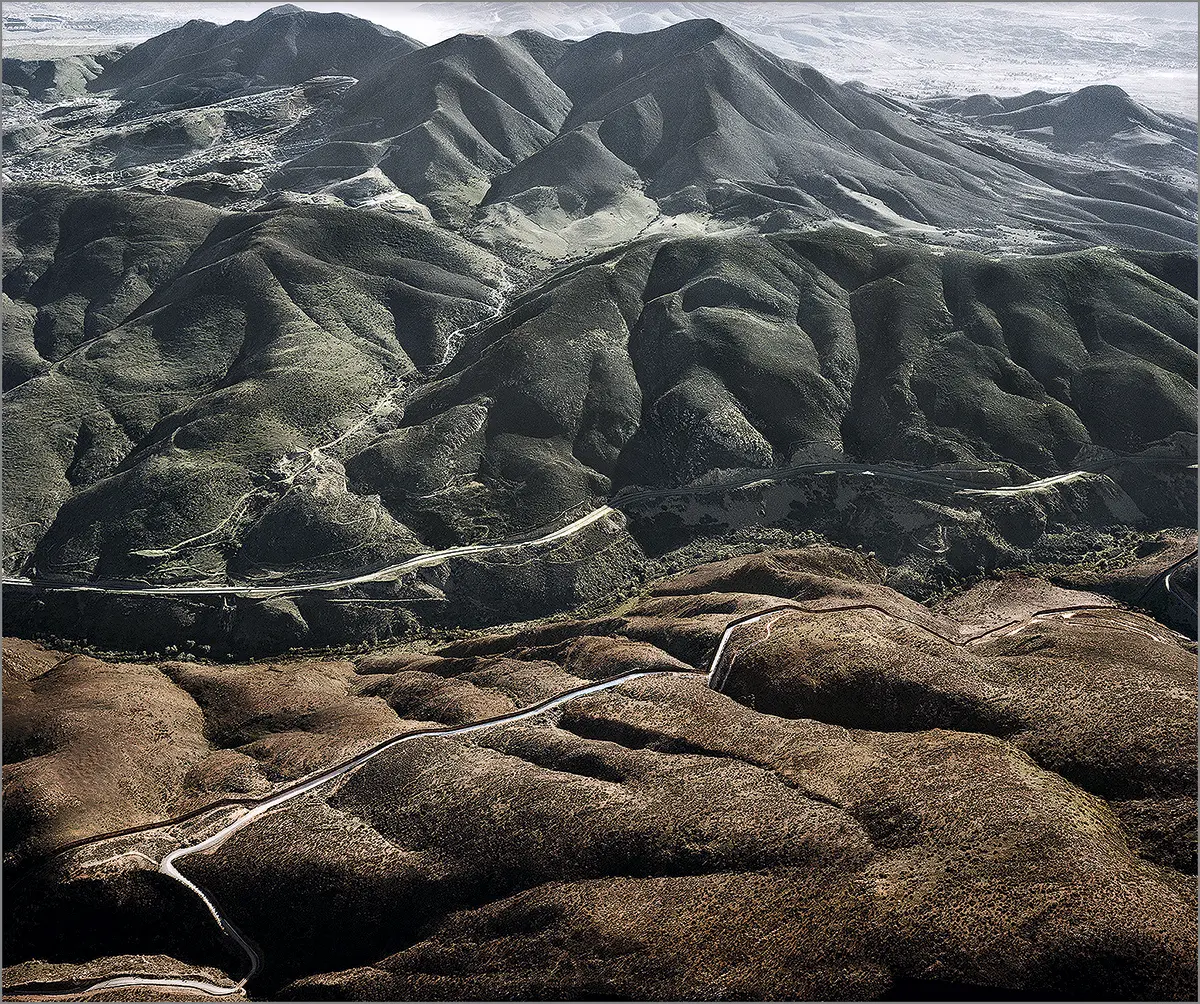
In Pablo López Luz’s Frontera (Borderland), our gaze encounters the random sinuosities of orographical territories and the traces of their violation by man-made adaptations for settlements, the extraction of resources, and the demarcation of the border between Mexico and the United States.
The signifying means of expression emphasized in this specific case of a political connection between nature and culture is large-format panoramic or landscape photography. A creative practice that Pablo López Luz has practiced in depth throughout his career, over the course of which he has transformed his critical revisions—this is to say, those that induce our gaze to question the intrinsic mechanisms of what we see—into contemplative motifs, be it the architectural reinvention of indigenous constructive traditions (Pyramid series); the hegemonic display of tourist services on ecosystems (Acapulco); affective/experiential nexuses with nature (Natura); the irruption of engineering works into features of the terrain (Terrazo); to mention only some previous projects by the artist that are connected in some way to his production in Frontera.
The diversity of formats throughout the history of photography, which began in relatively small scales related to its use for sociability, status, and scientific records, contrasts with the large dimensions of Pablo López Luz’s works in Frontera and his previous projects, which correspond to modernist photography and contemporary photographic practice, where the sensible experience to which the image invites us has an interpretive-reflective status, more than the condition that was propagated after the invention of photography by means of which it is an “objective mirror” of reality.
The cleanliness of the display at Arróniz Arte Contemporáneo emphasizes this intentional force that Pablo López Luz grants the contemplative potential encouraged by large-format photographic images presented as the only element in the gallery, which prompts a detailed visual probing of the spaces within the frame in order to gain access to connotation as the energy irradiated by contemporary photography.
The technical note in the gallery pays tribute to the historical photographic tradition by presenting us with a technological recapitulation, explaining that these photographs were produced in late 2014 and during the summer of 2015, in the course of four flights over Mexico and the United States in an R44 Raven II helicopter, covering 2.083 km in each route, at a speed of between 80 and 95 knots and at an altitude between 300 and 1.676 meters above sea level. In general, photography involves an operational and technical challenge that impacts the expressive reach of the images, and the works on exhibit in this exhibition are not an exception.
The resolution of these works, produced in the in-flight conditions described above, also determines the cameras and instruments used and how they are operated in terms of speed, aperture, number of shots, and other actions that connect us, via these qualities and their management, with the sublime and the unfathomable.
These expressivities, inescapable in his landscapes and panoramic views, are the pathway for the reflective critical operation that Pablo López Luz proposes, cutting across the literality of the images.
The sublime unfolds like a radical disparity between the scale of the human body and the features of nature, in an incommensurable view in the works in Frontera of soil textures, elevations, ravines, their striations, and hollows, their chromatic variations due to the shifts in vegetation density or aridity. The fog, the sinuosity, the horizon’s planes, and the overflowing mountain frames, have been precisely apprehended by means of height and distance. There is a sustained contrast between natural randomness and the regularities and grids of human intervention, in the marks of trails or highways traced and traversed time and again, or in the overcrowding of urban areas and the colorful accents contributed by pipes, constructions, warehouses, and any extractive device placed in the middle of a given territory.
In Pablo López Luz’s Frontera, these features are more than a mere formal exercise. We began this text by describing human presence as a violation of an environment. This series’ geographic situation at the border between Mexico and the United States forces us to confront the political complexity of this area and the social abuses in it. Works like San Diego - Tijuana XI, Frontera USA – México (San Diego - Tijuana XI, USA – Mexico Border), from 2015, or Tijuana - San Diego County III, Frontera México – USA (Tijuana – San Diego County III, Mexico – USA Border), from 2014, encourage a critique of the materialization of the symbolic border established hegemonically along The Line, the concrete barrier that separates populations and divides a developed nation from the more fragile and unstable country whose territory it took by force. In this series, these explorations run parallel to an awareness of the changes that human presence has caused in the natural world.
EUGENIA MACÍAS