
The title of the exhibition, Sound Transparency, attempts to synthesize to its essential form the proposal by Paz Lira: the translucency of a material created by living beings whose noise is captured and translated. The Chilean artist (Santiago, 1955) brought 450 honeycombs to the Museo Nacional de Bellas Artes in Santiago, Chile, to form with them a large chromatic wall measuring 11 meters high by 4 meters wide. Arranged on the white wall inside a spacious exhibition room, the work creates a “lightbox” effect that plays with the contrasts between the different shades of color of honey that, in addition, has been tinted with age. Lira is interested in explorations that lead her to the natural world, the work with waste materials and combinations of colors and tones. It is an exploration that Paz began in earlier works like Trastocado silencio (Disrupted Silence, 2012) and Palimpsesto (Palimpsest, 2003)—which used the remnants of a net for fish salmon as raw material—both also exhibited in the same museum, as well as by pictorial works characterized by abstraction.
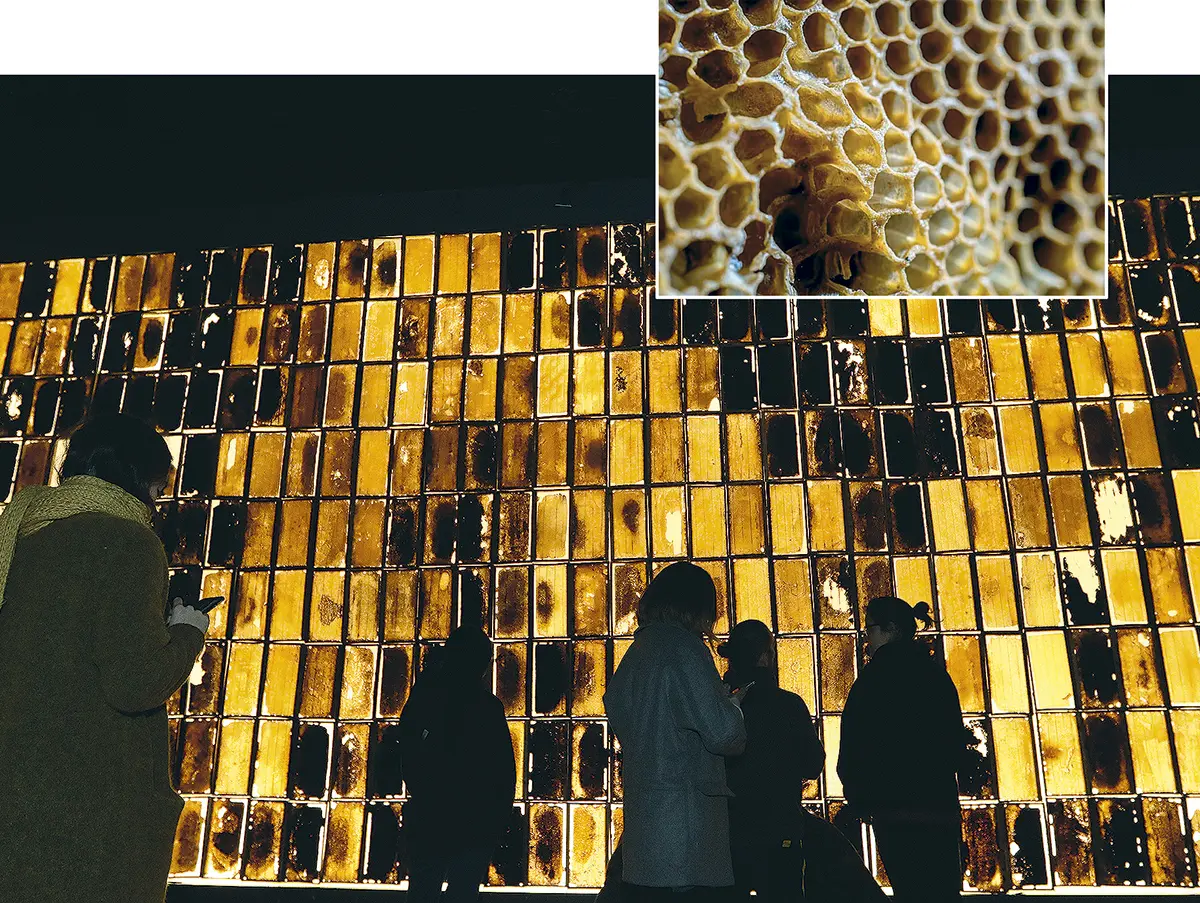
The exhibition is contemporaneous with another titled How to Catch the Universe in a Spider Web by Argentinean artist Tomás Saraceno, presented at the Museo de Arte Moderno in Buenos Aires. Both exhibitions have many elements in common. Saraceno let hundreds of spiders work to create silk compositions that, after months of silent endeavor, invaded one of the museum’s large exhibition areas. The spiders have a soundtrack: the minimalist sounds produced by these insects when they create. Paz Lira also takes advantage of the “artistic” work produced by another insect species—bees—and she intervenes as little as possible, only when it becomes necessary to compose an ochre and black wall. Her soundtrack comes from audio generated by an electroacoustic device that imitates the sound emitted by bees when they produce honey. In addition to the conceptual technical aspects, what makes the two exhibitions converge is a search for monumentality.
Nonetheless, while Saraceno’s exploration draws from the natural, artistic, and scientific worlds, Lira’s proposal is more a sensory and extrasensory experience. It is difficult to validate the written assertions made by Paz about Sound Transparency in passages that address the underlying danger connected to the disappearance of bees around the world and also attribute sensorial qualities to the installation that are hard to find—or that at least I could not discern, like the exaltations of the five senses, including an alleged sweet aroma that I was not able to perceive.
The sound generated by the bees as they produce the honey is reconstructed through an electroacoustic device called Luminist Garden. Something about it, perhaps its artificial nature, may not fit completely well with the artist’s intentions already stated. Nonetheless, the five-year-long project that resulted in this installation by Paz is not invasive or evasive: it is limited to favoring the contemplation of those “involuntary works of art” by “involuntary artists” that often teach us lessons that are much more valuable than expected. Like bees to honey, viewers approach this honeycomb of light and color in search of a relaxed and inconsequential aesthetic experience, no matter how much external noise attempts to raise indomitable factors a priori.
JUAN JOSÉ SANTOS