
Venezuelan artist Pedro Terán (Anzoátegui, 1943) is one of the central figures in the contemporary art of Venezuela. At a time when the crisis of identity of art was worsening and the definition of the work of art was unclear, Terán emphasized the importance of the processes that led to the creation of art beyond any material results and assumed the validity of thought as a central source for the creative act. His work is based on two pillars: on the one hand, on the development of a notion of time-space as a single term that does not function in a conventional manner, but rather where past, present, and future move forward across suspended spaces. Terán delves into the Time of the Ancestors—that original concept of the mythical time—with great skill and profound reflection; and, on the other, on the Body; also one from the origins; a central-body of actions and dimensions of contemporary aesthetics.
Terán was one of the first artists to show the body as a social space of relationships and as an Open archive by Pedro Terán. He offers us a closer look at the methods and paths that framed his artistic development, revealing the channels, questions, and conflicts of a journey in which the work and the personal biography merge through a series of projects, sketches, performance records, Polaroids, drawings, writings, photocopies, graphic works, photographs of interventions of the urban space; controversial accounts, catalogs, and videos developed between 1964 and 1968.
Twenty-eight works outline a walk through his installations, performances, and works with the body. In 1964, Terán traveled to Rome to further his studies. From that period come to his earliest archives of actions and images of installations that are today part of our conceptual artistic imaginary. They include ink on paper Autorretrato (Self-portrait, 1964) created during that period between Caracas and Rome, and Poema Romano (Manos) [Roman Poem (Hands), 1965], ink and collage on printed paper. In the latter, the hands are drawn on fragments of a poem and over two white and black positive and negative planes. In the white plane, a drawing of a body in an open space is incorporated into the hand to form a single entity. The synthesis between text, lines, and forms makes this small piece an important precedent for conceptual art.
The exhibition continues with a group of documents, Polaroids, and projects from the 1970s created during Terán’s stay in London—which leads one to think of the exhibition as a survey through this artist’s learning and traveling stages: Identity Card I and II (1971-1972), images for the construction of an identity in four times, where several photographs of Terán depict a progression in which he is gradually shown will less hair; Art, a la moda, escultura fría (Art, Fashionable, Cold Sculpture), an ephemeral work in which a block of ice hangs from the crotch of the artist who is wearing jeans; Para Vivaldi, variaciones en el espejo, develamiento (For Vivaldi, Variations on the Mirror, Unveiling), a portrait in three times that culminates with a nude, and Viajando con Terán (Traveling with Terán), both from 1972; Abecedario del cuerpo (Alphabet of the Body, 1972); and part of the series Polagramas (Polagrams, 1977-1978), structures created from fragments of a Polaroid image that gradually formed an entire portrait at the end of a single linear progression—a series that added something new to Terán’s artistic production.
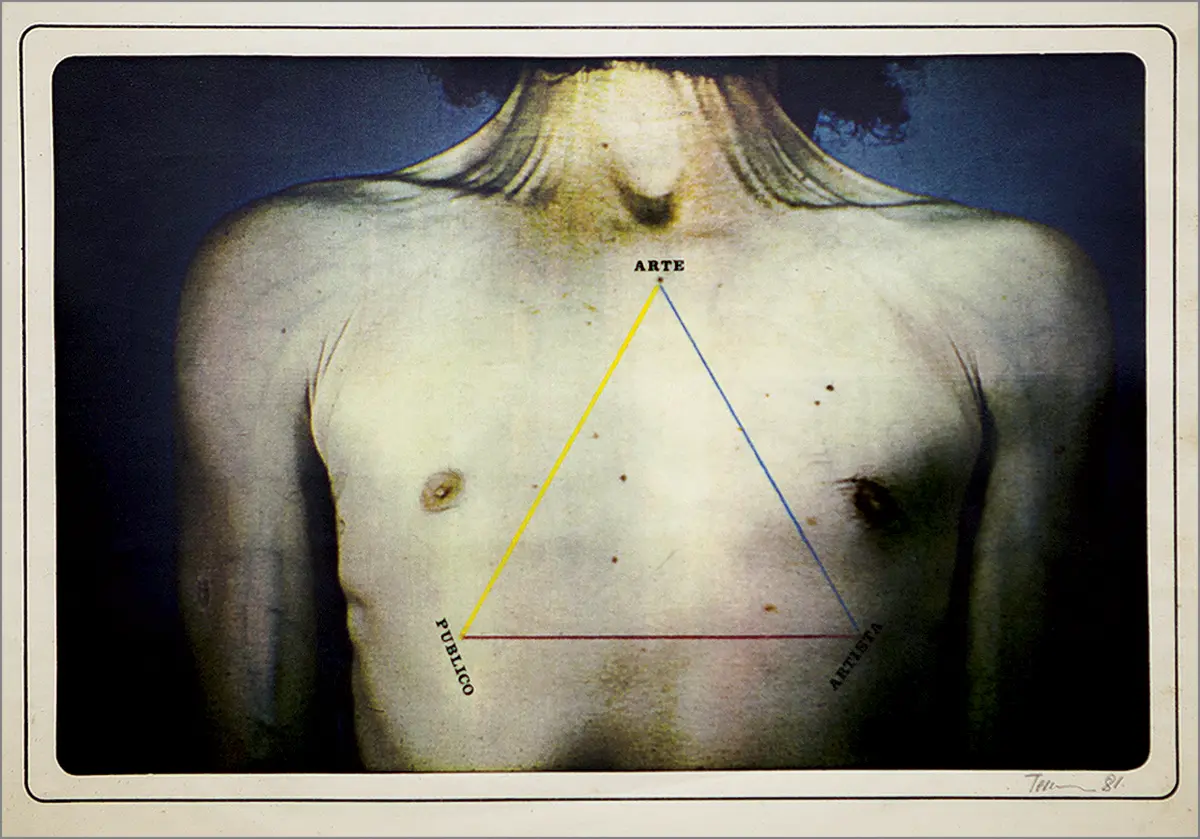
The exhibition also includes the following works from the 1980s and 1990s: Arte (Art), Público (Public), Artista (Artist) and Vestigio de Performance (Performance Vestige), from 1981 (where Terán focuses on the torso), and installations like Tierra de gracia (Land of Grace, 1982) and Escalera de Manoa (Stairs of Manoa, 1991-1994-2010). The latter is the record of an emblematic intervention in which the Space/Time concept proposed by Terán can be fully appreciated. With a simple and yet highly complex symbolic gesture, he placed the gold leaf on the staircase that connects two sections of Ciudad Bolívar in the Guayana region of Venezuela, the place of the mythical El Dorado. The shining steps stand on the place of the myth of the Golden Hills of Manoa. The golden links suggest the convergence of visual, ritual, and urban elements in a single space, in an over the reference to the region’s foundational myth. These proposals defined the mood of installations that always allude to an original territory in the spatial conscience of Venezuela. A large panel by the entrance displays leaflets, texts, published articles, letters, photographs, and documents that convey the ideas and discussions behind the works, as well as the conflicts surrounding the controversial figure of an artist who, misunderstood by the authorities, was expelled from the Escuela Cristóbal Rojas following a performance in which he stood naked before the audience. The Open Archive of Pedro Terán activates viewers' interest in the study of the history, contexts, and origins of contemporary art. Despite the complexity of the accounts included in the exhibition, the curatorship has been clearly conceived and laid out to encourage viewers to observe, think and approach the works by Terán from several perspectives—intimist, reflective, discrete but profound—that, far removed from visual affectations, are refined and appealing to the mind.
MARÍA LUZ CÁRDENAS