
Could we live in a gallery? Is it possible to transform the white cube into a living space? Brazilian artist Renata Cruz (Araçatuba, São Paulo, 1964) recreates a domestic scene at the Galería Blanca Soto, in Madrid. Using small drawings depicting realistic-looking tiles, Cruz builds a display with various everyday objects. Titled Forever Plus One Day, the exhibition draws inspiration from the writings of Jorge Luis Borges. In this case, the multiple cultural references contained in the literature by the Argentinean writer become excellent accompaniments for a curatorial concept that combines origins, techniques, and traditions.
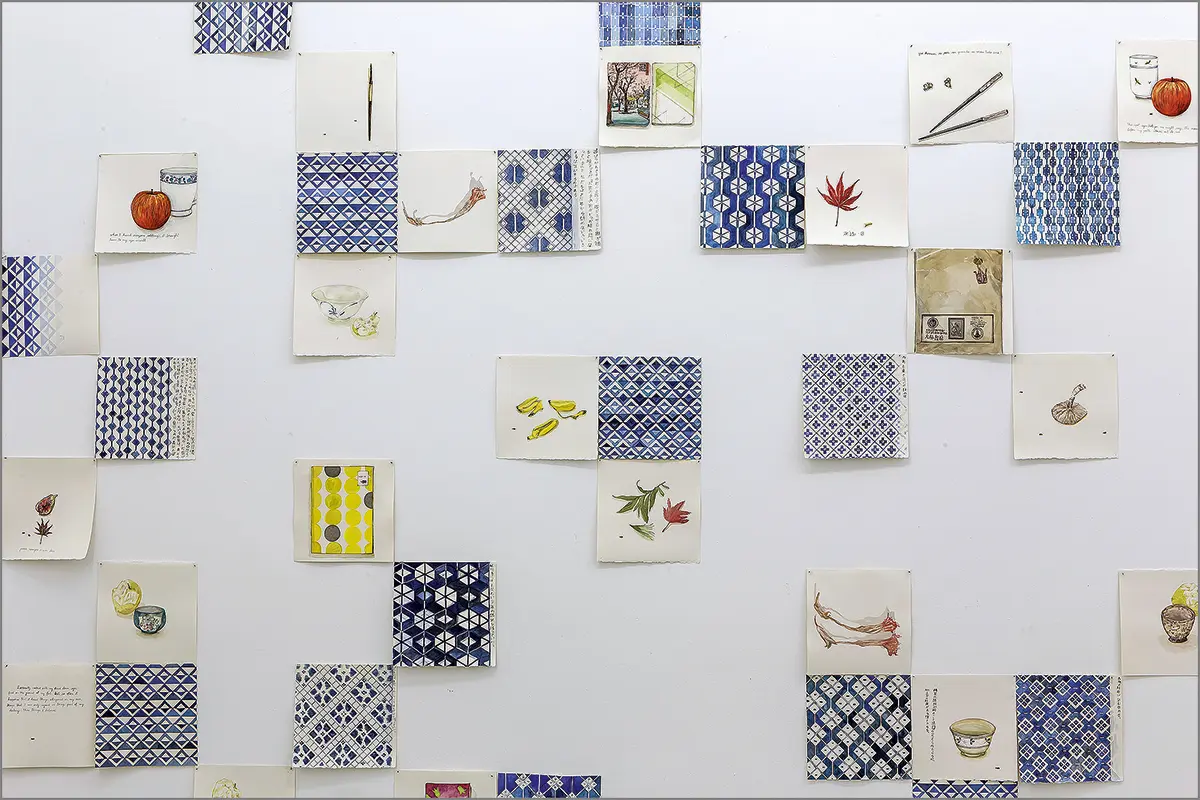
There are vases with flowers, candles, a mango sliced in two halves, and an oil dispenser bottle. Further ahead, there are also ceramic cups, a red leaf, and fruit peels. There are also geometric figures and decorative modules. The blue and white colors used to refer to Portuguese craft traditions. In fact, the exhibition project was born from Cruz’s experiences in Lisbon, where she presented a solo show at the Carpe Diem Arte e Pesquisa.
But there are also other elements that refer us to Japanese cultures, like the Momiji or maple tree, whose foliage turns into an intense color after autumn. And Japan is precisely another place needed to understand the exhibition. Renata Cruz presented a solo show at the Aomori Contemporary Art Centre that helped her resume her inquiries on the passing of time, on the things that remain, and those things dear to us, even if they are silent.
The exhibition by Renata Cruz is compelling because it vindicates handmade work, for the simplicity of its display (folded papers hanging on the wall in a very basic fashion), and because it reclaims a very specific iconography that we are not used to seeing in contemporary art galleries. It could be said that the exhibition is a sort of multifaceted still life, composed of small, juxtaposed, fragments arranged in the space like a collage. This “joy of objects” has to do with a vital exaltation that pays tribute to the world around us; well established in contemporary art, it has periodically reemerged since antiquity—present in the works of artists like Francisco de Zurbarán, Josefa de Óbidos, Jean Siméon Chardin, Clara Peeters, and Albert Renger-Patzsch, among many others. It is a feeling perhaps born from the realization that conceptual labyrinths end where matter begins. Like Pierre-Auguste Renoir said, “Hands can reach much further than ideas.” And this could very well be the underlying philosophy of the exhibition by Renata Cruz.
The drawings by Cruz also have structural value: emulating the traditional architecture of Lisbon, the work of art offers in this manner a double reading, ornamental and functional in nature. According to this compositional intention, the motifs in the textiles by Aomori offer the work of art support and form. But there are also texts in many of these “paper tiles:” we read words by, for instance, Dazai Osamu, one of the authors that Renata Cruz met in Japan. There is also the cover of the already legendary book In Praise of Shadows by Jun’ichirō Tanizaki, a classic essay on the relationship between Japanese architecture and the concept of the shadow. In this manner, the text accompanies the weave and the architecture, as if it also were a way to thread concepts, build beauty, and play with forms. About the intention behind the arrangement of her drawings, Cruz said that she is interested in open narratives that help her look for the many lectures that viewers may generate. The subjectivity of each visitor plays a role and becomes a particular walk through the exhibition in which his/her own memory, body, and experience intervene.
With Forever Plus One Day, Renata Cruz draws an arch between Brazil, Portugal, and Japan. It is impossible not to consider the historic connections between these three cultures. Aside from the obvious colonial links, the history of Brazil is also connected to Japan, especially in terms of immigration and the Japanese population that has historically lived in Brazilian territory. The curious thing about this exhibition at the Galería Blanca Soto is the presence of other connections having to do with every day and the value of small things. It is something like the rewriting of a micropolitical posture in aesthetic and emotional terms. This exhibition is the result of the amazement produced by an unexpected encounter: the surprise of finding ourselves before that which paradoxically has always been there.
ANA FOLGUERA