
Mano mal dibujada (Badly Drawn Hand) is the title of Peruvian artist Teresa Burga’s exhibition at SculptureCenter. It refers to the nine iron sculptures depicting Burga’s own hand, exhibited for the first time in the context of this show.
Since the 1960s, Teresa Burga (1935) devoted herself to creating strongly conceptual art that involves non-traditional materials. By the end of the decade, she was a feature of the Lima avant-garde art scene. In 1968 she won a Fulbright scholarship and traveled to the United States, to study at the Art Institute of Chicago. After Burga returned to Peru in 1971, her art was met mostly with incomprehension and remained out of sight for decades, safeguarded by the artist in her own home.
Part of the prominence achieved by Burga in recent years is due to the revision of her work carried out by Miguel A. López and Emilio Tarazona, who twelve years ago began a historical reconstruction of her work. López and Tarazona included some of Burga’s works in the exhibition La persistencia de lo efímero (The Persistence of the Ephemeral, 2007), and three years later they co-curated the artist’s first-ever retrospective, held at the Peruvian-American Cultural Institute. There they presented previously unseen material from the 1960s that Burga had not been able to show at the time. Recently, Burga has seen her work exhibited in such biennials as Istanbul and Venice and has had institutional shows in Buenos Aires, Mexico, Stuttgart, and Berlin.
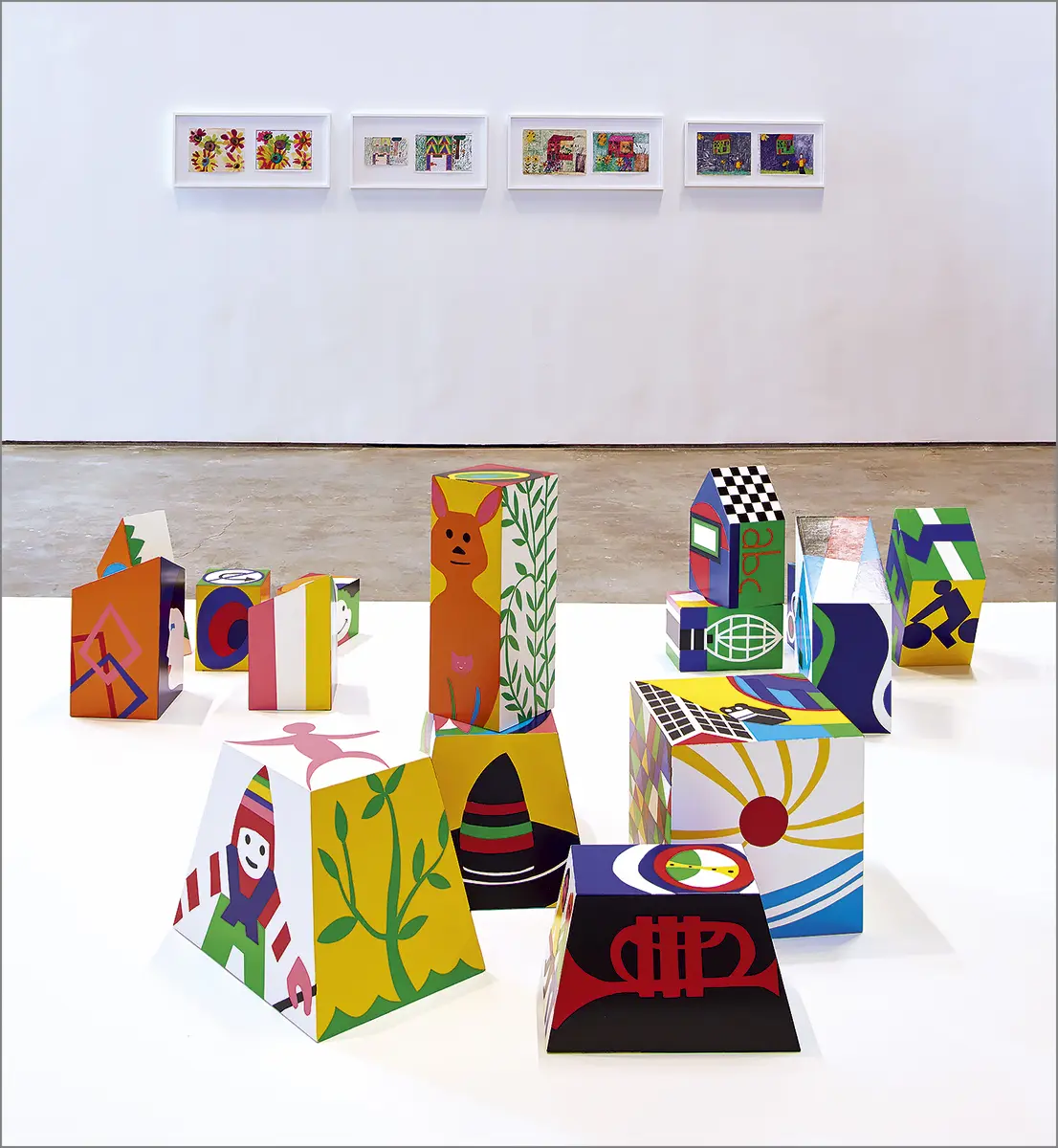
Burga’s show at SculptureCenter, curated by Ruba Katrib and presented as the artist’s first solo museum exhibition in the United States, features works dating from the 1960s to the present. With its many recent productions and its dominant Pop language, the exhibition focuses on the idea of play, on gender issues and the female body, and on the contrast between childhood and old age. Following through with the theme of the play, the sculpture series Prismas (Prisms, 1968/2013) consists of a number of polyhedrons with childhood images on its facets, but not only those: tree branches, a bunny rabbit, and sun share the space with road signs and fragments of advertisements, in a juxtaposition of meanings. Alongside them are two-dimensional paper versions of the same works.
Since the 1960s, drawing has been Burga’s preferred medium. She also adopted the method of recording on the margins of the work the date and the exact time—in hours and minutes—when each drawing was begun and finished, thus emphasizing artistic practice as a process. This exercise continues in more recent works, such as Burga’s drawings based on newspaper photographs, where she copies cityscapes and blighted buildings. In Escombros totales (Total Rubble, 2013) and Graffiti (2012), Burga observes the city of Lima by means of such reproductions and draws them in a pointillist manner. At the same time, she continues to use photography as a source in a series of drawings of people shopping in Lima markets; a single frame encloses the source photograph and the drawn version.
A third series, also rigorously dated, insists on a similar procedure. Burga copies drawings made by children. The titles of these works include the name of the young artist, as well as their age and the year when the drawing was made. The contrast between the two images not only interrogates the notion of authorship but also sets childhood and old age in contraposition to each other. The fact that these drawings by children are imitated by an artist in her 80s prompts us to rethink the ideas of copying and playing, as well as the stages of life.
VERÓNICA FLOM