
In the Venice Biennale, there are two biennials at once: the national pavilions and the show presented by Christine Macel, its artistic director. This duality is not entirely new. Already in past exhibitions, the weight of the mega-exhibition curated by the artistic director stole some of the limelight from the pavilions, however dazzling the latter. This time, however, Christine Macel took a step forward: she organized her own exhibition as a series of pavilions. In her curatorial essay, Macel writes clearly that her exhibition “unfolds in nine chapters, two introductory ones at the Central Pavilion and seven more at the Arsenale and the Giardino delle Vergini”. Yet, “each chapter represents in and of itself a Pavilion or Trans-Pavilion, given their transnational nature, which echoes the Biennale’s historical distribution into pavilions, the number of which has not ceased to grow.” In other words, Macel’s exhibition is a Biennale within the Biennale, a scale model or an abridged version, if you will, of the other exhibition, the one that takes place in the national pavilions at the Giardini, the remaining spaces of the Arsenale, and twenty-plus sites scattered around the city. As such, it provides keys to an understanding or a deciphering of the abundant and heterogeneous artistic offering at the 57th Biennale, part of a history that extends now for longer than a century.
To this history I will add that Christine Macel’s Biennale is an updated version of the discourse articulated in the legendary Les Magiciens de la Terre, curated by Jean-Hubert Martin and held in Paris in 1989; it could be said that this is a normalized, handbook biennale that not only confirms the validity of that discourse but also proves that what back then were radical innovations are now wholly accepted and incorporated into the routines that for the design and interpretation of art biennials and large-scale contemporary art exhibitions around the world. It is evident that without the precedent of Les Magiciens de la Terre, without the normalization of its radicalisms, it would be difficult to understand why this Biennale includes chapters so decidedly apart from what used to be the West’s artistic canon as The Pavilion of the Shamans, The Pavilion of Traditions, and The Pavilion of (Mother) Earth. Neither would it be easy to understand the fact that these heterodoxies coexist peacefully with chapters whose very title reasserts the West’s artistic and cultural orthodoxy: The Pavilion of Artists and Books, The Pavilion of Joys and Fears, The Pavilion of Time and Infinity.
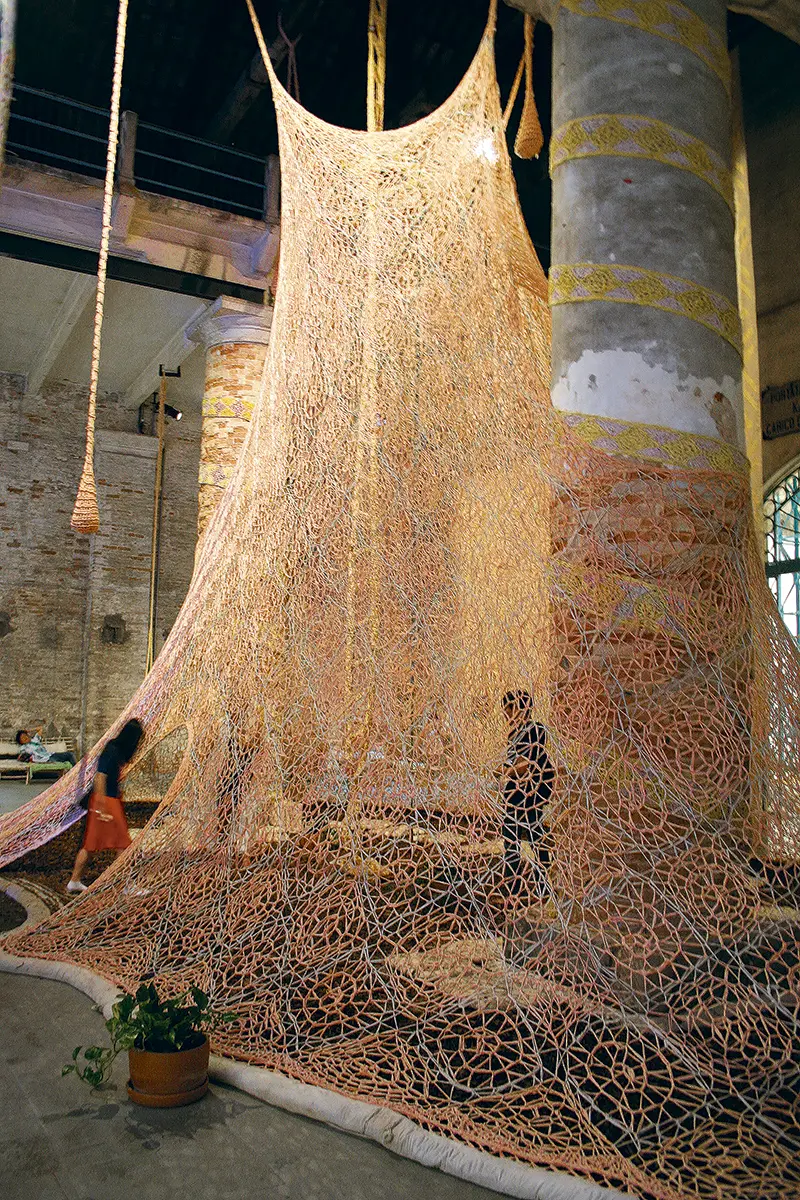
This normalization explains Macel’s inclusion in her project of Brazilian artist Ernesto Neto’s impressive installation at the Arsenale. It is titled just as what it purports to be, A Sacred Place—a title fully justified by the work’s scale, its spatial organization around a large column, its penumbra, the delicate veils that hang from the ceiling, the accumulations of sand and dirt encircled by rocks, the plants, the furniture, in sum the entire collection. Only that Neto has not erected this unusual temple in order to satisfy a desire for exoticism on the part of the audience, but as a forceful assertion of his belief that the wisdom of the Huni Kuin, an Amazonian people among whom he lived for a time, holds true potential for healing a sick world.
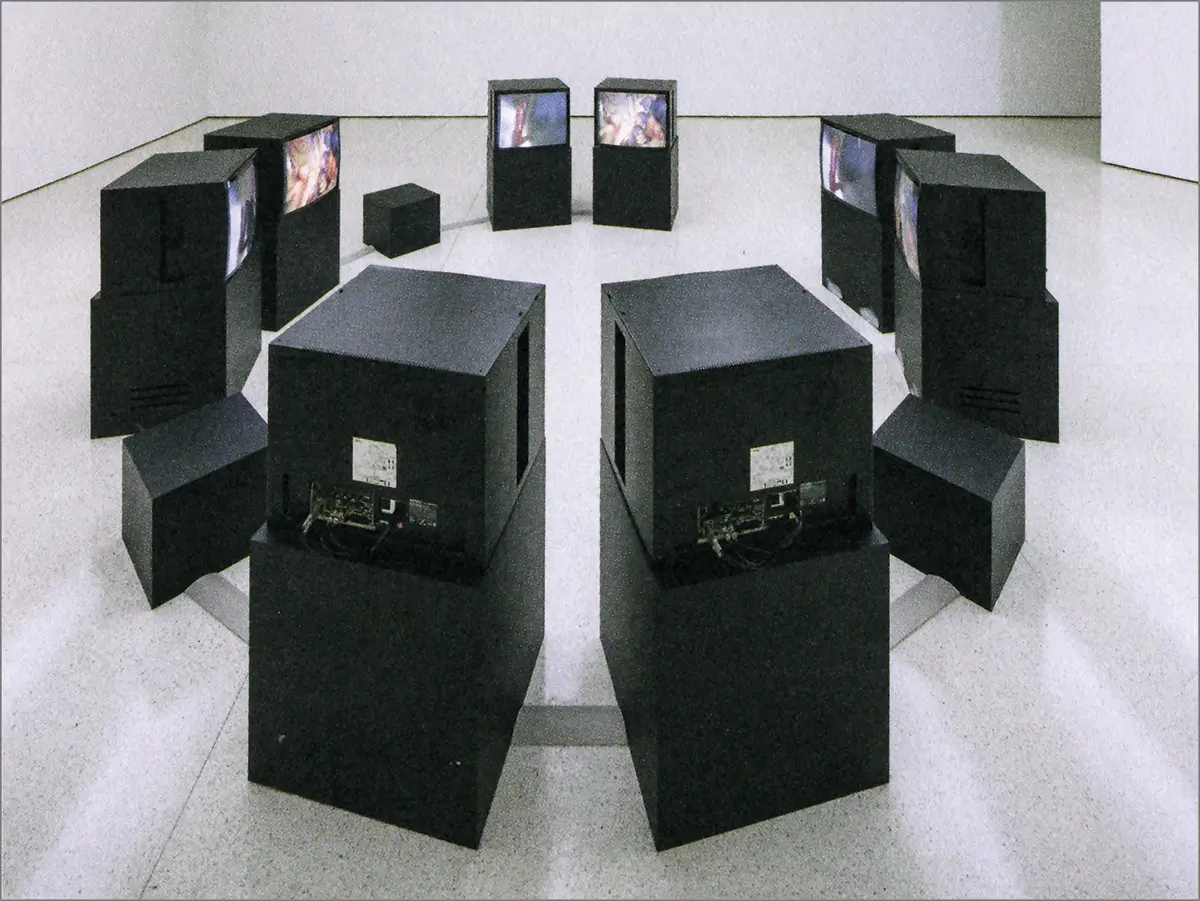
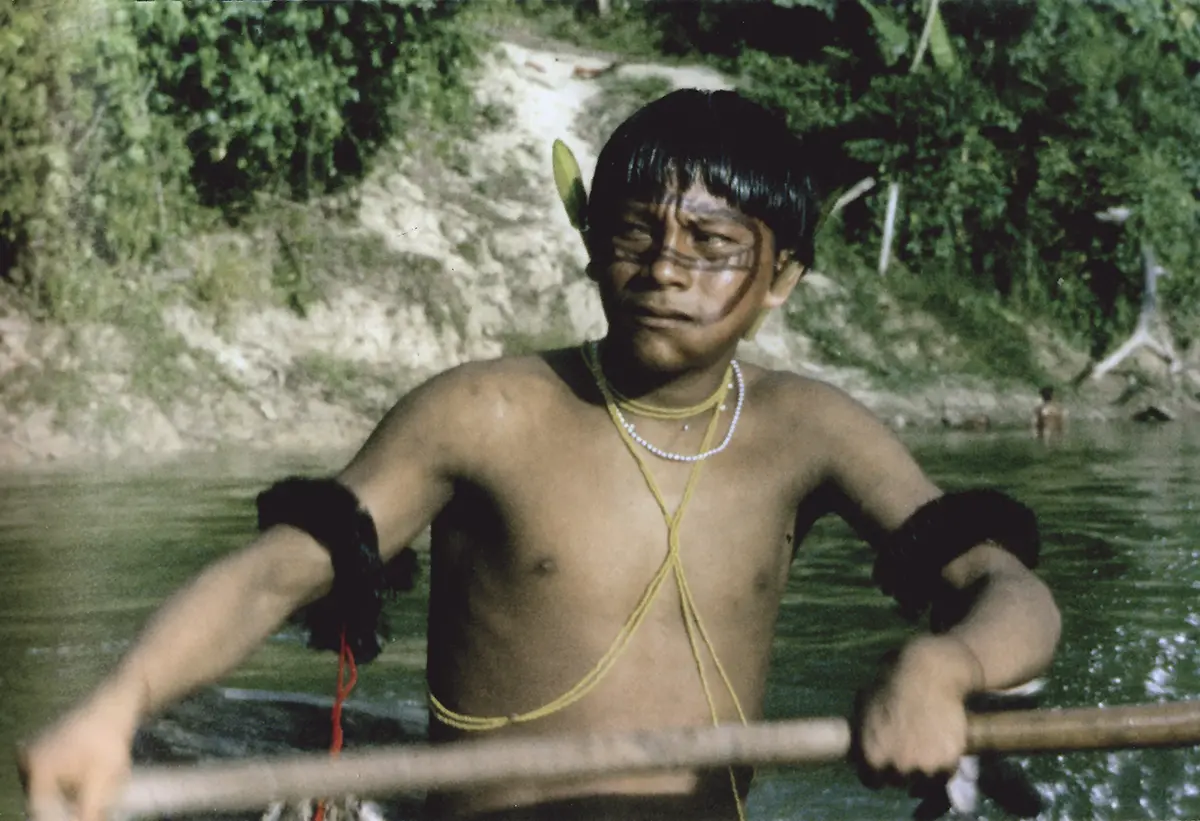
From that perspective, his installation is, rather than a standard aesthetic device, a healing place, the most appropriate site for the unfolding of a therapy dictated by ancestral knowledge. And it is precise because of its radical commitment to that knowledge that Neto’s work contrasts with Chilean artist Juan Downey’s video installation The Circle of Fires, also at the Arsenale. Downey’s work dates from the late 1970s and is based on an experience that had Downey, his wife, and their two children living with the Yanomami people, in the Amazon rainforest. Eight monitors arranged in an oval shape on the floor display videos that combine Downey’s recordings of everyday life among his hosts and those that the Yanomami made of him and his family, using a camera he provided. Like Neto, Downey traveled to the heart of the forest in search of an original people, with intentions that very likely mixed a romantic fascination with the “noble savage” and a desire to carry out an experiment in turning the anthropologist’s relationship as an observer with the observed subject into a two-way relationship. Downey observes like an anthropologist and is at the same time observed, and the contrast between the two gazes that his video installation makes possible might not be sufficient to clearly establish the precise and profound ways in which both ways of looking are different, but it does suggest the need to subvert the relationship of domination that ultimately obtains between the observer and the observed. Yet this need, which is indeed political, did not produce what we could call Downey’s conversion to Yanomami culture or his identification with some of its key aspects, as is the case with Neto and his conviction that Huni Kuin wisdom can save our world. And theirs, obviously.
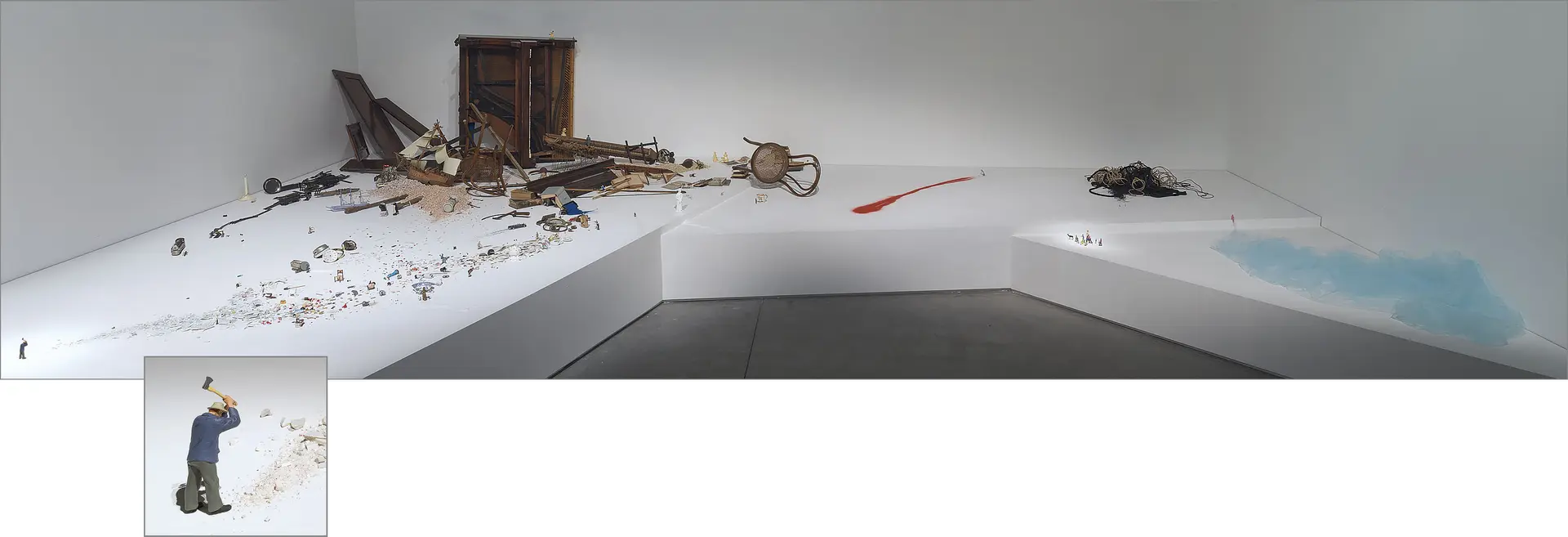
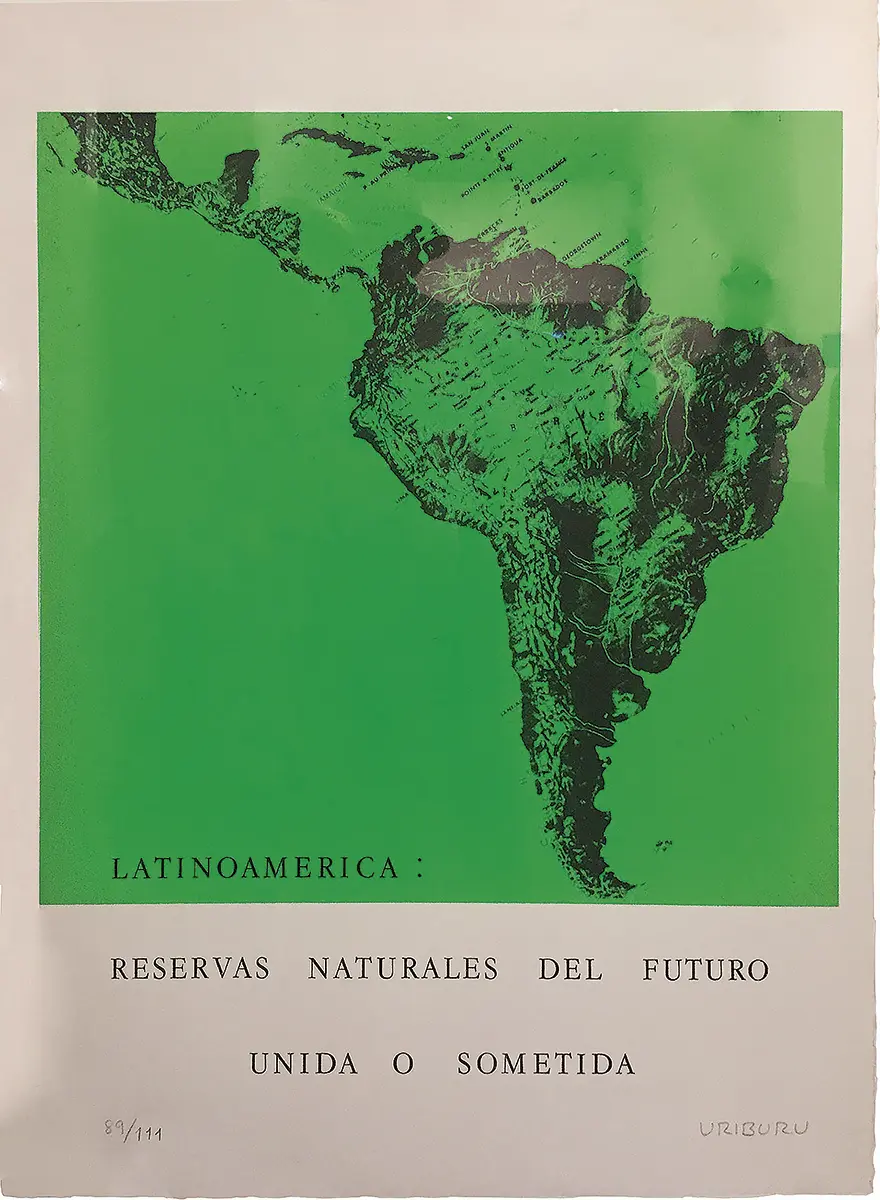
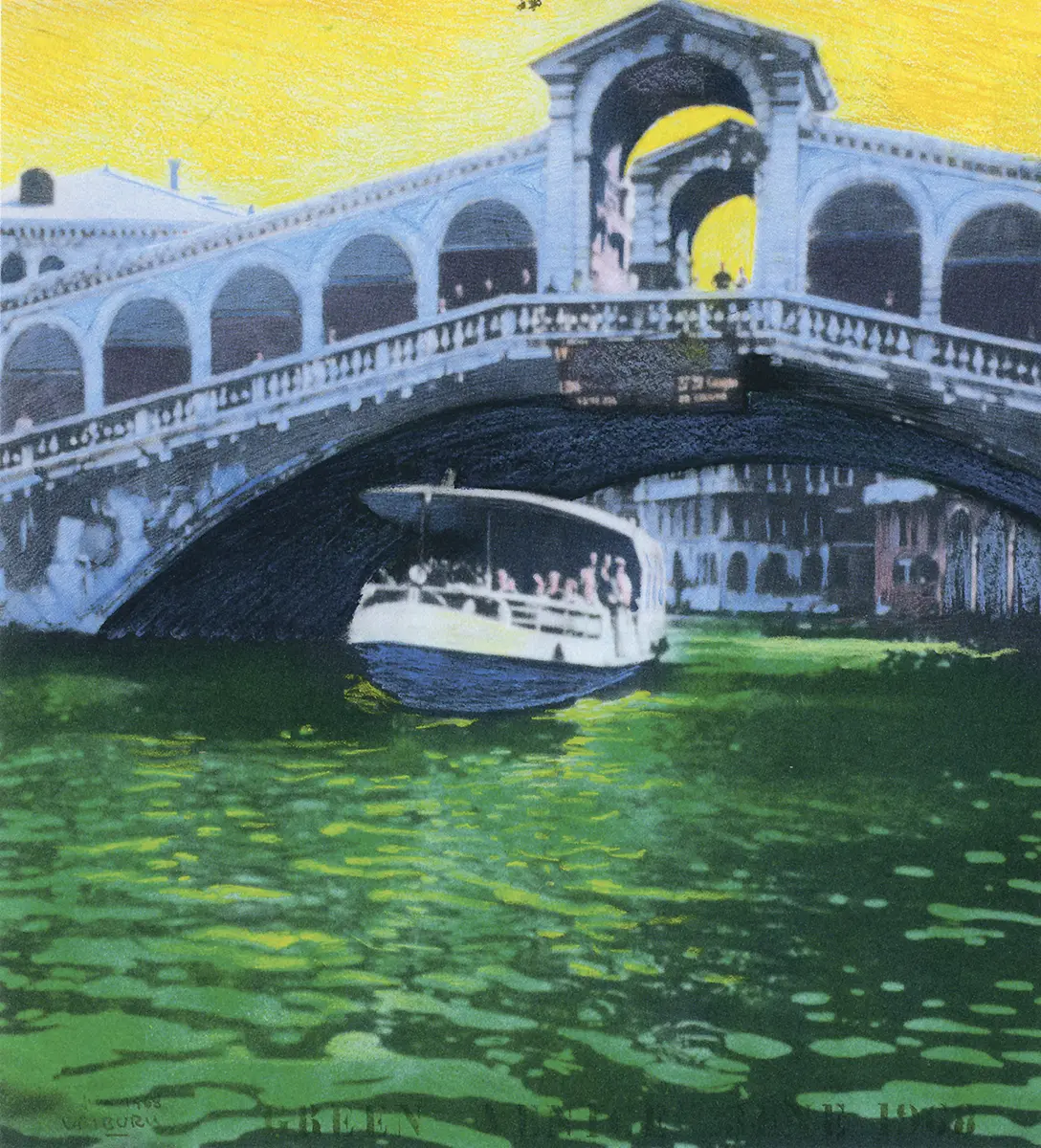
Contrasting Downey’s and Neto’s works—separated by four decades—also allows us to capture how much the trend that began with Les Magiciens de la Terre has advanced and diversified in its project of breaking through the modern art paradigm’s Eurocentric solipsism and opening it up to the possibilities of multiculturalism, the cultural project of globalization. Or better yet, one of the latter’s two basic components. Because while this Biennale is evidently multicultural, it is also pedagogical, as it mixes languages, aesthetics, genres, rhetoric devices, techniques, periods, with the very chutzpah that has become routine in biennials and mega-exhibitions. This element was already present in Les Magiciens…, but it is taken so far here that it affects the curatorial discourse to the point of rendering it confusing. In fact, the pavilion devoted to shamanism, under the pretext of Duchamp’s interpretation of the artist as shaman, one who has visions, includes works and artists who have little to do with the incorporation or appropriation of shamanism in a strict sense. Although valuable in themselves, the works of Rasheed Araeen (Pakistan), Yorgos Sapountzis (Greece), Martín Cordiano (Argentina), or Franz Erhard Walther (Germany), do not really fit the mold of shamanism, be it in a classical vein or as reinterpreted by Duchamp. Something similar can be said about the Pavilion of Earth, where works like those by Néstor García Uriburu (Argentina), Bonnie Ora Sherk (USA), Marko Pogacnik (Slovenia), Kananginak Pootoogook (Canada), clearly connected to our era’s ecological concern for the destruction of the environment, coexist with sculptures by Julian Charrière (Switzerland) and Erika Verzutti (Brazil), which only tangentially refer to that destruction. Something along the same lines could be said about the pavilion devoted to Traditions and Dionysius, although not so much about the pavilions devoted to Joys and Fears, Colors, and Time and Infinity, which, due to their abstract or diffuse definition, could afford the luxury of including works with the scarce or nonexistent connection. Among them, El hombre con el hacha y otras situaciones breves (The Man with the Ax and Other Brief Situations), a highly suggestive installation by Liliana Porter.
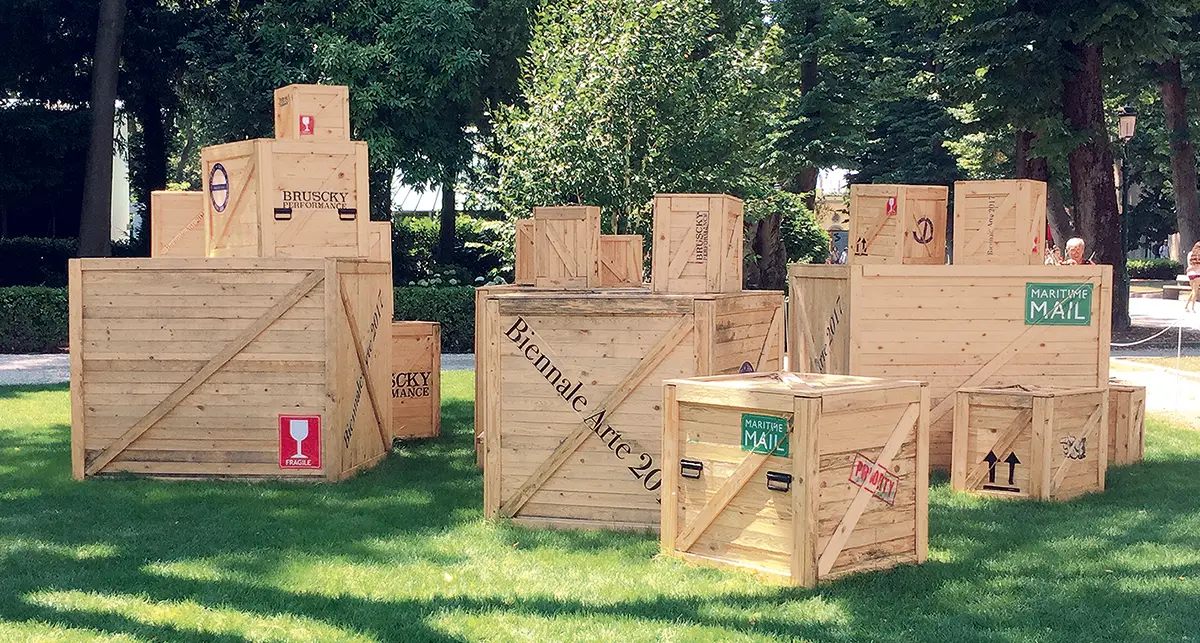
The case of the Pavilion of Artists and Books is different. First, because it is the principal support of the purpose of devoting this Biennale above all to those artists on whom Christine Macel intended to condense her title: Viva Arte Viva, which possibly means that art is alive because it is the life of the artists. A debatable thesis that is nevertheless coherent with the works featured in this pavilion: the studios and rooms where artists live and work. This option, however, forces an archaic reading of the artist’s craft, one that sees him or her above all as a romantic artisan in a context when the figure of the nomadic artist, working online and using digital technologies for the generation of images, is more and more dominant. Brazilian artist Paulo Bruscky’s open-air installation at the Giardini offered, meanwhile, an appropriate counterpoint to this romantic drift.
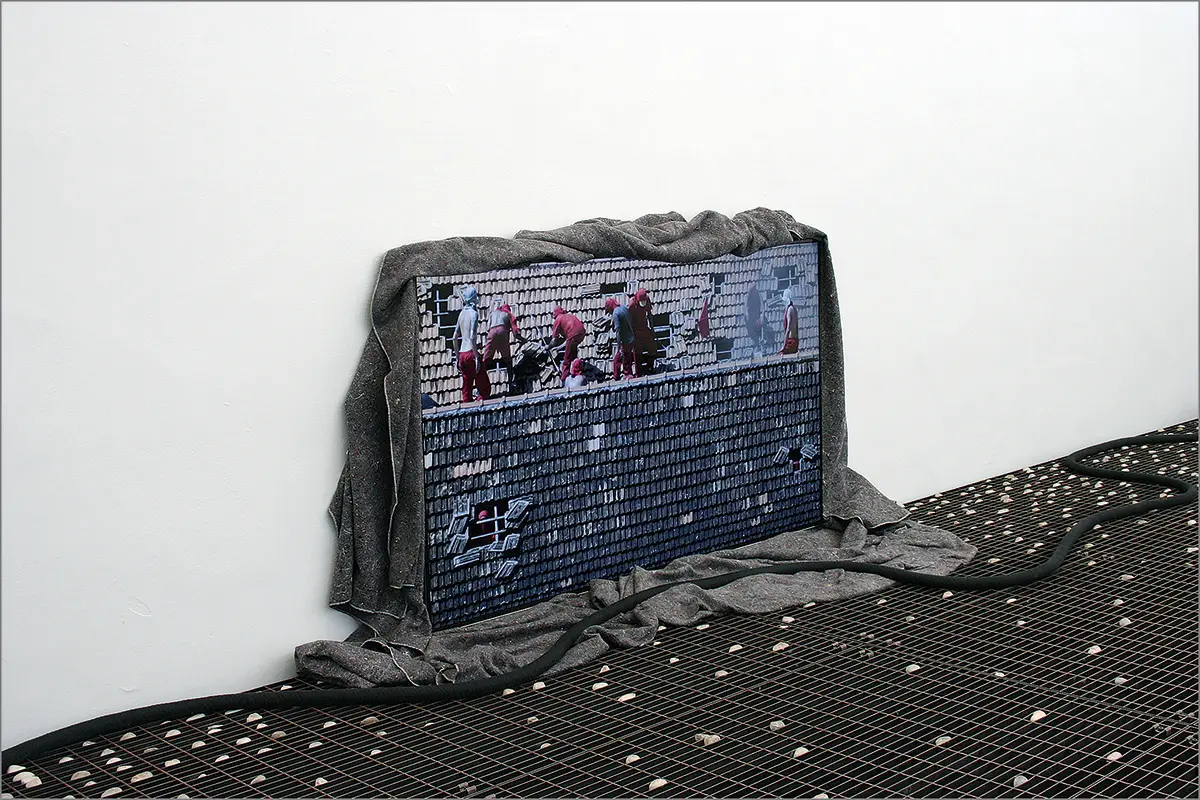
For me, the highlights among the national pavilions at the Giardini were, in the first place, Germany’s, France’s, and Russia’s. Germany’s, for the way the ephemeral steel and glass architecture of steel that covered its interior, intensified the sadistic coldness of the performances with which Anne Imhof obtained for it the Biennale’s best pavilion prize. France’s, for l'esprit de la géométrie with which Xavier Veilhan appropriated a chaotic merzbau by Kurt Schwitters in order to transform the pavilion into an auditorium at the disposal of professionals who interpret music inside it for the duration of the Biennale. Russia’s, for the forcefulness with which it staged an interpretation of the Theatrum Orbis—the world map published in Antwerp at the time of the Europeans’ discovery of the Americas—by Grisha Bruskin, Recycle Group, and Sasha Pirogova.
Other relevant pavilions are Israel’s, the stage for a complex and desolate spatial intervention by Gai Weinstein, titled Sun Stand Still. Korea’s, where an equally polyhedral spatial intervention by Cody Choi and Lee Wan prompts an ironic reading of the appropriation of US pop culture in Asian countries. And US’s, a concatenation of paintings in an expanded field where Mark Bradford intends to narrate a certain history of his country, using his own story to that effect.
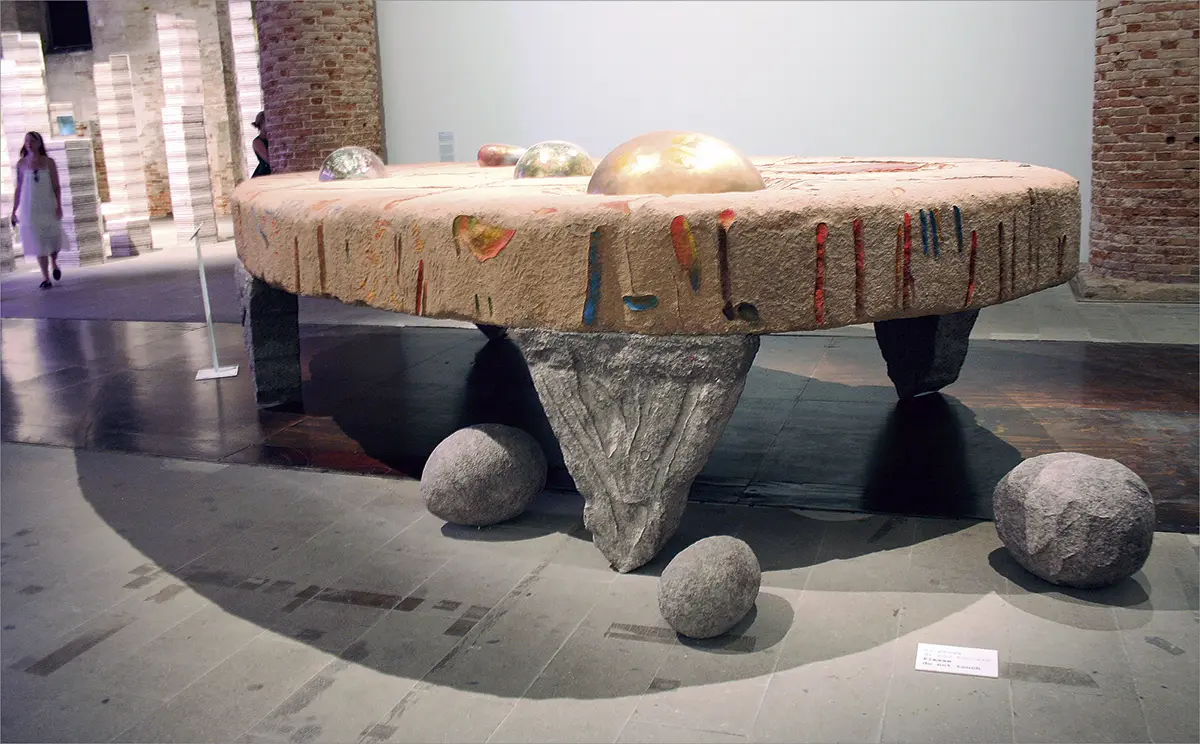
The Brazilian Pavilion features an installation by Cinthia Marcelle, Chao de caça (Hunting Grounds), dominated by the metallic mesh netting that tilts and covers the galleries’ floor. In the Uruguayan pavilion, Mario Sagradelli presented an installation that is a sarcastic comment on Ley del embudo (Law of the Funnel). And the Venezuelan Pavilion was devoted to an exhibition of representative works by Juan Calzadilla, titled Formas escapándose del marco (Shapes Escaping From the Frame).
At the Arsenale, the most impressive national pavilion, for its size, ambition, and composition, is China’s. The most disquieting, Georgia’s: a 1:1 reproduction of what could be Stalin’s birth home, inside of which rain fell down ceaselessly. And the most challenging, The Philippines’, dominated by Manuel Ocampo’s irreverent large-format paintings, accompanied by Lani Maestro’s keen essays.
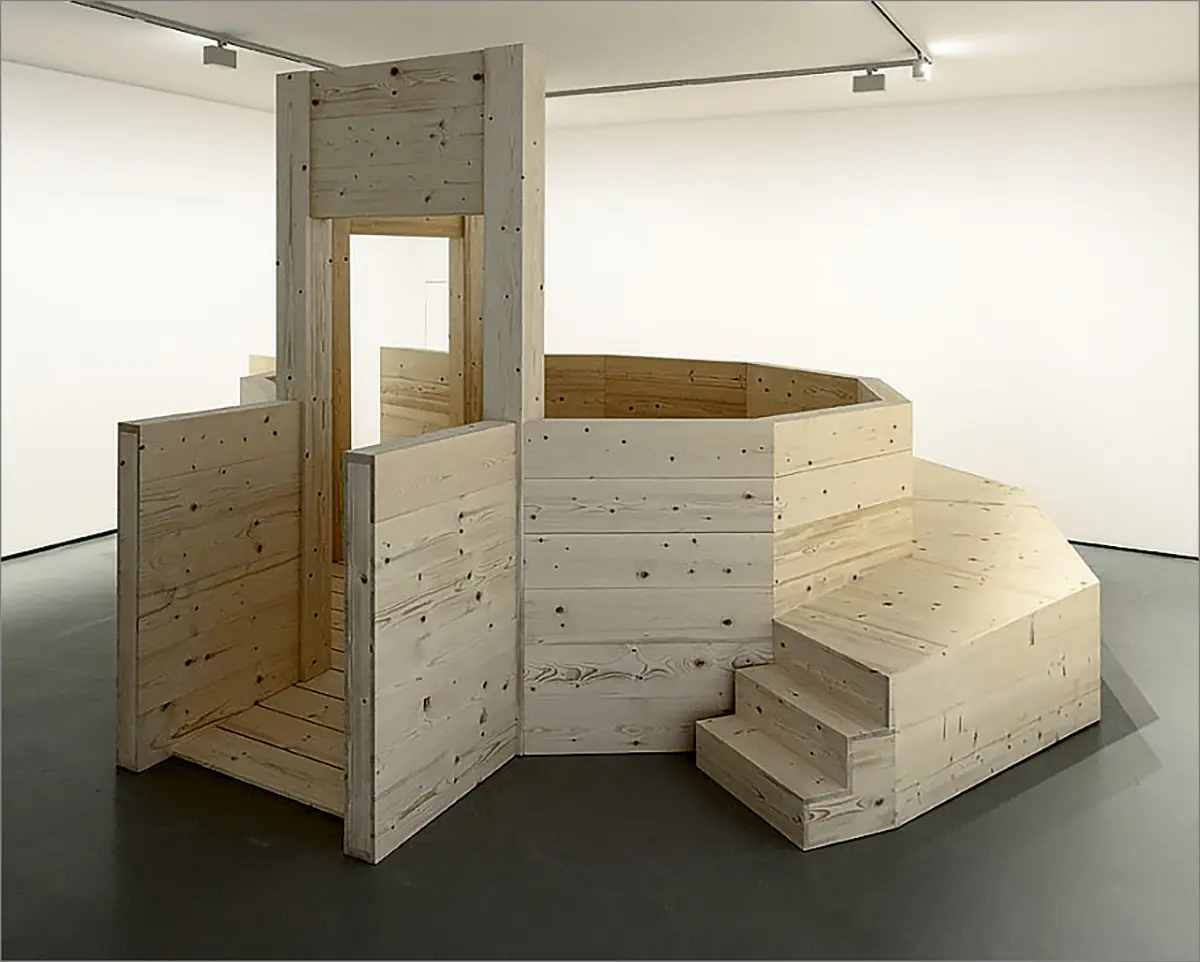
Meanwhile, in the Argentina pavilion, Claudia Fontes presented El problema del caballo (Horse Problem), a sculpture installation in which a life-size female figure confronts a large bucking horse suspended in the air. The scene, all in white, is complemented by a teenager sitting down on the floor and a series of suspended rocks. Fontes’ intention is to deconstruct the figure of the gaucho, part of Argentina’s foundational myth. The word Werken names a key figure in Mapuche culture, who uses masks to interpret words, and is also the title of Bernardo Oyarzún’s installation in the Chilean pavilion, which stages just such interpretation using a series of masks and an LED projection of 6906 Mapuche nicknames. In the Mexican Pavilion, Carlos Amorales exhibits a new period in his project of providing art with an (in)comprehensible language.
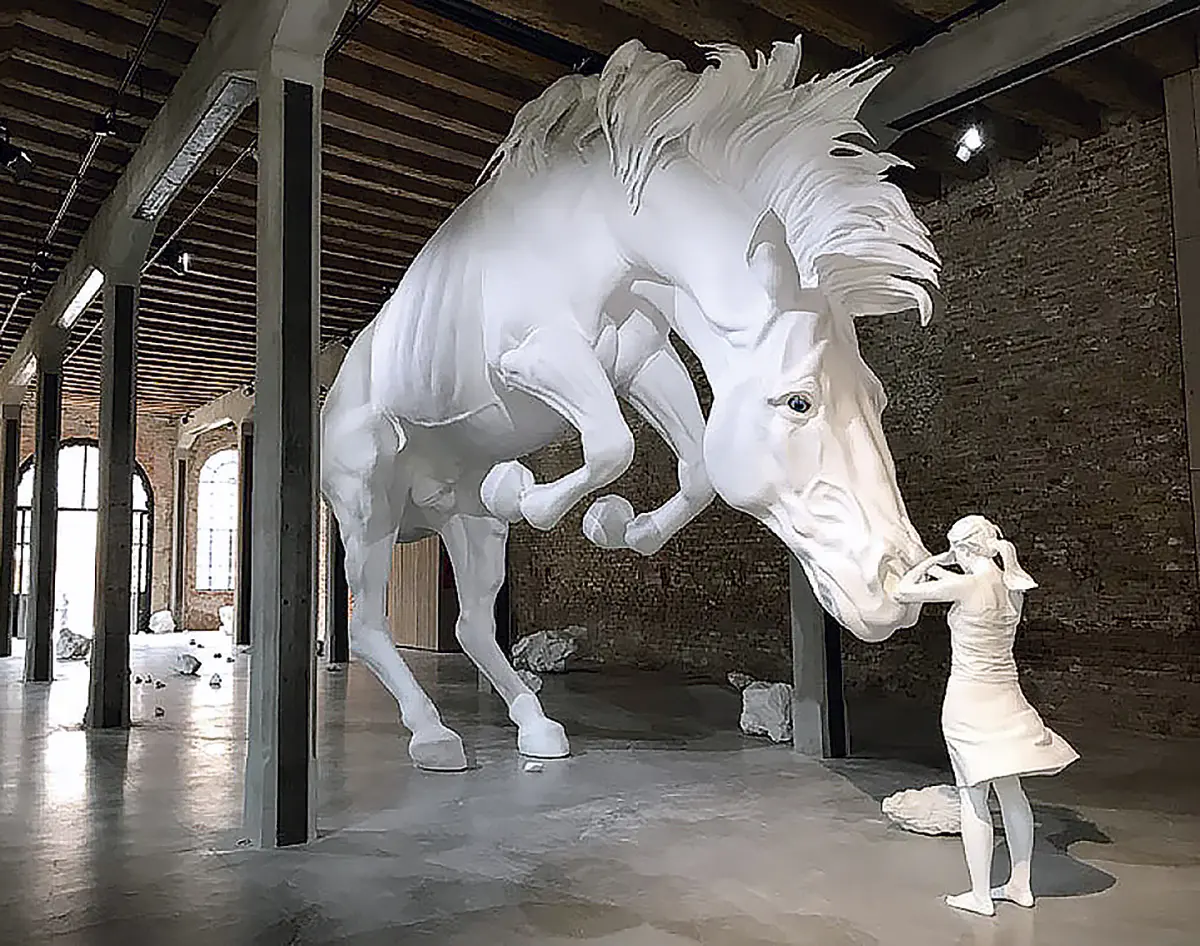
The Bolivian, Guatemalan, and Peruvian pavilions are located in different sites in Venice. As is Cuba’s, Tiempo de la intuición (The Time of Intuition), which brings together the work of 14 artists, among them Roberto Fabelo, Aimée García, Meira & Toirac, and Wilfredo Prieto.
* Photos: Celia Sredni de Birbragher.
CARLOS JIMÉNEZ
Essayist and art critic. Professor of aesthetics.