
The exhibition titled Elemental Fibers by Verónica González (Santiago, Chile, 1973) at the Galería Artespacio includes works created in the last two years. The variety of formats is immediately evident in the formal, colorful, and textured results. Nonetheless, the group of works—around twenty pieces—is pretty cohesive and does not feel incoherent. On the contrary, the show successfully conveys the extraordinary technical mastery and inventiveness of the Chilean artist (Santiago, 1973) trained at the Art Department of the Pontificia Universidad Católica de Chile where she majored in Engraving and Esthetics.
Verónica González works from a figurative language inspired by nature. Not nature in the landscape or a general sense of the word. She resorts to elements from nature like leaves, feathers, flowers, birds, corals, and small branches. Her approach to botany or zoology is reminiscent of the one employed by the naturalists from the Illustration: an inquisitive gaze capable of dissecting, and then artistically representing, the natural forms that interest her. She recreates what she observes and collects—as the tireless collector that she is, she has “an enormous catalog of natural forms” at her disposal that are the primary forms she uses in her work.
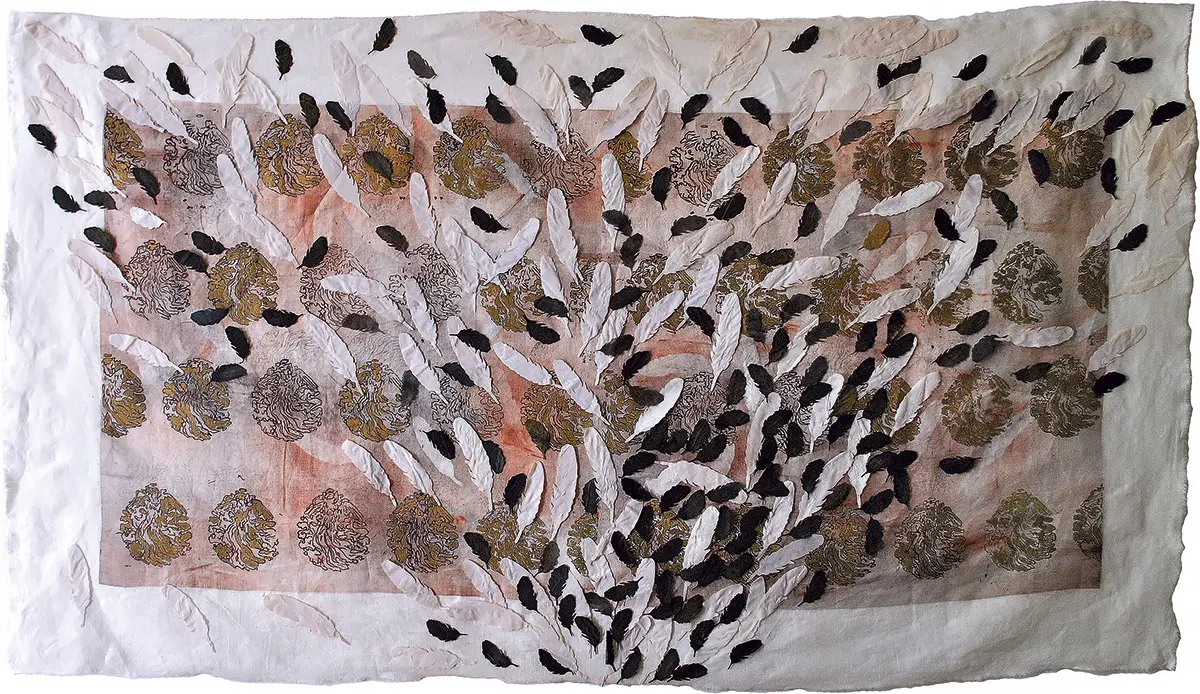
Seven large works share in common the forms of several types of feathers. Long, short, straight, and curved, these feather shapes are created through an innovative and very untraditional engraving technique involving the use of silk veils, strengthened with thin paper, to print her images. She intercalates and glues together two pieces of silk cloth with one piece of paper. The resulting veils are then stamped with the selected patterns using a laser cutter. Hundreds, even thousands of feather shapes or leaf shapes are created with the strengthened silk cloth. Some are dyed in low-density acrylic solutions. Once dried, the sheets must be individually pressed with a domestic iron. They are then glued and sewn, applying a nearly invisible stitch, to the supports previously worked through a wide range of engraving techniques. These supports include silks, linen, and other printed cloths. The very light works that result are placed (stretched or otherwise) on frameless white stretchers and displayed on the wall. The shapes may be arranged on the background surface in a dispersed manner, like in the piece titled Viento negro desde el este (Black Wind from the East, 2016), or may also be laid out as continuous texturized surfaces that blend together, like in Movimiento (Movement, 2016), a large white and ochre disk measuring 1.20 meters in diameter.
The series titled Botany is divided into two sections: One, titled like the series and created in 2016, from which three pieces were exhibited and that represent the more traditionally executed engravings in this current exhibition. Very light vegetable elements engraved on linen complemented by the almost invisible white feathers on the surface of the work. Here “botany” is not alluded to in the scientific sense of the term. The images of these engravings are artifices. They have an overtly archaic appearance that resembles herbariums. Nearly colorless vertical images placed on the center of their supports. They project calm, a tranquil beauty that must be found through careful observation. The exhibition as a whole requires viewers to approach the pieces with deliberate, careful, observation. None of the works are overt; they must be literally unveiled.
The second section consists of the so-called Japanese Botany works, very pale silks mounted on white stretched linen, with round or oval shapes sewn on them and rendered with engraving matrices and several inks. These applied engravings appear to be floating in an undefined space. Their treatment is effectively reminiscent of ancient, engraved or embroidered, Japanese fabrics. They are like small windows into an imaginary world, objects that float on the surface on which they are distributed; planimetric works that suggest a spatiality that is impossible to ignore.
The two Pajareros or Birds Cages are also works of large dimensions. By relying on engraving, cutouts, and embroideries on silk and linen, González composes serial work with forms that multiply in ordered lines across the surface of the supporting linen. Every form is reminiscent of a bird cage’s outline. Every element is worked on individually, both in terms of engraving and color. The airy engravings reveal the silhouettes of some birds or of barely insinuated botanical elements.
Three works of smaller dimensions engraved and embroidered on linen allude to strange fantasies about birds. Here, rather than mere support for the work, the stitching is rendered as if it had been drawn. The printed part comes from the copper manipulated with great liberty. Verónica González’s use of matrices has little to do with the traditional count of an engraving on metal. She uses them in their entirety or semi-blocked, with less or more ink, and in different positions. In this manner, the matrices are maximized through infinite combinations; the images obtained appear and disappear like Chinese shadows. While there are engravings, they are not expressly faxed copies.
Left to discuss are the three-dimensional pieces representing the most recent explorations by González: the Elementary and Experimental series. Using leftover silk pieces, perforated clothes with identical cuts on their surface, Verónica González constructs very light suggestive volumes similar to honeycomb structures, but looser. According to González, it is a work in progress. Although fascinating, it is true that they still lack the density and weight of her other works. Always concentrated on her most meticulous productions and presentations, the multifaceted engraver will just get better with time. This current exhibition is another decisive step forward in her already very solid artistic trajectory.
MARÍA ELVIRA IRIARTE