
Venezuelan artist Vicente Antonorsi (Caracas, 1952) has articulated an innovative discourse through the handling of materials, the construction of spaces, and the integration of several disciplines that have influenced his education. The result is a clean and multilayered work that allows viewers to inhabit the space from unexpected angles. The exhibition Angulars places his artistic career at a point of full maturity and achieved goals. The show encapsulates his research and concerns, his inquiries, and his journeys. It is a clean and well-defined path marked by a simple approach that achieves complex readings.
In Bogota, Colombia, Antonorsi earned an architecture degree from the Universidad de Los Andes (UNIANDES), studied Textile Design, also in that university, and Graphic Design at the Universidad Jorge Tadeo Lozano (UTADEO), which allowed him to develop relationships with teachers like Carlos Rojas and Olga de Amaral.
Once back in Venezuela, during the 1980s he worked as an architect and furniture designer, which helped him widen the range of materials used in his artistic explorations. In 1994, he incorporated the use of bahareque in his work, a material with interwoven vegetable fibers that helped him create compositions with effects and textures full of rhythms, colors, and contrasts that emphasized the symmetry and asymmetry of the sculptures. In 1999, Antonorsi incorporated the use of industrial wood in highly refined productions that made him one of the artists that challenged the dominant currents of contemporary art in Venezuela. From then on, his work enriched the evolving landscape of alternative ways of understanding geometry, focusing on basic forms like the cube—which he unfolded and flattened—but, above all, generating virtual spaces, drawings rendered with light, and traces made of air.
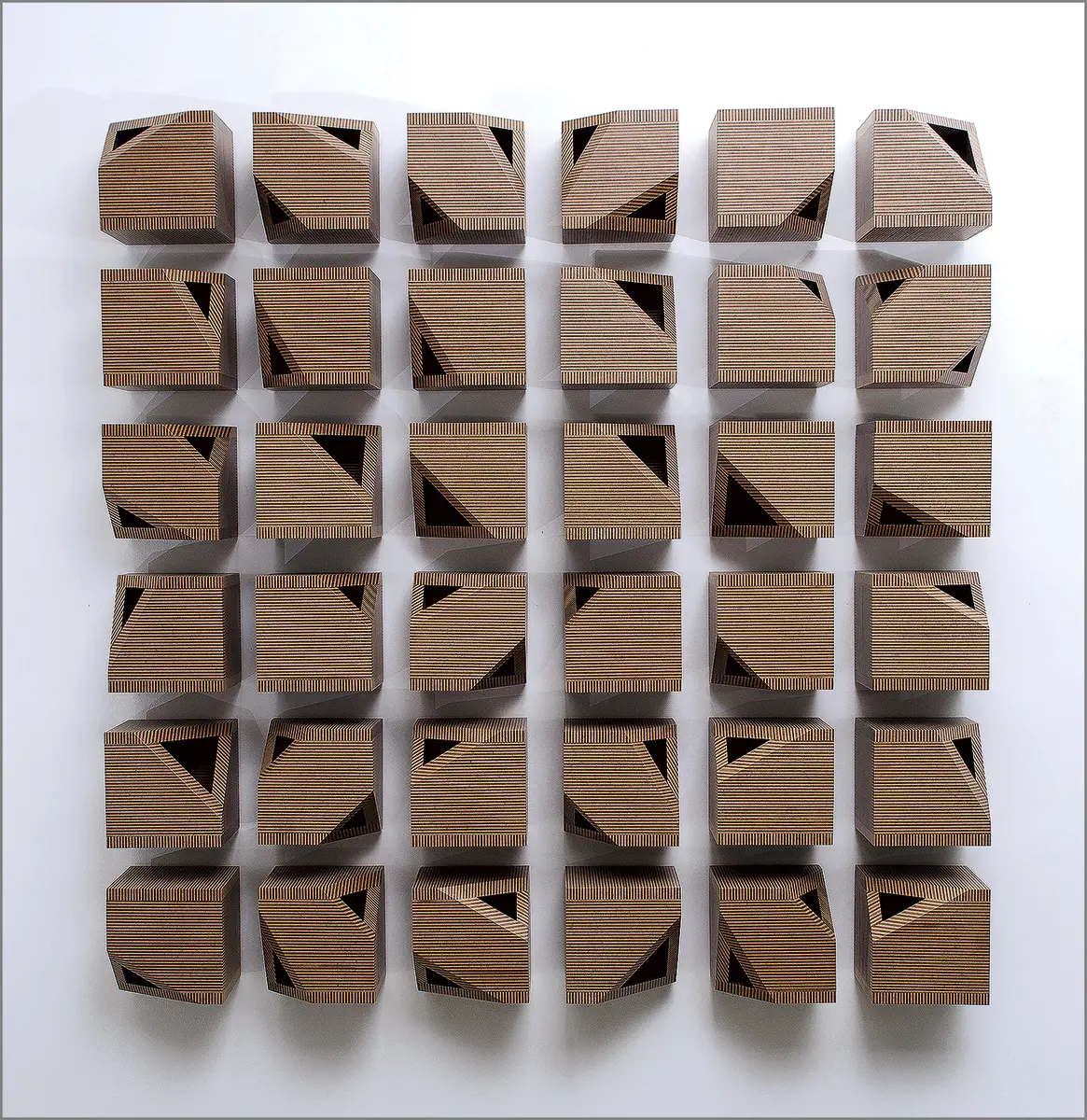
Angulars reinforces the intersection of relationships and convergences between sculpture and architecture, art and handcraft, as well as in the treatment of matter and in the various definitions of geometry. Fourteen large-scale works serve as territory for reflection that considers the incidences and influences of Antonorsi’s teachers in pieces that are at once architectures, ancestral weaves, and habitable spaces that showcase an absolute mastery of proportions. Structurally, there is a predominance of triangles and pyramids obtained from the meticulous segmentation of cubes and parallelepipeds, or from the extension of and intersections of lines over rectangles.
The transdisciplinary approach can be appreciated in the conceptualization of the space, where architectural thought (after all, an architect is a thinker of the space) and ancestral references converge in the artisanal weave. Hexaedros Perforados (Perforated Hexahedrons) and Dinteles Magníficos I and II (Magnificent Lintels I and II) reveal the manner in which Antonorsi builds his volumes layer after layer on wood or cardboard. It is during this process when the superimposition of textures and visual qualities are woven, where the vitality of the organic mantles and surfaces by Olga de Amaral is echoed; where weaves are used as metaphors in works rendered with striped writings, subtle colors, and well-defined lines—fashioned out of cut metal sheets and placed one on top of another.
The architectural basis of the sculptures is reflected in the titles—with words like lintels, columns, beams, and constructions—but also by broadening the concept of space displayed in the exhibition area: the sculptures are arranged both in the actual space and across an imaginary one. And Antonorsi appears to be equally working with both in order to explore the possibilities of the three-dimensional object.
His works are structures that not only inhabit the space in which they are placed but also expand it. Triangles are at once tangible and intangible, real and virtual, made of matter but also of lights and shadows that emerge from the emptiness produced by the diagonal cuts on the materials. A final result is a group of independent sculptures that are also part of an integral habitable system formed by the vectors, intersections, and connections established between all the works. It is also a totemic space that invokes rituals and the old and organic geometry created by the pioneers of abstraction in Latin America. Geometry organizes but also takes us into the territory of the unknown. This can be observed in the Columnas angulares (Angular Columns, 2016), with their serrated profiles, which reconfigure the internal circulation space of the works.
Antonorsi’s approach to the space favors dynamic tensions and the movement of volumes: in Construcciones en piedra dorada (Golden Stone Constructions, 2016) and Tiedros sobre plano (Trihedrons over Plane, 2016) forms to multiply, each module appears to detach from its predecessor and overflow with movements, rotations, rhythmic accents, and unexpected directions.
In search of simplicity and the primal, Antonorsi success in integrating support, space, and matter in his work through a single process: simplification on behalf of proposals that become complex spaces of relationships that multiply the angles of perception and enrich our awareness. These austere volumes in naked and deliberate spaces were conceived more as pathways to establish connections, as open systems of relationships, transitory destinations in which to momentarily rest. They define Vicente Antonorsi’s contribution to the understanding of contemporary artistic creation.
MARÍA LUZ CÁRDENAS