
“Let my poem be neither taboo, nor totem.” This phrase, a quote from Vicente do Rego Monteiro’s poem Meu poema, greets visitors into the gallery and gives this solo retrospective its title. Originally written in French, the poem provides a good clue to the restless personality of an artist often described as difficult, arrogant, and even intractable. Whatever the case, he was also a prolific painter, and Almeida e Dale presents a selection of works spanning the different periods of his career, complemented with works by Vicente’s siblings Joaquim do Rego Monteiro and Fedora do Rego Monteiro, little known to the wider public. Most of the works on exhibit belong to private collections.
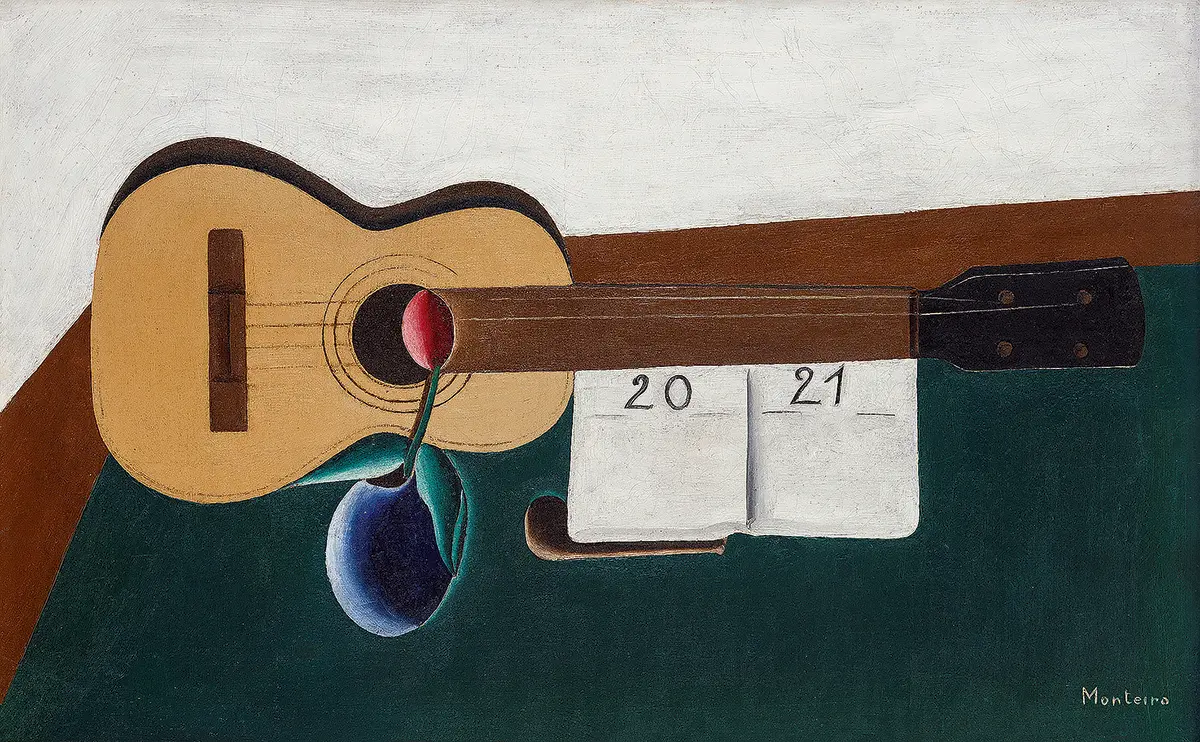
A modern artist who followed a unique path and was, perhaps because of this, less celebrated than his contemporaries in the Modernist movement, Rego Monteiro moved through a variety of styles and experimented with different techniques throughout his career in poetry and the visual arts. His life alternated between Paris and Recife, and he divided his time between painting, sculpture, poetry, and book publishing. Born to a seriously artistic family (of his siblings, Fedora and Joaquim became painters; Débora, a writer), Vicente Rego Monteiro began to learn the art of sculpture at an early age, not yet 13, in Paris, where his family had relocated in support of Fedora’s studies. This early foray into sculpture left an indelible mark on his way of painting. His best-known figures eschew the two-dimensionality of the canvas; on the contrary, we find in his process and emphasis on volumetry coexisting with compositions that are particularly economical in terms both of outlines and of colors. In the vast majority of his works, Rego Monteiro remained within a more or less luminous yet always opaque and dense range of ochres, rusts, and grays. These colors allude to the materiality of the Earth and are present in the universe of indigenous peoples, so dear to the painter’s imagination. His O Atirador de Arco (The Archer) illustrates these preferences: as is common in Rego Monteiro’s work, this is a rather large canvas (108 x 137 cm), split into two main mirroring sections, each depicting a standing indigenous man in profile whose arms emphasize the curve of the bow arranged in front of him. At the center, upside down, the title character prepares to discharge his weapon. The figures are schematic, made with just a few lines, and they share a common rotundity. It is interesting to note that the representation of indigenous individuals in Rego Monteiro seems to have Eastern elements as a point of reference. The face of the central figure reminds us of many representations of the Buddha, while the background characters follow almost faithfully the precepts of Ancient Egyptian painting: forward-facing torso, head, and limbs in profile. As he adopted different styles, the artist always retained his almost complete disdain for backgrounds; at best there is a shadow or—in his cubist period—a division of the plane, but the dominance of the central plane is evident. Even in that cubist period, the fragmentation of space does not unfold into different planes, as in Picasso or Braque, but rather splits a single plane into different sections that sometimes intercut one another discreetly, as we see in Mulher diante do espelho (Woman Facing a Mirror). Rego Monteiro also experimented with compositions based on a surrealist matrix, like Arlequim e o bandolim (Harlequin and Mandolin) and Uma bela na noite (A Beauty in the Night), where his treatment of the background approaches the sensation of insufficient air that characterizes metaphysical painting. It is said that Rego Monteiro often revisited older paintings and even changed their dates; this is why the labels in this exhibition at Almeida e Dale include no dates, leaving viewers only with those that appear in the works themselves.
Vicente do Rego Monteiro’s life had many ups and downs, likely derived from his complex personality. His relationship with the Modernist group was turbulent; a participant in the Week of Modern Art at the Municipal Theater in 1922, he nevertheless refused Oswald de Andrade’s invitation to join the Antropófago Movement in 1928, arguing that he had in fact been the precursor of “anthropophagy”. In 1930 he was the first to bring to Brazil works by the School of Paris, but to this day little is known about that initiative. A Government-supported exhibition of works in the same style, the Exhibition of French Art, held ten years later, is often given that landmark status. In the 1940s, Rego Monteiro devoted himself to poetry; after abandoning it he received the Guillaume Apollinaire Prize. In his older years, he painted compulsively and not altogether brilliantly, but it was in that period that the value of his work gained wide recognition. Rego Monteiro was a painter, poet, cultural promoter, sculptor, and even a maker of cachaça (Brazilian sugarcane-based firewater). Interestingly, in every one of his artistic endeavors accolades came to him only after he had moved on from that specific practice. In an ironic twist of fate, his oeuvre was never taboo, nor totem.
SYLVIA WERNECK