
With the exhibition titled The Water Trilogy 1: Ichárhuta: Autodefensión Approximante Vibrante Retroflexe Mexican artist Abraham Cruzvillegas pays a heartfelt homage to the natural, cultural and historic heritage of the Mexican state of Michoacán.
In two spaces of the Galeríe Chantal Crousel, in the city of Paris, Cruzvillegas installed a group of proposals centered on the serious issue of pollution and the degradation of the town’s main driving force and center: Lake Pátzcuaro. It is an issue that has caused the disappearance of local species and the end of several cultural practices like traditional fishing, a longstanding practice in this community since time immemorial.
With his characteristic adherence to synthesis and the collection and recontextualization of diverse elements, Abraham Cruz Villegas establishes a grammar charged with new connotations as he warns us about the imminent loss of the main natural and cultural values in the state of Michoacán, a “place of fishermen,” according to Nahuatl etymology. Michoacán was the name that the Aztecs and Mexicans gave to this fertile territory in Western Mexico, where majestic lakes were once surrounded by dense pine forests.
By relying on different icons historically associated with fishing and life around the lake, Cruzvillegas underscores the profound denunciation and clamor for the recovery of lost values.
Several audiovisual installations rely on music as an accurate vehicle to express, in falsetto and with improvised coplas and violins, a compelling message performed by a traditional Huasteco trio. A desperate song, sang by an Ambystoma dumerilii (known as achoque or axolotl) about to be devoured by a white fish, narrates the imminent extinction of life in the lake. Both are endemic and, unfortunately, endangered species that only live in Lake Pátzcuaro.
A staple of the local culture, the Chirostoma estor or white fish (also known as michín) hoists the glyph of Michoacán at the top of a green hill. Unfortunately, the white fish that for centuries fed the communities established in the region has been replaced by exotic species introduced in the lake, dramatically altering its natural equilibrium.
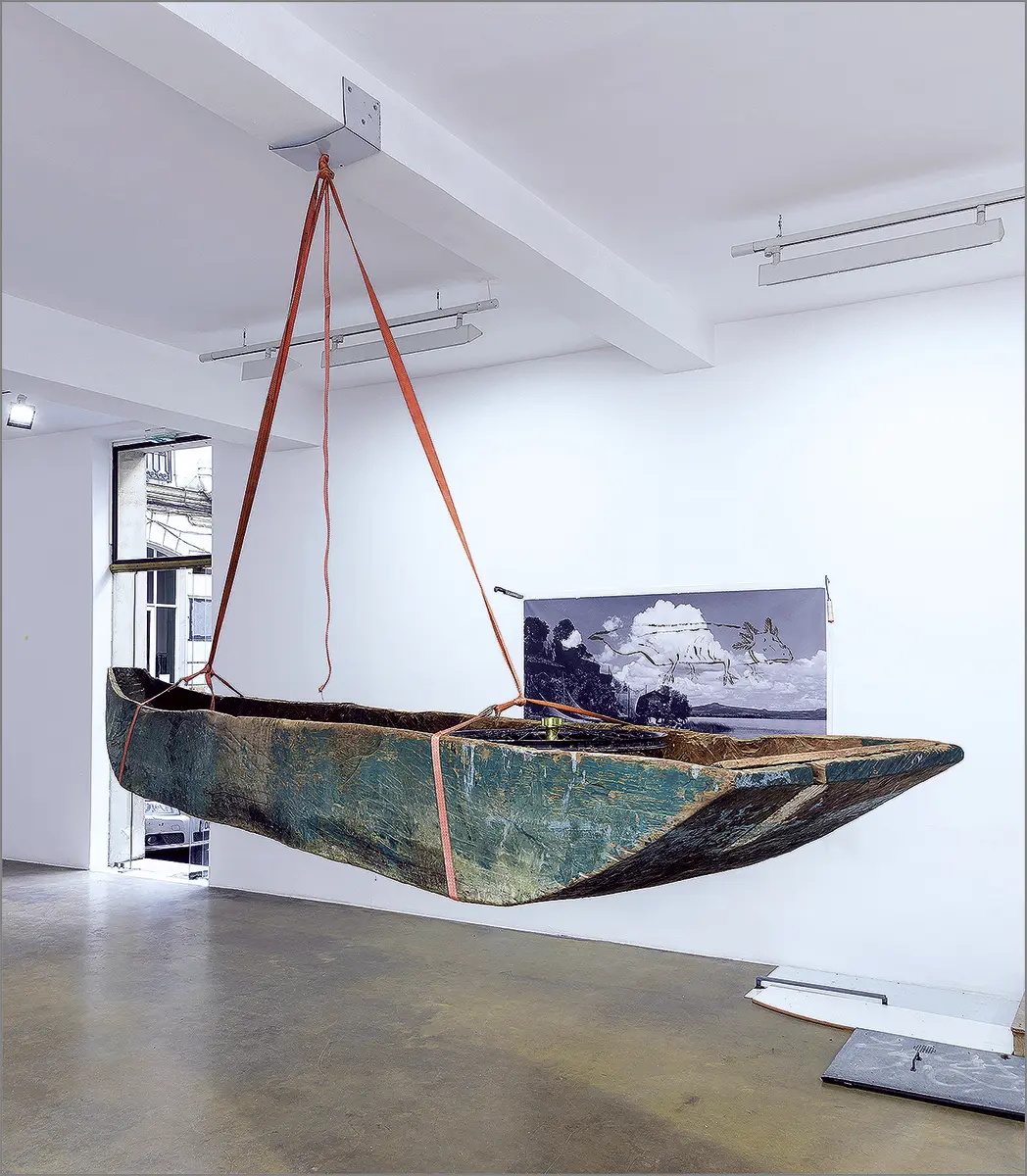
Cruzvillegas puts into orbit the cultural universe of Michoacán around the exhibition’s central piece: Ichárhuta atonal en cientotreyntaidosavos de tono (para Luis González y González) [Ichárhuta Atonal in a Onehundredthirtysecond Tone (for Luis González y González) 2017], a canoe specially used for fishing carved from a single block of pinewood. This watercraft is suspended in the air 49 meters (160.7 feet) high from the floor of the exhibition room, a number that corresponds to the shocking amount of mass that the lake has lost in little more than a decade.
Cruzvillegas declares his intention of shedding light on the effects of human activity on the environment and the manner in which such activity generates palpable and highly symbolic content. He emphasizes the delicate natural balance that can be literally left hanging in the air when no appropriate actions are taken and no efforts are made to generate awareness.
Located at high altitudes, Lake Pátzcuaro is home to an important settlement of archaeological, natural, and cultural remains. Its degradation is the direct result of global warming, the deforestation of neighboring forests and a population increase in the area, in combination with high levels of pollution, which not only negatively affects the local life but also its traditions.
Abraham Cruzvillegas proposes a reconstruction with the remnants that once made this region great: dances, rituals, the dynamics of community collaboration, and, above all, fishing—the activity from which the term Michoacán and the demonym michoacanos originate—is practiced with the emblematic butterfly-shaped nets called guaromútacuas. This practice is reproduced on the enlarged copy of a fifty-pesos bill that is part of the exhibition and that also serves as a fantastic exhibition room sheet.
Fishing nets and gear are displayed across the gallery space to convey the fragility that their existence represents.
Black and white postcards—memory fragments—of the overexploited region are displayed on the walls and kept in place with a machete and a sickle. They are intervened with drawings of the peculiar salamander that has also been condemned to extinction.
Lastly, Cruzvillegas echoes a particular situation that is sadly replicated in several other lakes and rivers whose waters embody the tragedy of environmental degradation. To right this wrong it is necessary to be self-motivated and become aware: we are all responsible when it comes to defending what is ours.
The Water Trilogy 1: Ichárhuta: Autodefensión Approximate Vibrante Retroflexe is the first part of an exhibition trilogy. The second part was presented at the Fondation d’entreprise Hermès, in Tokyo (April 2017), and the third one will be exhibited at the Museum Boijmans Van Beuningen, in Rotterdam (October 2017).
ELISA RODRÍGUEZ CAMPO