
Before delving into the exhibition Blind Spots, it is necessary to remember a couple of artistic experiences from 20th-century art that may help us better appreciate the interstices or narrow openings that are present throughout the show. They are like those cracks letting almost inaudible whispers into space to allow for the inference of stories that range from the material to the ethereal. They are like strainers whose fine orifices let through beams of light that blinds the viewer when his/her gaze rests on them. This work brings to mind, on the one hand, the artistic production by Henry Moore, the prominent English modern artist deeply invested in the study of sculptural forms. A visionary of positive and negative spaces, Moore masterfully conveyed in his work the mental constructs involved in perceiving any space, as his sculptures play with the viewer’s body and its multiple ways of perceiving reality. Likewise, we must also remember the bandaged knife, a reflection by German artist Joseph Beuys that involved turning the gaze towards the weapon rather than towards the wound inflicted by the sharp edge of the knife. Beuys advocated a substantial change in the way we relate to the body, objects, healing, and the political environment. Wounds can heal, but to avoid having to heal them all together it is essential to first heal the weapons. These two referents from the history of art are important to have in mind when approaching the two Colombian artists whose works complement each other in this exhibition organized by the Beta Galería. The show is constantly debating desire, incompleteness, questioning space and form, and proposing new ways of seeing and perceiving reality while generating doubts about what is being observed.
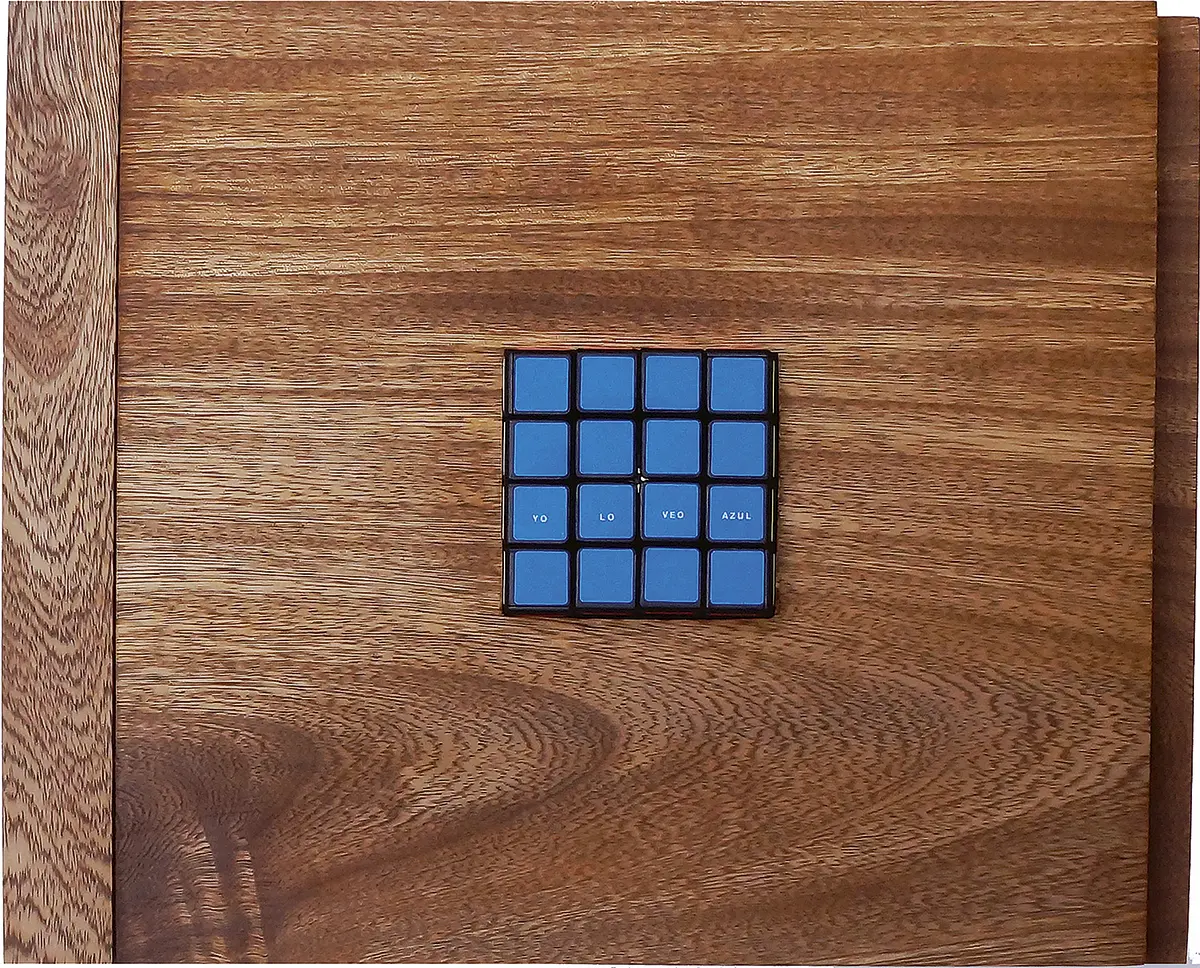
Adriana Ramírez proposes something like a series of contradictions about the aesthetic experience. Her gaze is centered on the doubts that stem from a phenomenological approach to perception. Do we all see the same thing when we observe something in particular? Do we all understand and experience the world in the same manner? How can we know what truth is when it has been fragmented in a thousand gazes and in a thousand experiences? Some of Ramírez’s works explore these questions by proposing simple but compelling games to viewers about the way we perceive reality. In these games, we find something similar to what we see when, for instance, we look at a postcard: two ways of narrating an experience; an image, and a text that can never be observed at the same time. While Ramírez’s work reveals a part of the reality of an object, we feel as if another part remains hidden from us. Thus, we are always before the abyss of the incomplete, we can never grasp the entire truth or reality of the things presented to us in this world. Or, to use Henry Moore’s work as an example, to discover new forms, new worlds and new realities depends on how we focus the gaze and the angle from which we observe.
Therefore, it is essential to carefully observe the simple horizon created by Ramírez with a few river rocks. Stones that have been rounded and shaped for hundreds of years by a river reveal lines drawn on their layers that collectively render a long horizontal line. Although they do not “know” one another, in this jigsaw puzzle the rocks are used to build a landscape. Thus, in that given moment, small instant, the lapse of time in which one pauses to observe something as simple in appearance as a stone; in that precise moment, a stone stops being a stone, ceases to be what it is supposed to be, in order to become an essential piece of the universe. Adriana Ramírez places us in limbo halfway between certainty and supposition.
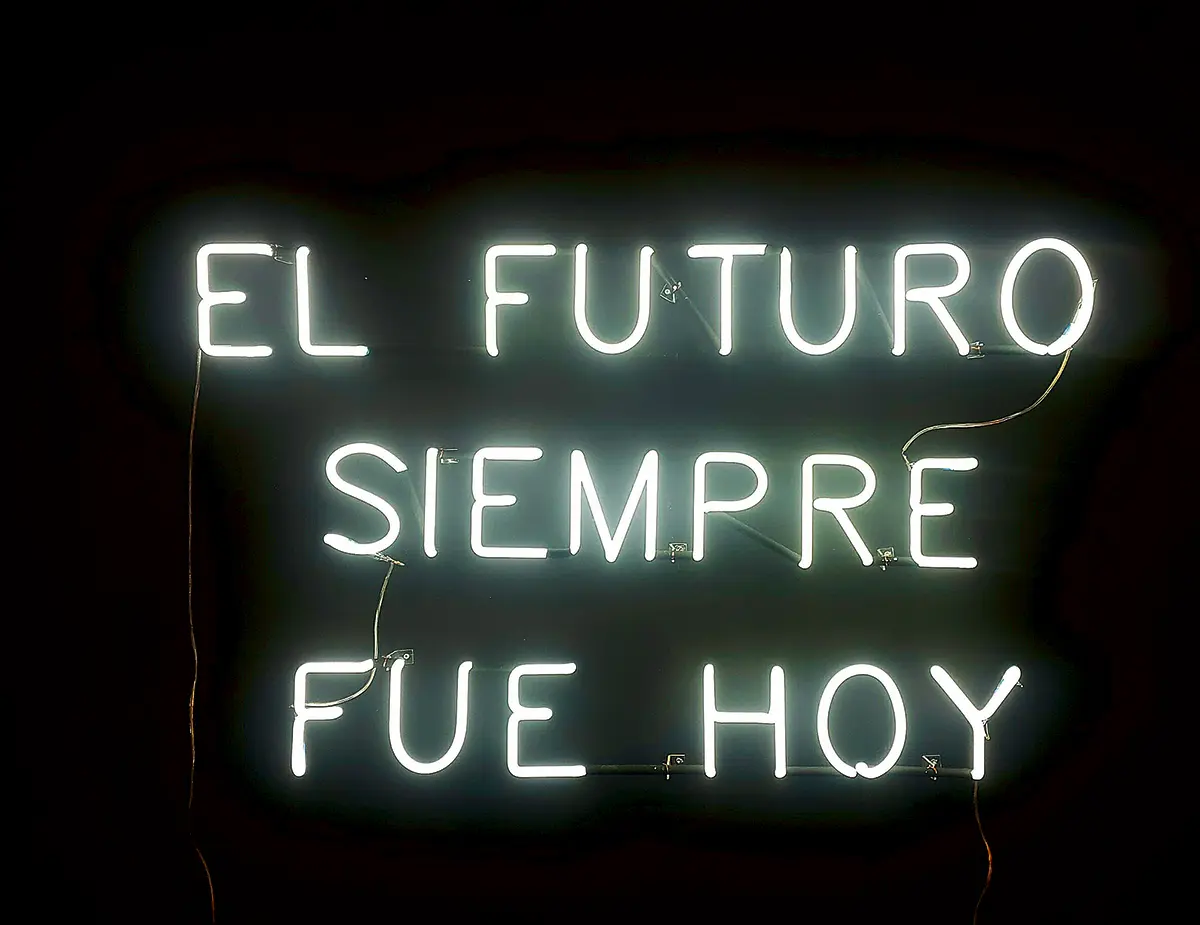
For his part, Guillermo Marconi proposes uncertain spaces that promote infinite and time revealing abysses that expose us to a different way of perceiving the passing of time. Is it through words, through gestures, through a mirror box? The game played here with time and its avatars is evident. Marconi immerses us in contradictions through works like El futuro siempre fue hoy (The Future was Always Today) and contrasts them with several boxes in which he has created small worlds that go back to another time with the help of mirrors. They are undoubtedly mirages of reality. When will that future, so often discussed everywhere, finally arrive? Or is this which I see today, here and now, something that comes from before or that will occur later? It is a curious way to invite us to live our present as an absolute present and not as a fake construction plagued with uncertain futures.
Marconi and Ramírez join forces to poetically dissolve truths into abysses. It is not only a matter of positive spaces but also of negative ones; it is not only the wound but also the entire soul that we must heal. It is not only about what we can observe, but also about everything else yet to be learned. Through different approaches, both artists question the truth that is sold in the market, built in the classrooms, promoted in the media, and framed within a small and homogeneous package.
ANDRÉS GAITÁN