
On the third floor of the Espacio Odeón, Colombian artist Alberto Baraya (Bogota, 1968) created an installation consisting of nine grand pianos and forty landscape paintings. All these elements generated a spatial intervention of the entire exhibition room while the layout proposed a direct interaction with the public. This type of interaction proposed by Comparative Landscape Studies, the show’s title, depended upon the active participation of viewers to reach its full meaning.
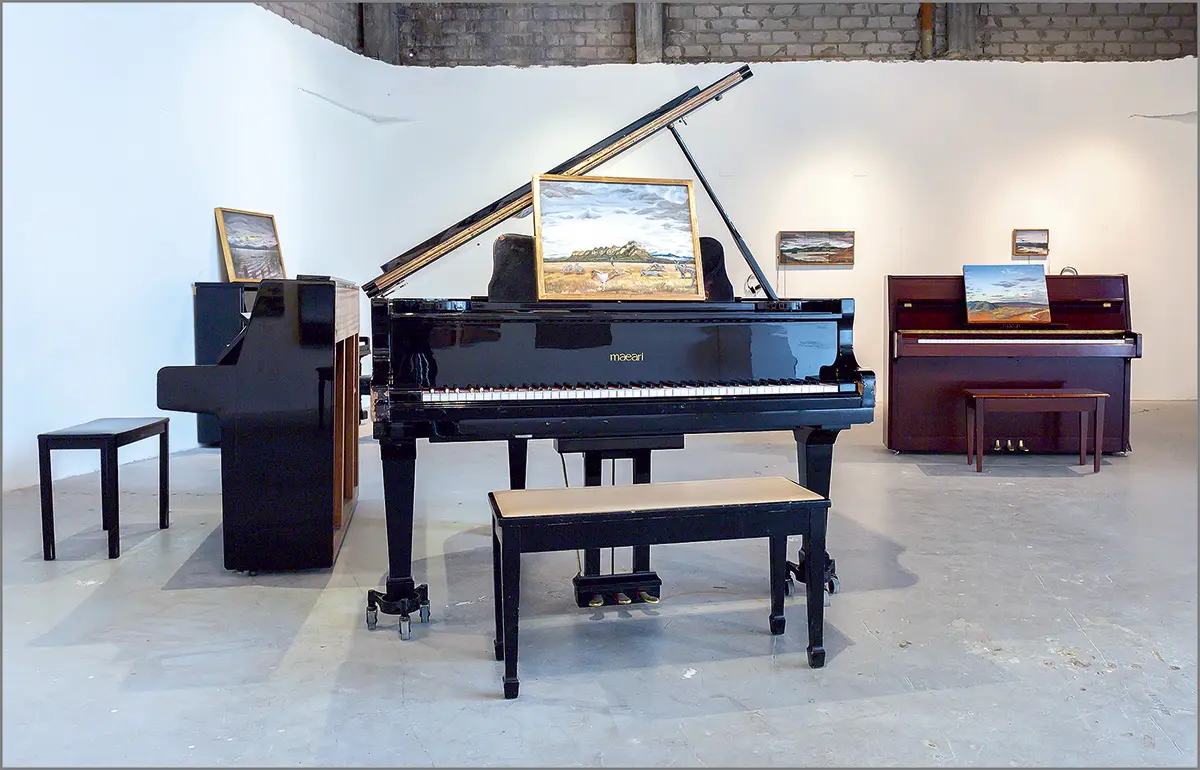
Every person visiting the exhibition was invited to take a painting down from the wall, bring it to one of the pianos, place it where the sheet music would go, and then “perform” the image in the instrument’s register, playing the black and white keys in any manner the visitor wished. By removing the landscape paintings from the wall, viewers were able to observe the vacated spaces left behind them thanks to the painted grey rectangles that, like shadows, covered the same surface on the wall.
Landscape paintings are often interpreted from at least two perspectives. On the one hand, by considering the subject approached in connection to specific geographical coordinates, which in turn are associated with the social practices that have defined the way in which that part of the world is evaluated. In this sense, the landscape can be regarded as a structural part of the cultural construction of nature. This perspective implies the existence of heterogeneity of latent places within the landscape as a genre.
But there is another point of view to consider when approaching the landscape. It is the very one that led Baraya to decide that that part of the world offered good reasons for becoming a subject in landscape painting: its coordinates offer a continuum of formal and conceptual characteristics that are present in every landscape. As pointed out by many authors, landscape painting is a pictorial genre that appears to anticipate the encounter of such type of scenes in reality: So much so that some people have even suggested that every landscape in the world is the copy of a previously painted landscape. In other words, all landscape paintings are the copy of the copy of the copy. This perspective would imply that all landscapes represent the same type of spatial situation and that the single distinctive quality of any given landscape can only occur in time. The piece of the world that Baraya sees as a landscape only exists during the few seconds in which light and atmospheric conditions make it look precisely like a landscape. This is the point of view encountered by the visitors to the exhibition.
The project Comparative Landscape Studies is based on explorations on the cultural construction of nature and takes into consideration the two aforementioned approaches to the landscape. Nonetheless, the latent instantaneity of the gaze captured in the depicted landscapes is expanded or stretched when viewers use the image as a guide to articulate the dissonant or consonant sounds that are projected inwards and outwards. Viewers adopt the point of view of the person who observes and classifies the apparent heterogeneity of the world, or, instead, can opt to alternate his/her place with the person perceiving the serial and repetitive structure assembled by reality.
When the exhibition is observed as a whole, including the interaction between other viewers and the various components, then it is possible to identify the rhythm generated by the interaction between time and space. This occurs when viewers successfully trace the entire movement of a painting from the wall to the piano as it leaves behind the matrix or mold to which it will eventually return. Some paintings rotate more than others, and some yet take longer to return to their point of origin. The project includes landscapes that allude to various geographical contexts that may seem strange to those who do not live there, to the point that those places could be deemed exotic. Nonetheless, these places only appear to exist behind the conventional wall surfaces on which their supports hang. By actively participating in the project, visitors generate a sort of dance that confers corporeity to the pieces, turning them from mere illusions into real objects that can be moved within the real architectural space. When they are placed on the pianos, the landscapes once again become spatial illusions onto which the gaze can be projected. This dance shapes the true coordinates where the landscape is able to reference the territoriality of a world in which the senses of the body, time, and place can be exchanged.
JAIME CERÓN