
A retrospective of the work of Belkis Ayón on view at El Museo is contemporary art that makes an impact strong enough to challenge preconceived notions about culture and contemporary expression. The fascinating work of Belkis Ayón is a powerful and important chapter in Cuban Contemporary Art, and an outstanding accomplishment considering her short life that came to an abrupt end with her suicide in 1999 at the age of 32.
Belkis was fascinated with the cultural heritage from Africa that had been nurtured and protected in secret by the African slaves in Cuba through the adaptation of religious beliefs, all of which forms part of the process of cultural amalgamation that happened in the Americas as a result of the African diaspora.
Contemporary artists from the ‘80s onward have been sensitive to this heritage and to the fluidity of hybrid cultures that develop outside the traditional centers of Western Culture or struggle in them as second-class citizens. An artist that comes to mind with this cultural baggage in the New York art scene of the ‘80s is the young Jean Michel Basquiat (1960-1988), who makes plenty of references to his ancient African roots through the allusions to Egypt in his works. These features of art from the periphery of traditional Western Culture, in a diverse, Post-Colonial world, were particularly relevant for the period and have been a constant in contemporary art criticism since these issues were brought to the forefront of art criticism at the Centre Georges Pompidou in the influential exhibit Magiciens de la Terre (1989).
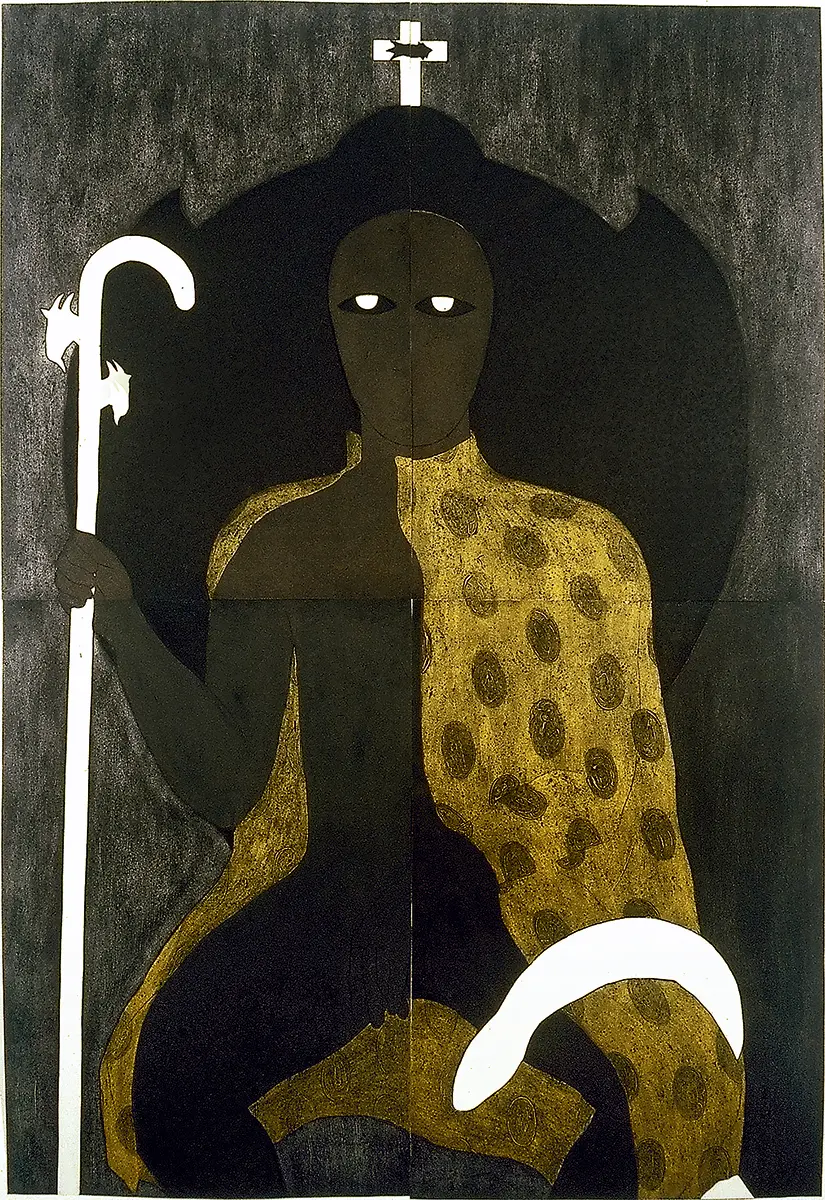
Cristina Vives, curator for the exhibit, states in her catalogue essay that there are three important landmarks in the development of Belkis as an artist. The very first occurred in 1986 when the artist decided to make the Abakuá secret society her subject matter. Then came her decision to work with collography exclusively; a video at the exhibit documents this complex process and we get to see the artist at work. The prints are texturized, like raised painting, which suggests reliefs.
The third development of her style occurred when she eliminated all colors from her work, reducing it to white, black, and the many shades of gray. There were also other additional challenges, as there were no visible records of drawing or painting from the Abakuá tradition except for the lines and graphics that are painted on floors or walls with white or colored chalk for the Abakuá rituals, known as Ekeniyo, plus the fact that dealing with a secret society for men made Belkis’ research yet another challenging process.
The early works from 1985/1986, before she had even started work with collography, are lithographs or prints; the scenes are Belkis’ narrative interpretation of Abakuá myths. Princess Sikán discovers a mysterious fish that is both a harbinger of peace and prosperity and an oracle as he communicates through the voice of an ancestor, King Obón, who is also Abasí, the Almighty God. Although forbidden to speak to anyone about its existence, she tells her lover about the power of the fish and he comes and claims it, a betrayal that will cost Sikán her life. This narrative is what provides the springboard for her work. In the early work it’s important to note the emergence of the isolated figure and to position the background and this figure in very strong tension. Belkis developed this tension much more efficiently when the colors went darker, adding an aura of mystery, and forcing the viewer to spend more time reading the work. The figures exude apprehension and compressed anxiety as it happens also with the images of Francis Bacon, one feels something has happened or is about to happen that is of dramatic consequence and most probably violent, for the body that is represented.
Belkis brings before our eyes the un-represented and secret. Her narrative is more a bridge into another reality than just an illustration of myth and as she progressed in her endeavor, we see clearly how she became obsessed by Sikán and the reality of her predicament as a betrayed and sacrificed victim. A work that illustrates this fate is La Sentencia (The Sentence) (1993) where we see Sikán covered in a garment made of fish scales, her hands tied with chains, her eyes wide open with fear as two white serpents approach her and a white hand emerges unexpectedly from the back. The representation of the myths can also be read as a commentary on the very real and unfortunate repression and censorship of Cuban life in the Tiempo Especial (Special Period), which lasted from 1989 till the late 1990s and adds up to about a third of Belkis’ lifetime, but significantly, three-quarters of her adult life. It is essential to put in perspective that this dark period of economic collapse and disillusionment was a constant throughout the production and development of her most significant work. She has captured well that feeling of entrapment that the oppressed have felt through the ages, from the dominant status quo. The paranoia expressed by her last cycle of figures, depicted in roundels with a single figure of Belkis/Sikán desperately trying to escape their surroundings, the most powerful of which is Dejame Salir! (Let me out, 1997). It illustrates this period with dramatic impact, and we sense the mythology of the Abakuá has become an allegory for her present condition and feelings so close to the time of her suicide.
What emerges from viewing this retrospective is clearly the engagement of a great voice, using the language of art to establish many complex dialogues with the great and ancient tradition of the Abakuá in a contemporary context.
It also brings to mind the necessity for more scholarly work and exhibitions dedicated to artists that encompass hybrid cultures, where a lot of the components come from sources unknown to the classical canon of western culture, and where appropriations from their ancient past are also a reaffirmation of independence and identity.
ALBERTO BARRAL