
This is, above all, an event. Carlos Arias has not held a solo exhibition in a Mexico City gallery since 1996. This show, curated and presented at Marso Gallery, is not limited to the new developments in the artist’s oeuvre, which has been characterized by an allegorical, political, and conceptual use of embroidery as copy, substitute, or simile of the pictorial, deployed for the first time (or having its starting point) in Chile: un país por conocer (Chile: A Country Yet to Be Known), from 1996, where a landscape in oil (a day of fishing) with blond children (who allude mockingly and ironically both to the propaganda of racial supremacy and to its establishment by the Chilean dictatorship as a political ideal to be pursued, or perhaps attained).
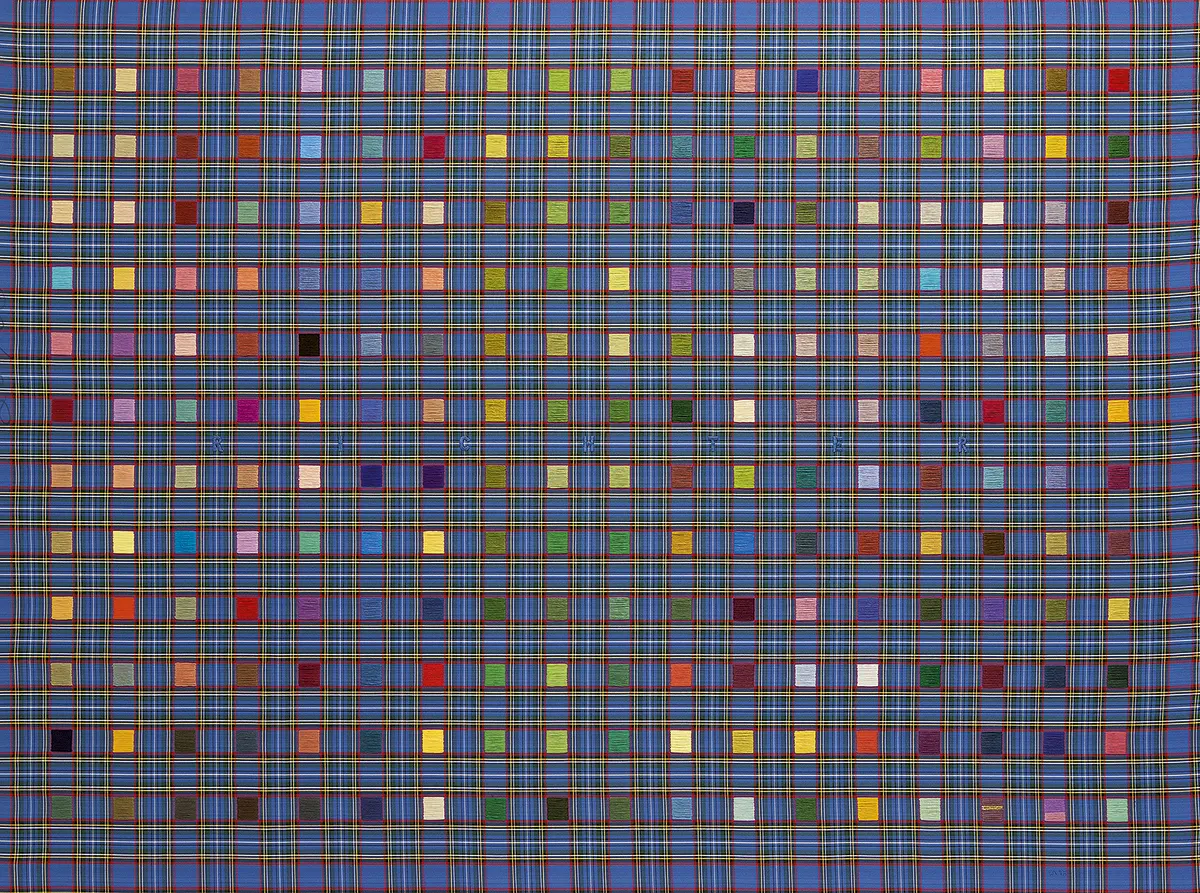
We must not forget that, to a degree, this exhibition is a consequence of Arias’ large retrospective at Capilla del Arte in Puebla and later at Museo del Chopo), where his work, which gained definition on the basis of the formal resources that derive from the different kinds of embroidery (in the process acquiring an increasingly more tactile quality and incorporating representations of sexual scenes and organic saturation of pom-poms), was organized historically, according to the subject. But I don’t mean to say that this is a mere distillation, taking into account the works that repeat from the retrospective, from the embroidered transcription of Lorna Scott Fox’s 1996 text about Arias to the cube masks and the thread column the artist created between 2001 and 2006, but rather a recapitulation of themes and resources that revise and reformulate Arias’ contents and formal explorations. This is evident in the tableaux that were set up inside the gallery using works by the artists in a variety of formats, showing family scenes with Nineteenth-century undertones, self-portraits, veiled portraits, and texts, in which we read “I like human beings, although at times I’d like for the world to be a desert,” or “The planet is sad but there are brilliant people,” or “We are going to be connected for the rest of our lives,” all ending in a series of canvases that repeat (seven times) what seems to be a declaration of principle and a conclusion reached: “To be gay is a state of grace where non-temporality appears naturally,” a good summary of an exhibition that revaluates and updates Arias’ works of the last twenty years, like a time without time that repeats as a struggle against an established order that resists disappearance despite its many de-stabilizations. Here the slogan does not lose its original meaning due to its repetition, it is not diluted, it is not rendered mere noise or a succession of undecipherable signs; transformed into labor—embroidered—it reasserts itself as border or protuberance and it resists—physically and morally—the very order that overwhelms and relegates it. It defeats that order because of its seeming subjugation, from the subjacent seditiousness that nevertheless always prevails in a new disorder of things that can only survive in the present time. From his mimicry of the pictorial Arias moves to a mimicry of the sculptural, where he combines the hypnotic pattern of the fabric (the text that repeats to become the ultimate meaning of what is represented and what constitutes it) with the precariousness of the materials—the dichotomy between process and duration—in order to (literally) hang like an organic whole that finds support in empty space, in that which exists between the threads and escapes to make their survival as floating weights possible: surpluses that plot their shape, meaning, and purpose in space. One standout among Arias’ most recent works is Doblegarse (to Bow Down), which echoes and summarizes the process followed by the artist over the last twenty years, representing a completed cycle (the work on which the word doblegarse has been embroidered frames a piece of fabric with minimal motifs: keys, hearts, cups, phalluses, crosses, arranged in a random way)—like notes he has taken down—in which the legend "When I know" jumps into view. Traditionally relegated to the realm of “female” activities, embroidery plays a paradoxical role that wavers between submission and sedition. It has been arranged above another embroidery, from 2016—yet another random sample of traditional plots and motifs, on which we read the word Bordado (Embroidery). The tautology here alludes to the work of Carlos Arias as it has evolved in time: a succession of themes and motifs connected by a plot that binds them conceptually and physically, to the always obscure and obscene meaning of the primordial.
RICARDO POHLENZ