
The depths of Carlos Rojas’s aesthetic language cannot be covered in any review of his work. One must leave his works to do the talking. But, be that as it may, one could at least venture to point out a few clues and dissertations about his artistic practice and the construction of a universe of inquiries answered through an intuitive approach to learning and the research of several practices. Knowing this allows us to better approach the exhibition of emblematic works by Rojas presented at the Galería El Museo in Bogota, where a part of the Colombian artist’s body of work was displayed chronologically—I believe more with the intention of paying tribute to Rojas than to propose a disciplined curatorship. The exhibition showcased Rojas’s versatility and his mastery of the different materials used throughout his creative life. Likewise, the show conveyed his recurrent ideas about the world and his desire to understand the concept of time and our very existence without dueling in any kind of torments and, instead, relying on an analytical approach developed through an intimate understanding of science and mathematics.
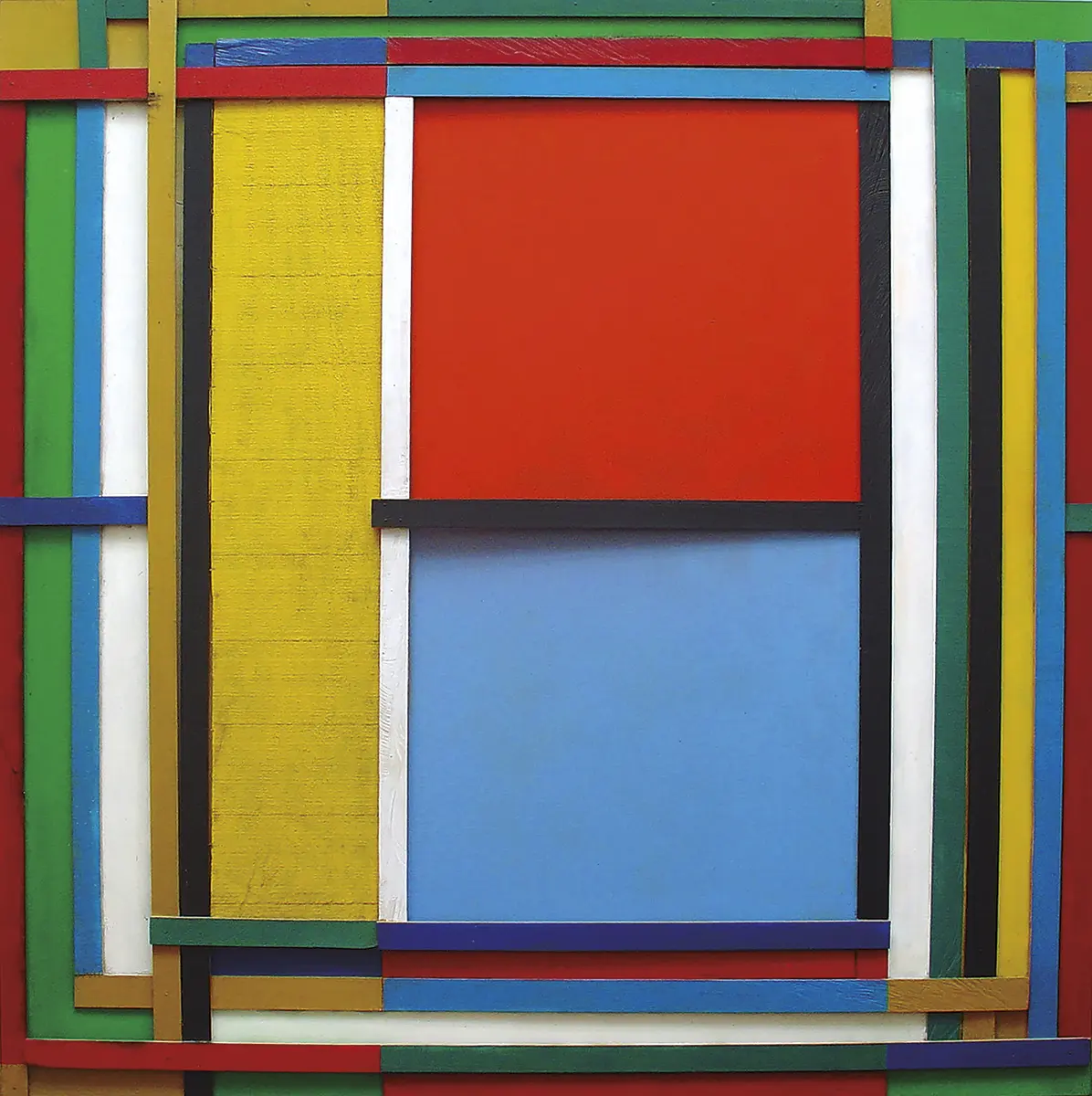
Informed by his continuous study of geometry as the foundational basis for his discoveries, Carlos Rojas (Facatativá, 1933–Bogota, 1997) transformed painting into a space for experimentation and, above all, for critical thought. In his aesthetic pursuits, he pushed the boundaries of reality and dissected it through an integrated aesthetic proposal in which a dialog was established between matter, reason, and spirit. The findings yielded by this process become evident in the works mounted on the walls of the exhibition space, where the coherence embodied by his artistic production is revealed through the growing intensity of processes that result in provocative works with tangible textures.
As part of a group of artists who during the 1980s and 1990s took all kinds of risks, Rojas confronted historic changes with the conviction that transformations were slow and unified events and that it was very difficult to perceive their effects. Nonetheless, the influence of the visual culture of the time and his own studies refined his processes and, obsessed with the pictorial language, staged his personal interpretations of the context in which he lived, always with visionary results because he understood time from a non-linear perspective. In this manner, abstraction—a phenomenon that emerged from the intense observation of his surroundings—was naturally integrated into his work, almost like the masterful introduction of silence into a musical composition. I dare say that his abstraction was unique in his time because it alluded to a form of mysticism that avoided fashionable trends and even historic narrative in its most traditional and chronological sense.
Works from the series America, Horizons, Crosses, Glued Papers, Golden, Signs and Signals, Mater Materia, Mutants, and To Be Painted were part of the exhibition. They showcased Rojas’s mastery of an ever-changing visual discourse that nonetheless kept asking the same questions regarding time, space, the vitality of cultural origins and traditions, his interest in spiritual matters, and the world order. To rethink what painting was all about from a perspective framed by the historic period and the aesthetic changes that were occurring, resulted in a disciplined and endless formal exploration informed by all the knowledge that Rojas accumulated through theoretic constructs and, above all, through the experience gained with his travels and most intimate experiences.
Lastly, I think that the exhibition succeeds in offering viewers a close look at the creative universe of Carlos Rojas, through a montage that evidenced his formal solutions and the different interests that life aroused in him. His obsessive observation of the surroundings—both countryside landscapes and urban ones—offered him information that he used in his painting and assemblages. The research and experimentation of elements like line, color, and geometrical figures offered keys for the configuration of an abstract language like few others, at a time when in Colombia, an earlier generation had already outlined important precedents within another context and from other formal and thematic positions.
It is pointless to repeat what many have already said about each of the series by Rojas and about the artists and experiences that influenced him. Everything about these themes has already been covered in a number of publications. Instead, I believe that here it is important to pause and consider the compelling power of Rojas’s language and the great efforts he made towards the accumulation of referents from a wide range of sources and to turn his work into a space in which to question everything; not with the same purpose of an anarchist, but with the drive of a person hungry to discover the essence of the world based on an understanding of the dramatic nature of beauty, of instability as a possible state, and of the implications contained in the organizing system that determines what we call reality.
Rojas never set limits for himself. Without hesitation, he immersed himself in dissertations involving subjects like architecture, design, music, literature, mysticism, ancient culture, and physics, among others, to build a structure of thought that consistently offered his images a unique power.
ÉRIKA MARTÍNEZ-CUERVO