
Walking through a narrow corridor, sidestepping a dirty mattress, careful not to touch any of the cables hanging from the ceiling, ducking to avoid hitting a set of lights; the visit to the exhibition by Diego Bianchi begins to feel unsettling, even exhausting. It appears as if the moment to actually enter an exhibition room with works of art will never arrive. Or, am I already in the exhibition?
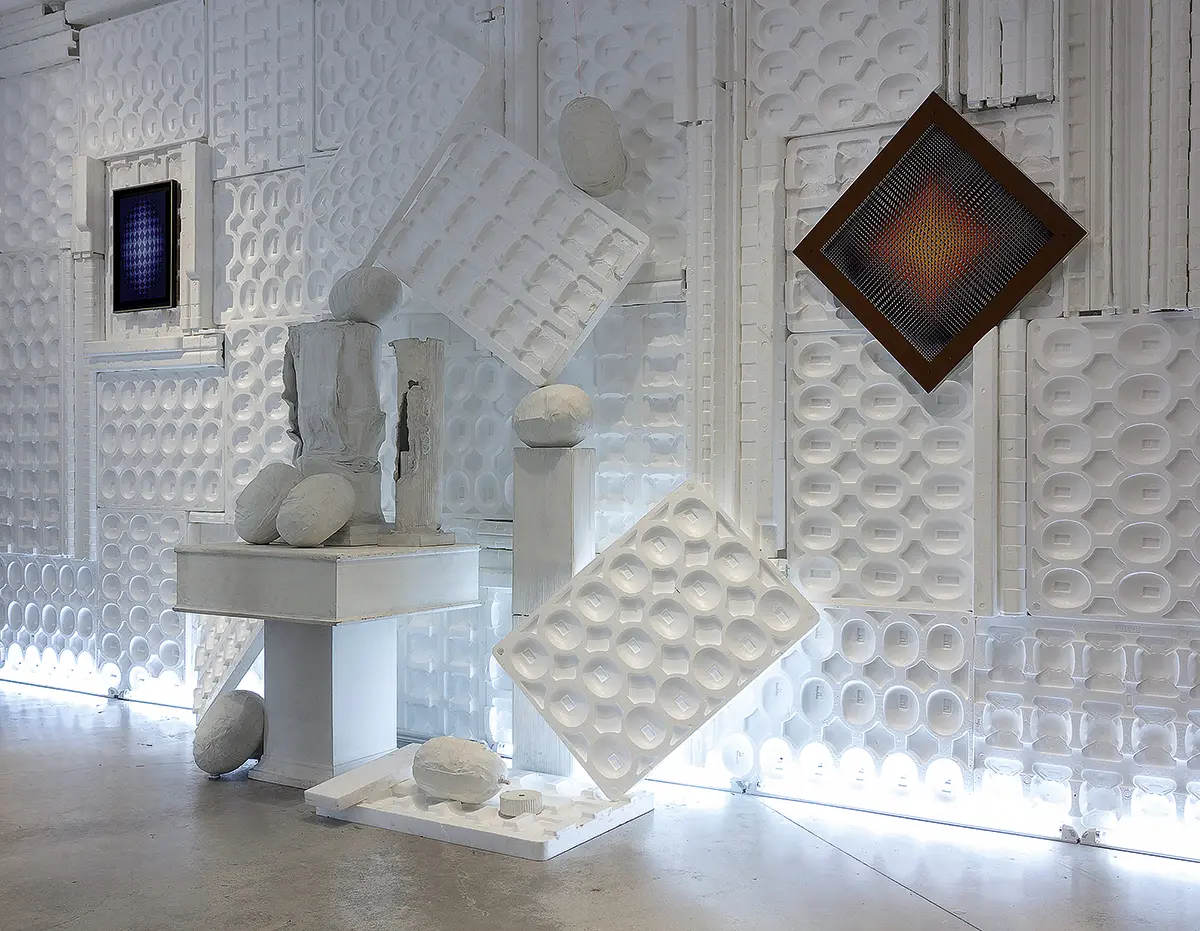
The effect Bianchi aims for, to disrupt our need to assign labels (“this is art” and “this is not art”), is achieved from the moment viewers get inside the winding corridors that surround the central exhibition room, which can only be accessed by holding the hand of another visitor. By maintaining physical contact with another equally confused person, it becomes possible, if not “comfortable,” to explore the space without walls. By then, what appears to be works of art are displayed throughout the space as if they were chaotic inhabitants embroiled in multiple dialogs. Sculptures, objects, installations, and other hard-to-label pieces populate the "museum within the museum," proposing an inescapable feeling of alienation. Here, Bianchi shows a combination of his own creations alongside works from the MAMBA’s permanent collection. Works by Enio Iommi, Jorge Gamarra, Gyula Kosice, Eduardo Mac Entyre, Rogelio Polesello, and Rubén Santantonín interact with creatures expressly produced by Bianchi, generating a new conversation about the value of art, the difference between an art-object and a common object, and the demystification of contemporary art. That the Museo de Arte Moderno agreed to lend works from its collection for this destructive operation is highly commendable.
The work created in recent years by Diego Bianchi has focused on the massive intervention of museum spaces, reconfiguring and deconstructing both materials and meaning. Through huge holes, sinkholes, improvised corridors, industrial structures, retail store mannequins, objects of daily consumption, and other decontextualized elements, Bianchi pushes boundaries, sabotages the direction—physical and mental—of the viewer, and exacerbates the absurd component in art.
Experiences like those proposed at the 2015 installation WasteAfterWaste at the Pérez Art Museum in Miami, the 2011 installation-performance Ultimate Realities at the 11th Lyon Biennale, and the 2010 installation-performance Ejercicios espirituales (Spiritual Exercises) at the Centro Cultural Recoleta in Buenos Aires, have represented trial and error events in which rather than attempting to achieve a finished production, Bianchi has used experimentation to underscore its procedural value.
Bianchi’s influences (particularly Thomas Hirschhorn’s) are mixed in a cocktail shaker to make a rather tasty drink amid this transitory period in art. While some of his pilot trials contained messages that belong to the past (before Harald Szeemann and his exhibition When Attitudes Become Form), the message is updated every so often. On this occasion, the greatest defiance is also the sharpest ironic criticism to the system: to display works from the permanent collection of one of the best museums in Argentina alongside, and under the same conditions as, repurposed and recycled elements. In this manner, elements that were part of the MAMBA’s earlier exhibition titled Pablo Picasso: Beyond Similarities, are now displayed along the access corridor. Perhaps Javier Villa, senior curator of the museum and the person responsible for inviting Bianchi to exhibit at the space, is now having second thoughts about the whole thing. But visitors to this chaotic show sarcastically titled The Present Is Enchanting will appreciate the provocation.
JUAN JOSÉ SANTOS