
It has been a long time since drawing overcame its condition as a distinctly two-dimensional medium. Some may even think that its purpose was never only to translate the three-dimensional realm into a more elemental plane—a rather automatic and very limited understanding of what drawing is. There are actually several important phenomena in drawing worth mentioning, among these: an implicit drive for transformation channeled by the drawer, a desire to become somebody else by the manual creation of a reflection on paper (or on any other surface); a circumstance that underscores the humanity of apparently very natural action.
In the exhibition titled Things Gradually Leave Us at Casa Proartes, curated by Miguel González, Diego Hernández proposes a game by including self-portraits in drawings that reproduce old photographs. He draws an exact replica of the original photograph, even copying any damage to the photographic paper and material, negative spaces, scratches, and out-of-focus areas. He inserts himself as a character in the middle of the scenes as if he somehow wanted to use the medium to experience that moment from the past. A gesture that attempts to turn this artist into a witness magically transported to the moment and place depicted in the photo in order to interpret the historic moment with his presence: a dislocated perspective.
In Things Gradually Leave Us Hernández expands the notion of drawing through experimentation, by entering and leaving the plane, zooming in to expose the landscape, or out to reveal the dust created with the graphite, the material used to render the image. The show covers two exhibition areas. The main exhibition floor contains the 2017 series titled Variables, consisting of five numbered small boxes that contain photographs depicting various scenes in the life of different man, expanding from childhood to marriage; each box and photograph is accompanied by its own drawn replica, its own distorted reflection: the face of the anonymous subject has been replaced by Hernández’s face. A disturbing effect is achieved with this insertion into photographs from another era. Those of us who know Hernández feel a sort of estrangement, an uncertainty provoked by the drawing’s precise execution and its trapped lie. This exhibition area also displays an untitled work consisting of a large table that could be establishing a connection between art’s inherent poetic freedom and the documentary nature of the material; namely, a table that supports the historic weight of the elements displayed on it, like, for instance, the writings on the back of the photos, manuscripts, and old photographs of cities, among other materials. The walk through this exhibition room concludes with a large drawing created in 2017 titled 9 de mayo de 1939 (May 9 of 1939), which depicts a small landscape photograph with that same date written on the back (the photograph is shown on the next floor).
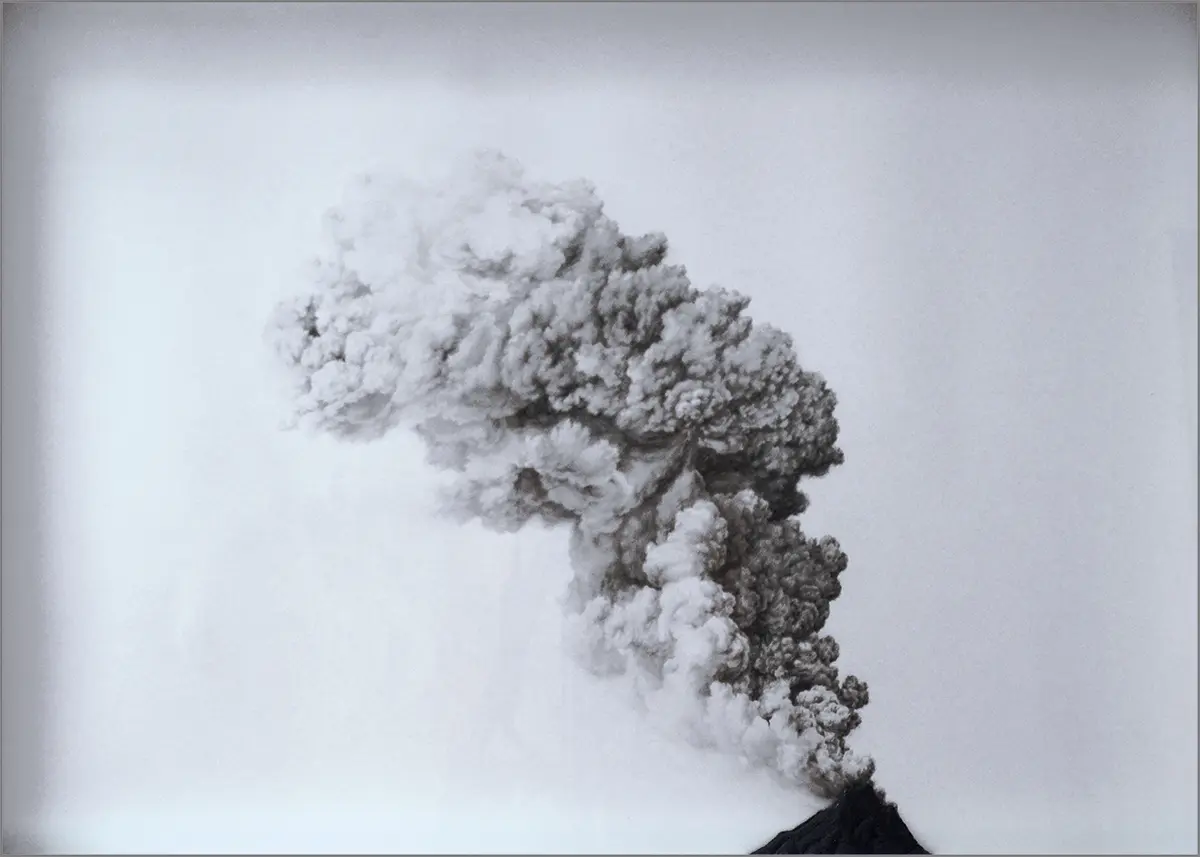
The second exhibition area contains a scattered montage in which the drawn landscapes displayed become sort of punctuations or accents throughout the space. There is a diptych formed by two works titled Humo I (Smoke I) and Humo II (Smoke II), in which a smoking mountain is repeated like several reversed copies of copies of the original. Nonetheless, the mountain is an accumulation of graphite dust and resin from the frame. The smoke looks exactly the same as it appears in the original black and white photograph. It is important to point to the subtle nature of the deceit, as well as to that which, from a distance, appears to be a two-dimensional form but is actually revealed as having volume upon closer inspection: the absorbing black of the dust that has left the two-dimensional plane and is spread outwards. This effect also allows for the two-dimensional rendering of the smoke to also appear to be leaving the paper. The only thing that betrays the effect in this sequence is the unbreakable stillness of the wooden frame and the protecting glass.
Lastly, the second exhibition room also displays a 2017 untitled sculpture entirely created with graphite dust and resin. It looks like a small fragment from some natural topography; a black coal mountain kept on a wooden support. Measuring 20.5 × 10 × 8.5 cm, the small sculpture is essential for making sense of the exhibition as a whole, given that the dust it contains was generated through the action of drawing the images; it is the material that was left behind after rendering the images on paper.
This exhibition accomplishes a highly subjective process centered on the drawing. Diego Hernández inserts himself in his drawings while expressing their documentary nature through distant and close approaches to the original photographs, as the works oscillate from memories to hallucinations while retaining, in the end, a contemplative intention towards that which cannot be memorized: a pleasurable experience before a boundless landscape that demands our presence (through the artist’s own), and one that can hardly be conveyed merely through a photographic image. This contemplation is explored through a play on dimensions and the resignification of the material: the dust that must no longer remain on the plane is actually an object in its own right, the particle of the mountain.
BREYNER HUERTAS