
Elsa Zambrano (Bogota, 1951) presents the exhibition titled Assemblies at the Museo Rayo in Roldanillo, Colombia. Under the curatorship of Miguel González, Zambrano’s show is presented alongside other exhibitions by women artists, including: Paintings by Ana María Rueda, Textiles by María Angélica Medina, and, as guest work, Alicia V (1991) by Liliana Porter, among others. In this solo show, Zambrano includes a large series of small boxes made with found and collected art postcards. It is worth pointing out that she develops her work through the collection and reorganization of everyday elements. In this instance, master works from the so-called universal history of art are placed in small scenes filled with references alluding to the collective memory and traditional wisdom.
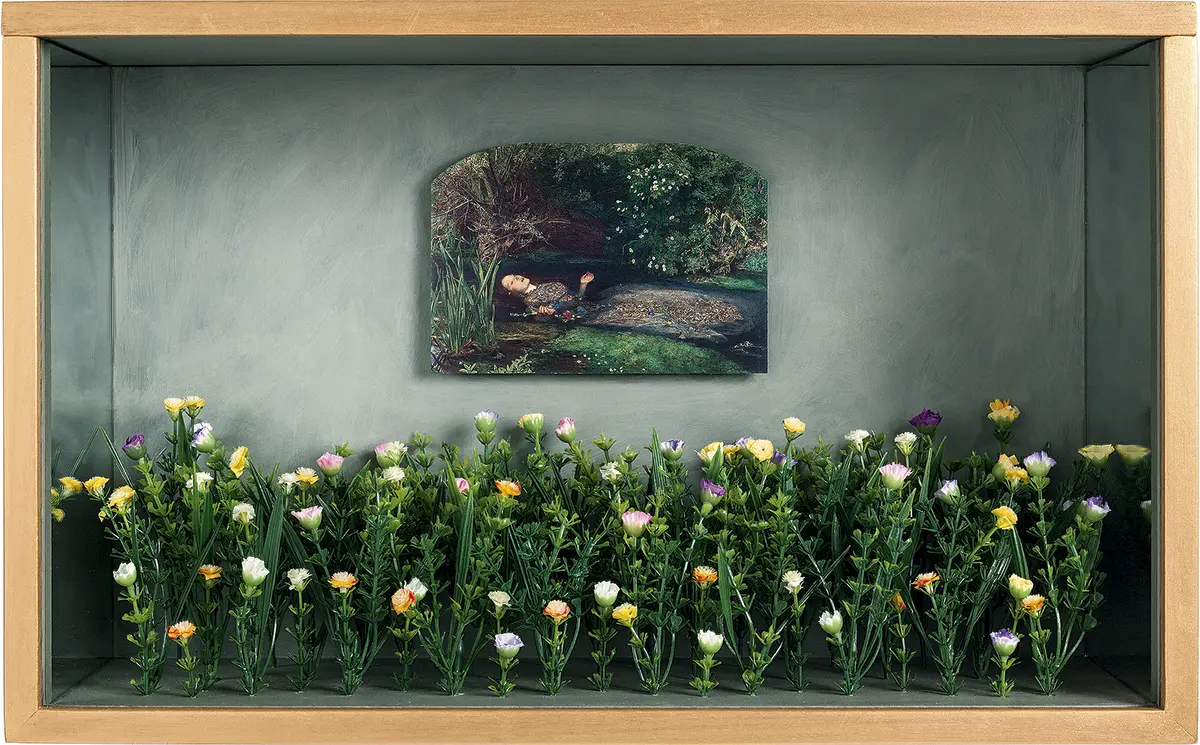
Zambrano miniaturizes the curatorial exercise and proposes small museum spaces as works in which objects directly refer to art collections as gestures: small boxes with souvenirs, postcards, toys, and reproductions from the most important mythologies in universal art; objects from the most solemn museums around the world presented through generic elements delivered to the hands of a massive public—and to the hands of an artist who, aware of their symbolic possibilities, collects and assembles them to redefine their aura. Through this new approach she transforms the nature of their narratives.
In this manner, Zambrano proposes series of small theatre-like scenographies contained in boxes that are exposed to viewers through the fourth wall. We assume the role of a front row public looking within the frame for the associations that the artist has suspended like codes. We observe these pieces in search of the critical meaning that they contain, produced by the juxtaposition of two objects and the resulting signs. In the piece titled Monalisa, for instance, we observe a mob of small toy figures with their backs turned to us and their hands raised as if they were taking photos the postcard of Mona Lisa (as it actually occurs at the Louvre, in the exhibition hall where Leonardo Da Vinci’s La Gioconda is displayed). In another example, figures from Bosch’s The Garden of Earthly Delights leave the postcard and stand in front of the image that used to contain them. They appear to be rediscovering their own world as they observe it from a new perspective outside the frame. This back and forth between dimensions seems an interpretative exercise that approaches art history and makes critical commentaries from the perspective of popular culture. The boxes allude to a slightly distorted universal knowledge in which the confusion generated by the scenes require a quick lecture that moves from the purely contemplative to criticism.
André Malraux (1901–1976), the renowned French politician, writer, and adventurer, proposed the concept of the “imaginary museum” to address the new technological developments associated with the reproduction of images, with an emphasis on the possibility of transferring the images of all works of art to postcards and books so any person could own his/her own personal museum. This development in art reproduction greatly strengthened European art, elevating it to the category of “universal” art, as result of all the encyclopedias and books that have been published about the art of that continent from the Renaissance forward. The universal nature of this art succeeded in exposing its images around the world and establishing them as an essential part of popular culture. On this occasion, the works by Elsa Zambrano could be regarded as an answer—from a very specific, microcosmic perspective—to the more established structures of art by an artist attempting to somehow intervene that history by deforming the elements of that great art and turning them into small circumstances.
In the small box titled Millais, Ophelia (2016) the flowers of John Everett Millais’s painting Ophelia (1852) leave the postcard to artificially bloom on the frame, increasing the depth of the image, staging a preamble for the gaze and resizing everything under the constraints of an assembly and its apparently naïve nature. Elsa Zambrano collects souvenirs and figures that allude to art. A great part of her work involves collecting, reorganizing and accumulating actions. There is a political dimension to the possibility of transferring fragments of universal works of art (postcards and toys) that resides in the effect produced through their removal from the source material, their recontextualization and mystification. On the other hand, the boxes in this series expose viewers to a new origin or point of departure that echoes all the knowledge accumulated around the works, creating a new narrative with brand new words. Approaching Zambrano’s works as neologisms can lead us to consider the existence of vernacular languages that directly correspond to the micro-social reality of communities. In this sense, the boxes created by this artist can be interpreted as an alternative language that borrows the characters of the established language but relies on its own grammar and accents; something that could be regarded as an answer or reaction from the local context towards an entire history imposed by the art world like a block of words.
BREYNER HUERTAS