
Five years after her last solo exhibition, Fernanda Laguna (Buenos Aires, 1972) presented En la galería de arte (At the Art Gallery) at Galería Nora Fisch. The exhibition starts with an intervention on the main space’s large window overlooking an important Buenos Aires avenue; Laguna’s large, fragile white paper curtain covers part of the glass yet also invites intrigued passers-by to discover the art inside the building.
Even though the exhibition space is not particularly large, it is not possible to apprehend the exhibition in a single glance; the fact is that the works are to be discovered in stages since the artist segmented the main area of the gallery into several different zones. To that effect, she built a wall in the middle of the room that is presented as a new white paper curtain announcing and introducing the second moment of our itinerary through the show.
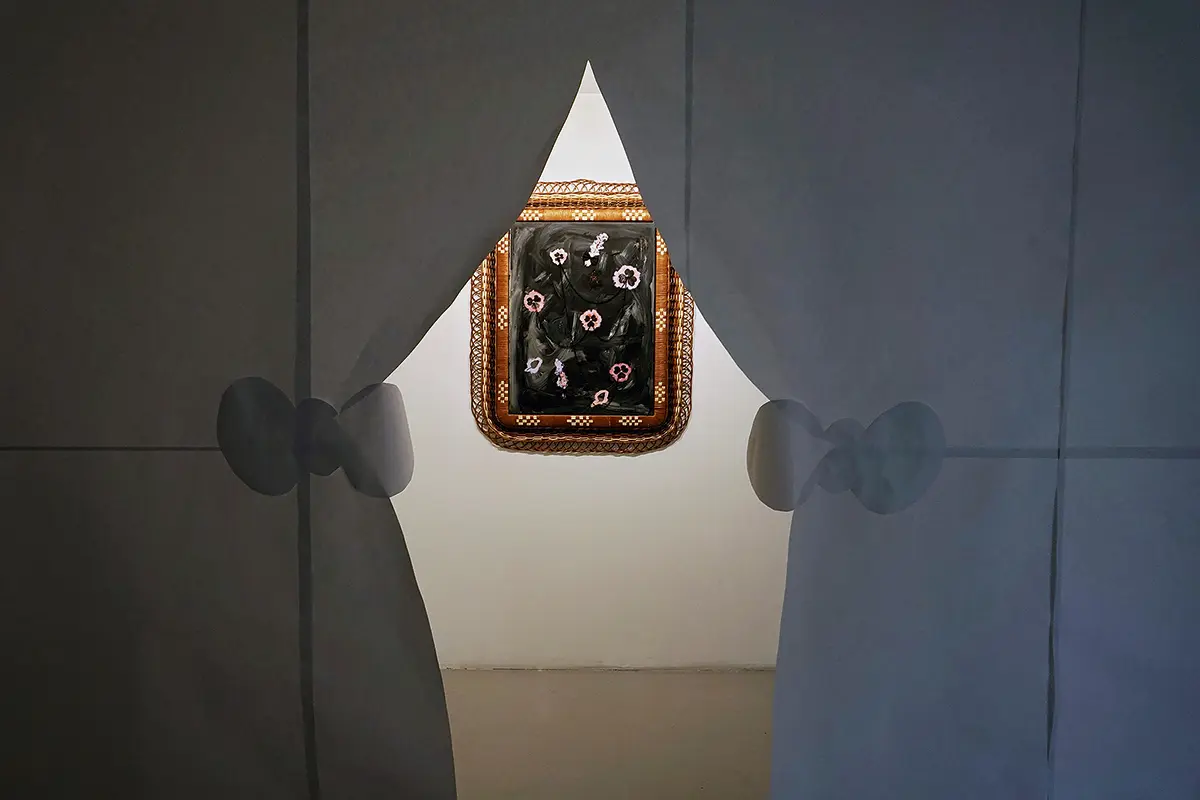
Let’s focus first on the first set of works on exhibit, however. As we enter the gallery, we see an abstract, precarious-looking abstract painting of oval shapes with irregular outlines, in pink hues. This painting was made on cardboard with a strange joint in the middle of the image, accentuated by two bows made with pink satin ribbon. Placed next to this image is a collage from Laguna’s series Los mimbres (Rattan); a small drawing made using thread and shells; and, to the left, a small window in pink wood with two curtains that open to reveal, inside, two cute characters waving hello. All of these items are connected by pencil drawings on the white wall of the gallery: fantastical characters, geometric shapes, and messages. Among the texts are expressions of wishes, phrases in reference to the works on exhibit (such as “the artwork is that which is painted in acrylic and satin bows”), and even an announcement for Diego Bianchi’s contemporary exhibition at the Museo de Arte Moderno. It is all framed by a variety of vignettes that envelop the space, both the works and the various drawings. But, where does each individual work begin or end? Is it one and four works at the same time? Are the paper curtains part of the work? Perhaps our gaze is not to be directed at the individuality of the artworks but at the modalities of the exhibition and the potentialities they open up for the works.
Moving on to the second curtained section, Laguna included a series of videos projected on a plasma screen, but with a series of peculiarities. First, there is a remote control at the disposal of the audience that allows visitors not only to select which one of the six videos to watch but also to watch any one of them from the beginning, something rather uncommon in contemporary video art experiences, where visitors often find themselves inside a dark room where they catch a video on a loop at whatever point it is at that particular moment. In this case, the artist created a room with two large wooden benches and a small freezer, and a bottle opener that invites the public to drink from a beer jug while watching the videos; in a way, all of the elements proposed by Laguna are invitations for the viewer to remain in the space, perhaps for longer than usual. The videos were produced by the artist; camera in hand, Laguna proposes introductions to or guided tours of her oeuvre, as well as playful explorations that are also connected with what we mentioned before about the modalities of the exhibition.
In fact, it is not by happenstance that the gallery’s second exhibition space features a separate show curated by Fernanda Laguna and Cecilia Palmeiro, Mareadas en la marea (Seasick in the Sea Swell), which focuses on records, images, objects, documents, and bibliographies around the Ni Una Menos (Not A Single One Less) movement, with particular reference to the worldwide Women’s Strike on March 8, 2017. Here, Laguna—the creator of landmark projects in the local art field, such as Belleza y Felicidad (Beauty and Happiness) and Eloísa Cartonera, and someone who has worked n the visual arts as well as the literary field and on cultural promotion—once again brings into the debate and interrogates the specifics of showing and exhibiting/exposing.
AYELÉN VÁZQUEZ