
Water as a subject has appeared repeatedly in Cuban art and literature, prompted, among other reasons, by the country’s evident insular condition. One is reminded of Virgilio Piñera’s famous poem La isla en peso (The Weight of the Island), so influential for an entire generation of artists and writers. In The Oceans, his most recent solo exhibition, Humberto Castro (Havana, 1959) proposes a renewed approach to a subject he has engaged for years from a variety of perspectives. This was indeed one of the subjects of his ambitious project Tracing Antilles, exhibited for the first time in 2013 at the Frost Museum and later at the Polk Museum of Art, both in Florida. It is not by chance that so many of the works included in that exhibition dealt with the issue, given the mythological, historical, economic, and social importance of water, especially of the seas and the ocean, for the Caribbean region.
One of the centerpieces in Tracing Antilles was the work from which it took its title, a large-format video projection depicting waves as they crashed against the shore in front of a large canoe. This is the thread that connects Castro’s previous work and his new proposal. According to the artist, The Oceans represents a transition between the project mentioned above, which took him years to complete, and those that will come in the future. It summarizes the previous period of his production and inaugurates a new one. To that end, Castro brings together works in different media on which he has worked simultaneously over several years. In paintings, drawings, pottery, and sculptures, Castro demonstrate his mastery of stroke and line. This is particularly evident in his works on paper, especially his female figures, whose delicate lines reveal Castro’s undeniable technical command.
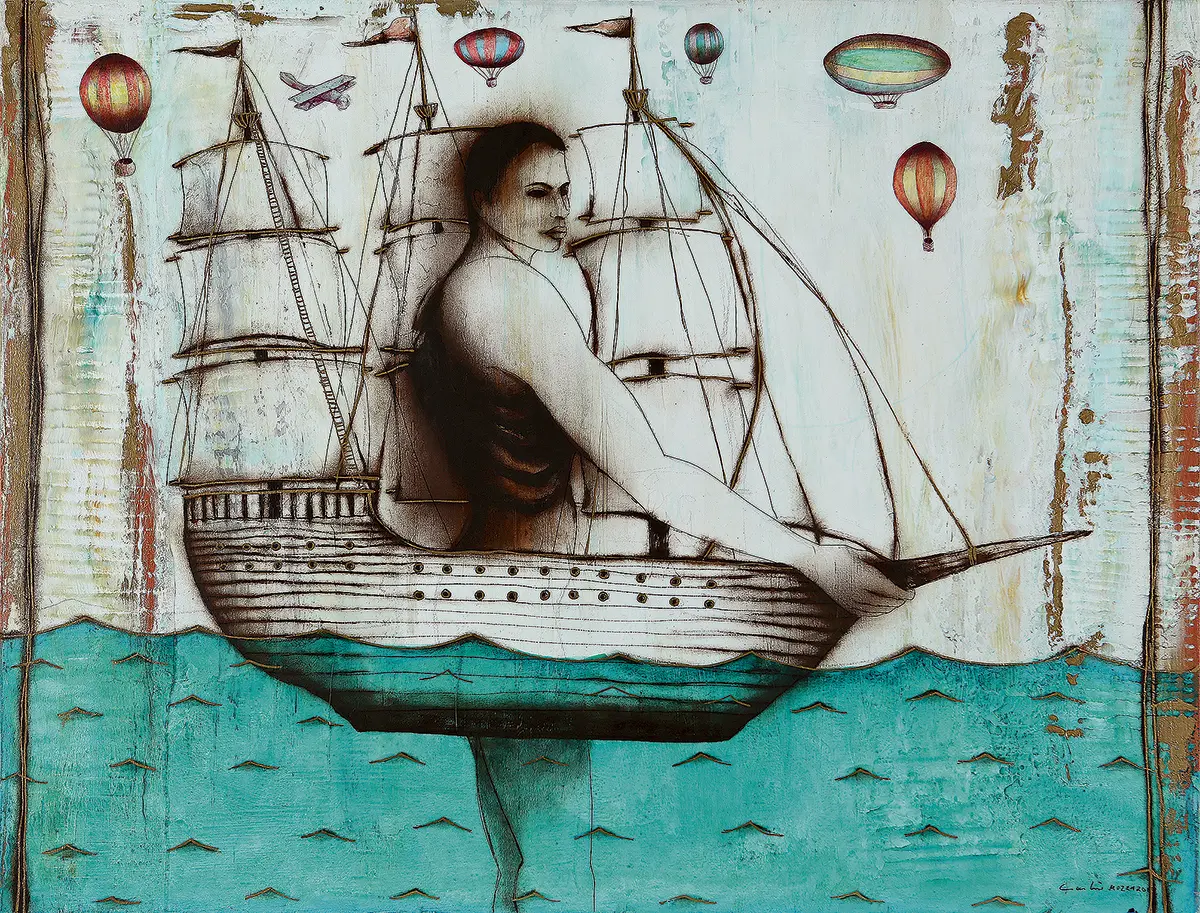
The works on exhibit in this show combine some of the historical factors that determined America’s conquest by the Spaniards with others of a more existential and personal bent, like the artist’s thirst for freedom. We find references to the Conquest in works like Navegante (Navigator), The Ocean Mother, Sleeping America, and El Cacique Solitario (The Lonely Chieftain). By including Christopher Columbus’ three iconic ships, Castro brings to the fore the entire process and its implications.
Stylistically, Castro includes in these works elements that have characterized his art for years, defining his production and becoming, in a way, a personal seal. The stylized figures that appeared early in his repertoire of images continue to be central in several of the works. Among them are Castro’s winged beings, which blend a thirst for liberation with the possibility of motion and bring to mind the artist’s previous works inspired by the Icarus myth. To return to Piñera’s poem, the island’s “accursed circumstance of water on every side” drives Castro to visualize such a desire for liberty as possible only by means of those wings. In this context, they can be interpreted as a will to emigrate. Several works in this show reflect the same idea, among them Open the Waters, from 2014, Flying City, Gift of the Sky, and Sunset, the last two from 2017. The fact that Castro continues to work with this subject speaks of continuities in his oeuvre that are not only stylistic but conceptual as well.
Many years have passed since Castro held his first exhibition in Cuba and became one of the most relevant artists of the 1980s in the country. A thread can be followed from those early expressionistic works to his most recent productions, especially via his sustained interest in human figures. In a way, Castro’s most recent exhibitions return to a subject that he investigated early on in his career: the massive extermination of Cuba’s indigenous peoples. Castro journeys back to his roots with a fresh and much more all-encompassing vision, one that includes other points of reference, and brings it all into the present to extend his inquiry to the region as a whole. Besides presenting every conflict from a historical and social perspective, here Castro sheds light on the ocean as a borderland, as a source of life, anxiety, death, transformation, and, ultimately, regeneration.
IRINA LEYVA