
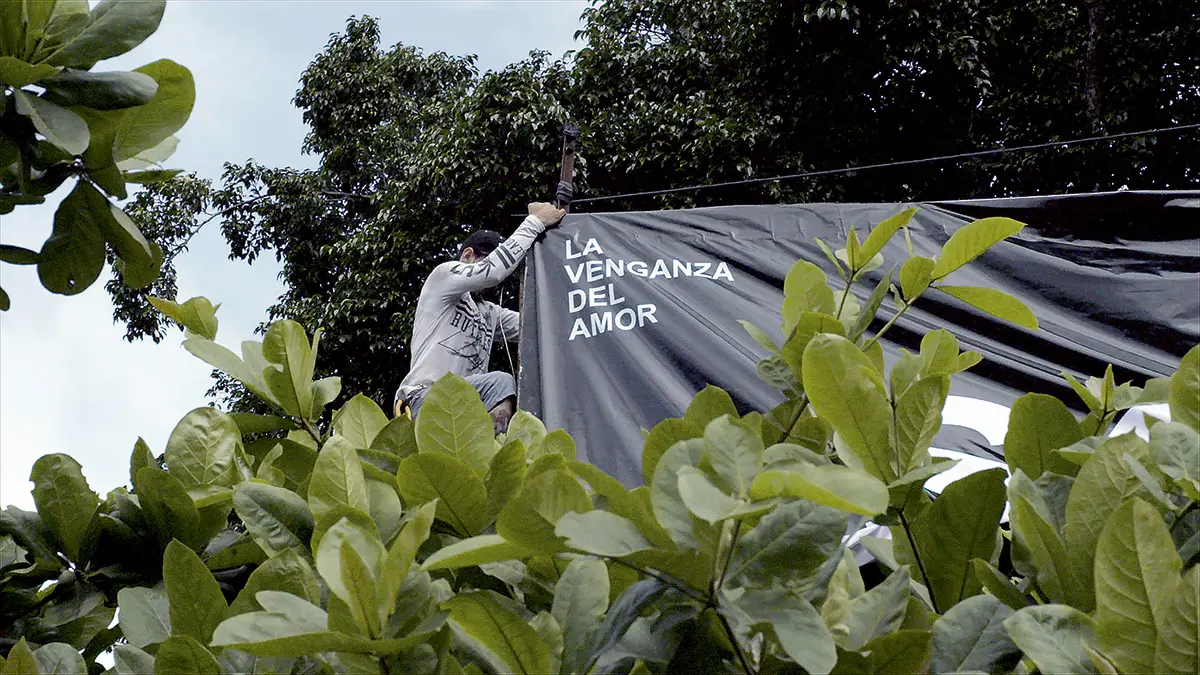
Perrotin Gallery opened in April its new space on the Lower East Side with the exhibition La Venganza del Amor by Colombian artist living in Paris Iván Argote. The title of the show refers to one of the scenes of the video As Far as We Could Get (2017) projected on one of the walls of the gallery. Filmed in two antipodal towns, Neiva (Colombia) and Palembang (Indonesia), the film draws a parallel between them and shows how, despite being geographically opposed, they have much in common. In one of the scenes, the characters express in Spanish and Indonesian their intention to take control of their communities and, unlike those who hold power, they hope to do so with respect and affection. As Argote explains, "La Venganza del Amor is a state of mind, it is rage, it is tenderness, it is the desire to change things and make them work under parameters other than domination.” The title, written in Spanish, has a certain air of soap opera and constitutes a “statement” in the context of his first solo show in the United States, a country where this issue is the order of the day due to the current political climate.
In addition to the video, the exhibition includes seven concrete sculptures from the series Among Us (2017), four installations of the series Setting Up a System (2017), two works from the series Covers (2017), and a sculpture titled Sweet Potato (2017). Each of the works is related to the artist’s intention to modify the perspectives from which we look at history and how we conceive concepts such as knowledge, truth, progress, and the idea of the “other.” The works refer to specific data, historical facts, archives, and/or documents, but are treated as short fictions. The sculptures in concrete look like architectural ruins. Except for the titles, the phrases that appear written and punched by big holes – "Be with Me," "Love Me," "We hope they Hope" and "Extremely Opposites, Extremely Close" – are practically illegible.
The collages are made with texts and images of political propaganda and historical archives that he intervenes with through meticulous laser cuts and perforations. The different layers of texts and images, made of paper and wool, symbolize the multiple perspectives through which one can observe reality or interpret a text. An over-sized aluminum sweet potato covered in gold leaf is a commentary on large-scale globalization and the transit of goods and values since colonial times. Despite having saved Europe from hunger and having been integrated into all cultures, the sweet potato still has a humble and austere connotation. In this case, the large size and its golden tone also make reference to the gold that the conquerors took to Europe. According to Argote, his intention is to propose a new icon and to draw attention to the type of images used globally to represent knowledge and value.
Argote’s work is based on the research of sources and archives. The images and texts included in his collages come from books, posters, and comic strips that have to do with ideological conflicts or are made in political contexts where there is some kind of tension. According to him, “even the banalest of images contains a world of information and ideology. The most trivial images are sometimes much more violent than the others, because of that quiet normality that is scary.” Questions like Why does a certain image exist? What ideological standard has been produced? or On what ideological pedestal is it posed? serve as a starting point for analyzing the material, questioning it, and modifying it in order to reveal intrinsic contradictions and assume compromised positions. The carefully chosen texts can be read as intimate and personal messages, but at the same time, they are closely related to more general concepts such as power and knowledge.
The works included in this exhibition speak of the way in which each person assumes, in the private and the public realms, his or her own history. This is defined by multiple factors such as being born in a specific place, living in one way or another and being part of a community in a specific social, economic, political, and cultural context. Through his work as an artist he asks how, individually and collectively, we negotiate with the social groups with which we interact, with specific cultures, traditions, and ideologies. His intention is not to accurately account for specific events. On the contrary, he makes interventions and makes them obvious. His works, regardless of the technique, generate reactions and questions about the construction of values and ideologies, at both local and global levels.
FRANCINE BIRBRAGHER