
In Jamaica, John Dunkley (1891-1947) is considered one of the most important artists of the 1930s, a foundational decade for what would come to be known as the Jamaican School and a time when a sense of national identity and national art began to be forged. Although famous and celebrated in his native country, Dunkley is mostly unknown abroad.
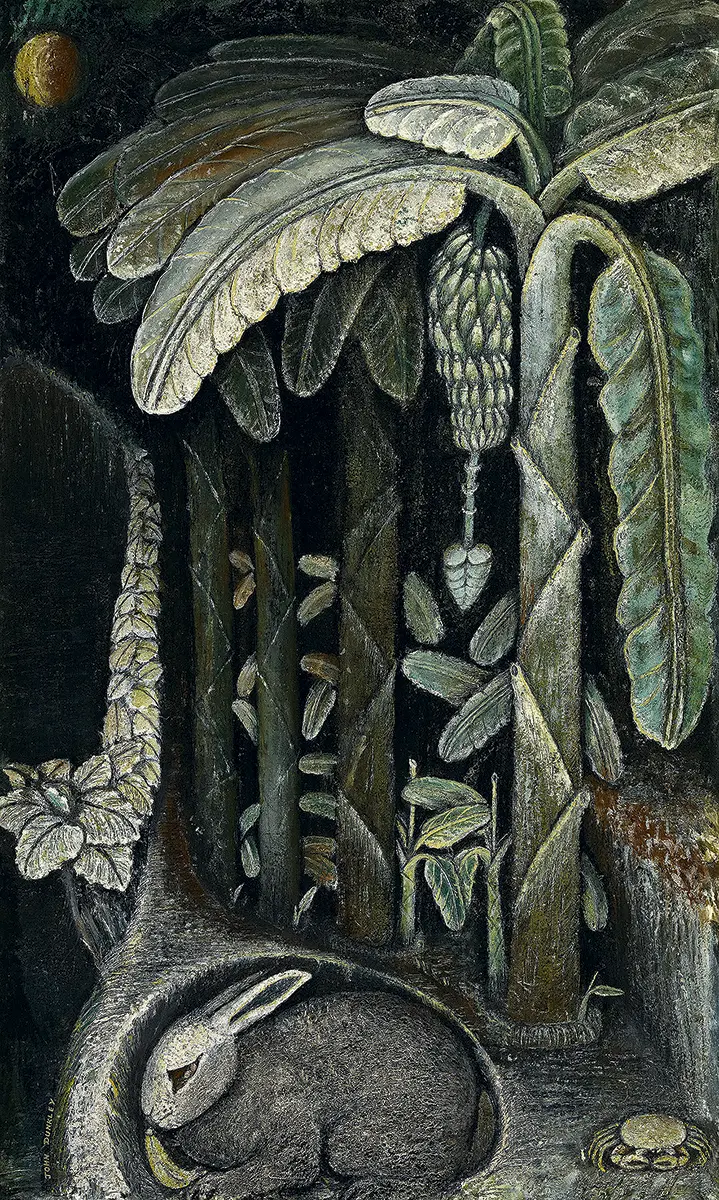
Curated by Diana Nawi and Nicole Smythe-Johnson, John Dunkley: Neither Day nor Night is an attempt to close this gap. It is the Jamaican artist’s first exhibition in the United States, and also the first one anywhere in the world since 1976 when David Boxer curated a Dunkley retrospective at the National Gallery of Jamaica. Dunkley’s work has been on permanent display in the Gallery ever since, and has been included in a number of important group exhibitions; but it has not been the subject of another solo show until now—much less one as large as the one under review, which features forty-seven works, between paintings and sculptures, mostly on loan from private collections and many on public view for the first time. This exhibition also includes an excellent catalog with essays by the curators, by David Boxer, and by Oliver Senior, providing a well-rounded view of the artist and his oeuvre. These essays help ameliorate the long-lamented scarcity of detailed information about Dunkley, particularly with respect to his youth and his travels through Panama, Costa Rica, and Cuba. Although an exhaustive timeline has not been established, the reconstruction provided allows us to separate fact from fiction, at least to a degree. It is known that Dunkley worked with a photographer in Panama, possibly Clarence Rock. His responsibilities might have included coloring black and white photographs, a common practice in the period. This information helps us understand why Dunkley often resolved his compositions using resources borrowed from photography, such as truncated perspectives or photographic angles. Also, as David Boxer points out in his essay, this was one of the reasons behind his decision to use photographic images as the inspiration for some of his paintings. Dunkley’s work experience perhaps even influenced his preference for a dark palette and for setting his images in mostly dim atmospheres. In terms of the application of color, many of Dunkley’s paintings appear “illuminated” by means of a technique similar to photography.
A barber by trade, after returning to Jamaica around 1931 Dunkley set up shop in Kingston’s Princess Street, reserving a space to work on his art whenever he had some free time. Dunkley was an untrained but not uninformed artist. He owned art books, including a monograph on Rousseau, and the French artist’s influence on his Jamaican counterpart is immediately apparent, as Boxer establishes by comparing Dunkley’s only still life, Vase of Flowers, to Rousseau’s famous Bouquet of Flowers with China Asters and Tokyos, from 1910.
At first glance, Dunkley’s work would seem to depict a fantasy-laden, surrealistic universe. Perhaps because of this characteristic, accurately defined in the title of Boxer’s essay, which also became the exhibition’s overall heading, it is often impossible to precisely determine whether the scenes are set at dawn or dusk. This idea is also partly reflected in Dunkley’s inclusion of animals that are not characteristic of Jamaica, such as gerbils and kangaroos. Once decoded, however, Dunkley’s art is clearly revealed as an expression of its times. This is evident, for example, in President Roosevelt Gazed at Portland Bight, from 1940, or The Good Shepperd, a portrait of Alexander Bustamante, Prime Minister of Jamaica. In the latter, Dunkley turned the very metaphor that the politician made famous in the country into a visual resource.
Dunkley also depicted in his works many everyday Kingston characters, like the famous 1940s racehorse we encounter in Jacob’s Ladder. Similarly, he left a record of his admiration for famous local boxers and cricket players, as in Boxer, a sculpture of Tiger Jack Fox.
With this substantive and more than representative selection of works, the curators have provided a unique, all-encompassing view of John Dunkley’s oeuvre. The exhibition abundantly demonstrates that he not only painted landscapes but was also intent on communicating his ideological concerns and representing the reality around him.
IRINA LEYVA