
According to the Book of Exodus, the term “manna” or “mana” (מן) means in Hebrew: the miraculous bread sent by God to the Israelites to sustain them during their forty year travels through the desert. Also used as an interrogative pronoun equivalent to “What is this?” mana tasted and looked like the thing that one most desired. It was also briefly mentioned in the Quran in the al-Baqara, al-Aʻrāf, and Ta-Ha surahs or chapters.
Today, mana is also a term that refers to role-playing and fictional games, limited blue color energy that invokes spells and/or incantations. It is often represented as a magic potion able to bring back powers through meditation. Not only limited to magicians, but highly-ranking warriors also use mana. Its ludic meaning stemmed from the religious concept.
In the annals of humanity, just as it occurs in role-playing games, the construct of history is a given. Victors recreate their glories, while creators deconstruct those narratives and insert new meanings in them, infusing the old soporific discourses with new significations.
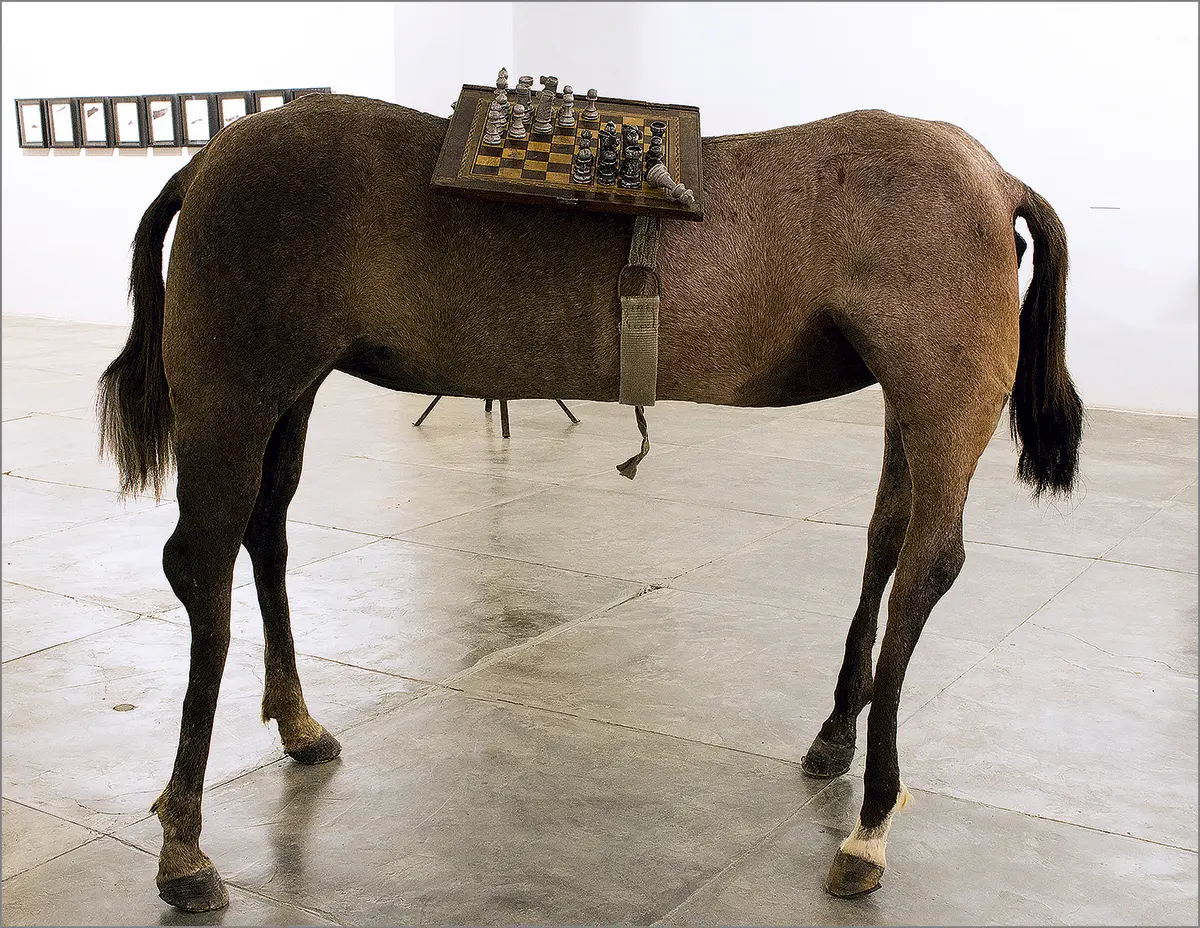
With surgical precision, José Manuel Mesías (Havana, 1990) dismembers in his work the traditions, approaches, visions, taboos, and amulets inherited from one generation to the next by Cubans living on the island and abroad—like mana that nourishes the amen of Orbis.
Today, the Factoría Habana gallery reaffirms its defiant curatorial strategy by including a project like this in its seductive and risky architectural space. The exhibition Index of Images by José Manuel Mesías dissects the visual narrative of the centuries-old Cuban knowledge of history. With art on its side, Mesías plants a new invention with which to illustrate, question, disseminate and centuplicate the embryonic tissue of visual and discursive representation of the Cuban Nation. The show covers the three floors of the building. Its factual and visual diversity establishes different levels of knowledge that explore and capture the sensorial abilities of the average Cuban as well as of the most erudite.
Index of Images encapsulates history, homeland, and characters. It is also divided into four subthemes: Liberating Army, Herbarium, Bestiary, and Reliquary. Weaved like the Fates would weave the thread of life, the themes and subthemes “intertwine figures, events, and contexts with historic, mythic, artistic, linguistic and domestic referents” which “are reminiscent of those display windows or cabinets of curiosities that contain great discoveries […] from explorations by travelers, which delighted both the curious as well as collectors.”1
Indebted to the Cuban school of painting, influenced by those who arrived at the shores of Cuba to live our story and recreated it as a “universal story;” inspired by the sketches of medieval bestiaries and educational books about painting (to compensate for the lack of direct exposure to the original works); we find in these works a Mesías that exhumes, collects and reorganizes with an eagerness to renovate the notable remnants of the history of Cuba and its great leading figures, in order to nourish those of us that enjoy playing “Cuban Tetris” with chips charged with an authentic political, historic, and natural taxidermy.
The defiant titles that Mesías gives to his works automatically turn us into new explorers. To paraphrase a maxim by a Catalonian contemporary of his, Antoni Muntadas, perception requires being involved.2 It seems to me that each title serves to establish complicity with viewers. La imposible representación del rostro de Ignacio Agramonte (The Impossible Representation of Ignacio Agramonte’s Face, 2012), Cabeza de caballo (Horse Head, 2017), La insubordinación del Coronel A (The Insubordination of Colonel A, 2017); Majá con machete dentro (Maja with Machete Inside, 2017), El letargo de la ciénaga (The Lethargy of the Swamp, 2017), El médico del espacio (The Space Doctor, 2016), and La expiación de Calixto (The Atonement of Calixto, 2017), among many others, are presented to us full of allegories that strip, disguise, and alter the cultural heritage of the social conscience and historic truths of Cubans.
The museographic theatricality displayed in this exhibition finds fertile ground in which to plant new and different meanings. The show is emphatic in the self-assessment of objects found and reorganized by Mesías with the creative intention only found in a new word; one which can only make us believe through devotion for art (as it if were a religion for provocateurs).
Influenced by Lydia Cabrera, Samuel Feijoó, José Lezama-Lima, José Miró-Argenter, Fermín Valdés-Domínguez, Esteban Pichardo, Fernando Ortiz, Serafín Portuondo-Linares and many other creators from earlier generations whose works were able to generate cracks, Mesías’s work exhales fresh air even as it appropriates “images by others” with a vision that is very much his own.
The dramaturgy of this historic-based visual approach leads our senses to the most hidden corners of the social being, where the incredulity of Saint Thomas is not enough; even when we observe it here, we hesitate.
This philosophical narrative is potentially anarchic and variable. It is subjected to our previous knowledge of the historical fact of the protagonist, to how much we enjoy entering our “swamp” and how we decided to mark the trail to return.
Cubans across the mappa mundi who do not fear the blue: let us immerse in Mesías’s mana and play our roles while we wait for the right time.
NOTES
1. José Manuel Mesías, Index of Images. Factoría Habana, Havana, Cuba, 2017.
2. Antoni Muntadas, multiple works. Warning: Perception Requires Involvement. New York, 2003.
MEIRA MARRERO