
Antonio Negri and Michael Hardt contradicted a famous phrase by Georg Wilhelm Friedrich Hegel in their book Empire (2000) when they wrote the following: “Philosophy is not the owl of Minerva that takes flight after history has been realized in order to celebrate its happy ending; rather, philosophy is a subjective proposition, desire, and praxis that are applied to the event.” From this perspective, philosophy would inhabit a present always conceivable as a place where art and life converge, and its formulation would not be determined by a Roman goddess or, say, by any other thing that adheres to the progressive design of the West.
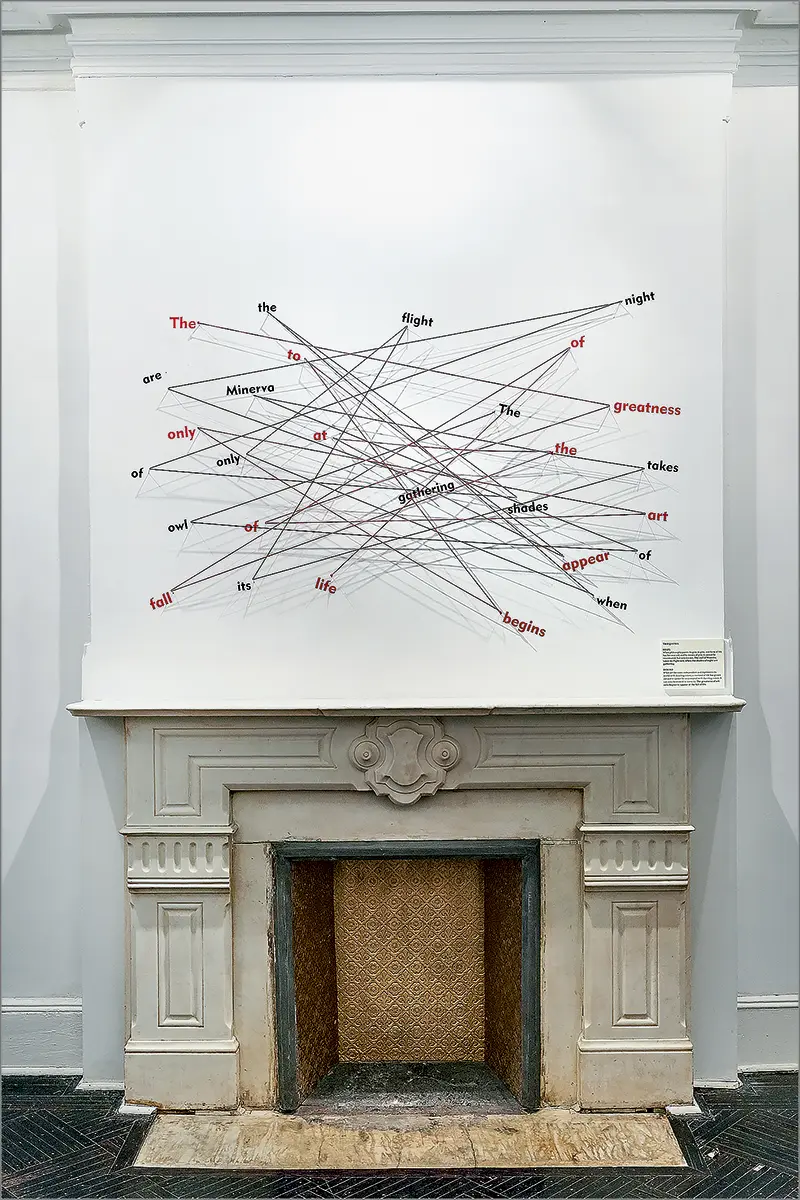
An installation, consisting of black and red words printed in a plotter, is an ideal work to ponder a central theme in the third solo show by Leandro Katz (Argentina, 1938) titled Leandro Katz: A Canoe Trip, presented at the Henrique Faria Fine Art gallery in New York. Affixed with pins to a wall that expands over a chimney, the words refer precisely to the quote by Hegel that Negri and Hard criticized. Katz once again deconstructs the phrase, not only by fragmenting it but also by including another phrase, this time by Guy Debord, quoting Hegel. Titled Two Quotes (Hegel/Debord), this work created between 2016 and 2017 invites viewers to a double-action in which the physiological exercise of the gaze and the symbolisms generated by perception converge: by following the black threads that lead to the black words, viewers can construct, with a certain degree of difficulty, the phase by Hegel in English: “The owl of Minerva takes flight only when the shades of night are gathering.” If instead, they opt to connect the red threads to their corresponding words, then they can form the second phase, this time by Debord: “The greatness of art only begins to appear in the fall of life.” But if viewers choose to approach the work as a constellation of unified words that are nonetheless isolated from their original meanings—at least those intended by their authors—then, not only the linear chronology of the phrases is interrupted, but so are the specific contents of the phrases disseminated in the piece. In this instance, the viewer, more or less aware (not a minor factor), would consciously or unconsciously ignore the fact that art and philosophy are only possible in that time-space in which the event approached has already occurred. Since the 1970s, Katz has been using language to create new languages and, with them, other times and images turned into words, and vice versa. Now he has created a language that contradicts itself time and time again: it exists to be read and learned like a phrase or image that quotes the past and the linear history celebrated by the present; but, at the same time, it negates all of the above. It is in this double operation which rather than a reflection results in negation, and sometimes in doubt—although it never stops questioning canonical models like Minerva—where all the 28 works of the exhibition by Katz intersect.
Berta Sichel wrote the following in the curatorial text for the exhibition: “Those who have been following Katz’s career over forty years and are passionate, like I am, about his short and oblique experimental films, his documentaries on recent Latin American history, or his conceptual photographs of Mayan ruins, will find that in this exhibition he is not afraid to challenge his long-time admirers. Once more, Katz wants to show that to him art is a wide subject and open to experimentation.” Sichel proposes then a scriptural “travel guide structure” to assist visitors in their walk through the exhibition and the observation of Katz’s “experimentations,” seemingly heterogeneous at first glance. This setup not only generates a temporary guided tour for the appreciation of the works but, at least in my opinion, appears to be designed to interrupt any linear chronology.
An example of this is the work that inspired the title of the exhibition and that is displayed by the gallery entrance. The first thing that catches the eye is the two dates that appear in it: 1970 and 2016. Having recently read about what Joaquín Barriendos has called the “archival twist” in Latin American art, when referring to the conceptualist practices performed during the 1960s and 1970s, revived and reconstructed in recent years,1 I thought that this was one of those instances; that, perhaps, having already exhibited these photographs more than four decades ago, now, as he considered them for this retrospective, Katz probably decided to insert texts in them. But the images, according to Katz,2 had actually never been printed before. Although they were created a long time ago, the photographs did not materialize until 2016. Katz revisited the past and used memory to construct the present and his experience. Argentinean writer Tutuna Mercado reminds us that in En Estado de memoria (In Memory State) the photographs allude to a trip that Katz took by canoe around Mayan archeological sites. In this linear temporality, the ruins do not scar until they disappear. The Mayan civilization does not disappear either in the monolog by poet and playwright Stephan Brecht shown in a small monitor. Written by Katz for the screenplay of his film Mirror on the Moon (1970), it combined Brecht identity and a story about documents lost in the river during the Colonial era. By naming and remembering them, the voice prevented the documents to disappear twice. In this manner, without grief or melancholy, the artist and poet in Katz remind us that, while Minerva’s owl exists, there are other owls, other serpents and other birds out there, which do not wait for nightfall, for the glorious sunset, to write, photograph or travel through Mayan ruins; that, like ruins, his works exist, resist and persist in his memory, in the present.
NOTES
1. Joaquín Barriendos, “Reterritorializando los sesentas. Archivos, documentos y posestructuralismo en el museo de arte,” in Alejandra Castillo y Cristián Gómez-Moya, eds., Arte, archivo y tecnología (Santiago, Universidad Finis Terrae, 2012).
2. Leandro Katz, correspondence with the author June 22, 2017.
FLORENCIA SAN MARTÍN