
“The eye is the lamp of the body. If your eyes are sincere, your whole body will be full of light,” is written in a 1959 edition of the Gospel According to Matthew (6:22). This is perhaps the source that inspired the romantic saying “the eyes are the windows to the soul.” Not directly associated with this, but unavoidably connected to it, is the group of works titled Stop Following Me, Morning Star by Colombian artist Lorena Espitia (Bogota, 1983), presented at the Museo de Arte Moderno de Medellín (MAMM) and curated by Catalina Lozano.
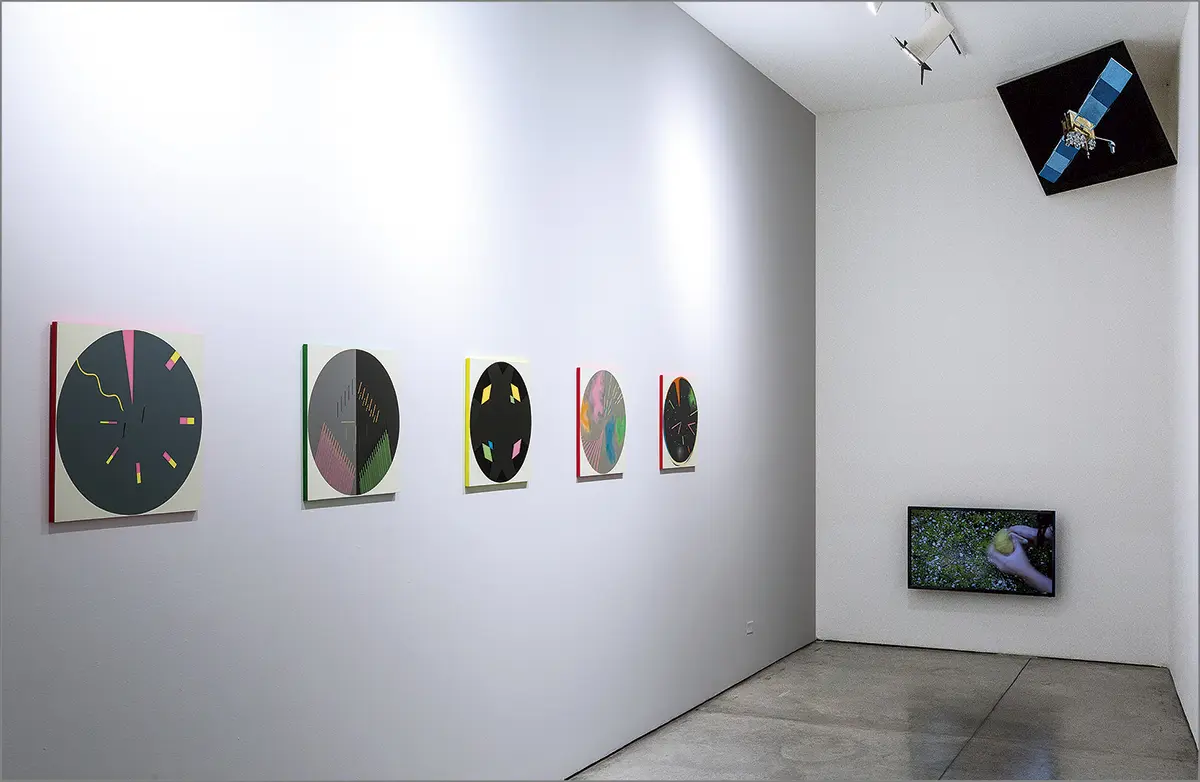
This proposal is based on the findings by Czech anatomist and physiologist Johannes Purkinje during the 19th century when he successfully deciphered part of the internal structure of the human eye and published a series of ghost images reflected by the eye—which would eventually be called Purkinje Images. Lorena Espitia displays those results in a sort of cabinet filled with multiple mediums, all of which are centered on the subjective relationships that make individuals unique and unrepeatable, where the eyes are more than protagonist; they are the liminal space that separates and connects our internal universe with the outside world that we share with everyone else.
The cabinet consists of two spaces. In keeping with the dynamics that allow for the flow of information between the internal and external worlds, a narrow corridor is a preamble to entering the main exhibition space where the development of the mise-en-scène is completed.
Three components are displayed in the external part of the exhibition. A series consisting of five abstract paintings, which haphazardly copy the experiments performed by the artist on her own eyes, is almost musical in their allegorical take on movement and time. A video once again shows Espitia trying to produce fire with two stones; one of them golden, as if it were the sun in the hands of mankind. The experiment is not successful. Above the screen on which the video is shown, an oil painting is displayed in a very unconventional manner. The vertex formed by the three surfaces, on the right upper corner of this entrance hall, holds a realistic image of the GPS Block IIIA, a new generation GPS satellite that should have been launched into space in 2014 but that, as a result of problems with its navigation controls, is now scheduled to launch in 2018. Once again, the exterior makes references to what is in the interior, precisely where an objective observer would see the globe.
The second exhibition space, already the interior, invites viewers to experiment precisely with the notion of the internal. Here, the show focuses on our ability to perceive with our eyelids closed as we attempt to see those images described by Purkinje. We are inside the eye. Two more series of paintings, both abstract, subtly seek to disrupt our perception and force us to look even further in from within. It is something like a deep introspection that pretends to generate awareness of who we are beyond our external appearance.
One of the series, the one displayed right before the entrance, consists of five circular paintings that appear to levitate over the surface. An aura coming from behind in each one creates chromatic differences between their outlines, as each format is resolved through concentric circles that gradually get closed to the center with subtle color variations. The effect is almost hypnotic.
Nine square paintings hanging on the right wall describe aleatory forms rendered with predominantly light pastel-like colors. Each is an essay on what occurs internally.
Hanging in the center of the room, slightly to the left, an intricate dance of canes with formal and chromatic variations evokes neuronal impulses. The slow rhythm proposed by this movement verges on poetry.
In a corner opposite to the walls where those two series are displayed is a curved form that connects the two surfaces: a painting of reticles drawn with iridescent colors that vertically cover the light spectrum on wood. The result achieved with this piece is as calming as it is fascinating.
To exit this eye we encounter a video projection that recreates the images of the deepest possible realm as seen from within: the Purkinje Images.
According to the curator of the exhibition, painting is not the end in itself in this proposal that is part of the C program. Nonetheless, it is gratifying to observe the way in which Lorena Espitia’s artistic prowess, when combined with science, amplifies her ability to cover necessary themes relating to matters that we often do not see because of how evident they are.
Stop Following Me, Morning Star is the poetic declaration of a young painter who is not afraid of blinding her vision of an already well-known world, as she centers her gaze in the sparks made by two stones that, like tinder, have the power to transform that which has remained intact forever. The exhibition is an invitation to take a renewed look from well within, from inside the soul’s window; through a crack that leads the gaze to eternal mysteries in realms that art is very adept at exploring.
OSCAR ROLDÁN-ALZATE