
Newspapers around the world were aburst this past July with the hulking figure of a giant white block, 5,700 kilometers in size, adrift in the Antarctic Ocean. A chunk broke off from the Larsen C ice shelf, and its journey continues to be monitored today by planes and satellite cameras. Before one read the details, the images seemed a harbinger of the apocalypse. Later we learned that the dislodgement was predictable and that it resulted from common iceberg dynamics; it is unclear whether the event is connected to climate change. Nevertheless, the alarm served to underscore the urgency of seriously confronting humankind’s recklessness towards nature.
The multidisciplinary group show Naturaleza. Refugio y Recursos del hombre (Nature: Mankind’s Refuge and Resource) succeeds in bringing to the fore humanity’s catastrophic impact on the environment, yet it also promotes a measure of redemptive hope. The selection of works recreates nature and the disaster that currently afflicts it, both emphasizing a will to defend it and shedding light on human excesses. Perhaps the exhibition aligns with the spirit of that indigenous saying that tells us: “The Earth is not an inheritance from our forefathers, but a loan from our descendants.” The artworks on display at CCK engage a number of different concerns about the present and future of nature, by means of site-specific installations, paintings, sculptures, interventions, performances, video art, and photographs.
Naturaleza… brings together 45 Argentinean and international artists, both well established and younger, as well as engineers and scientists like Joaquín Fargas and Nadia Guthmann, among others, who work with the imagination in parallel to their research; after all, art and science are together in a quest for knowledge and share a passion for discovery, albeit with different organizing horizons.
This serene yet unsettling exhibition fulfills adequately the herculean task of occupying the 2,900 square meters of the second and fourth floors of CCK, divided into ten exhibition galleries. The space opened in May of 2015 as Centro Cultural Kirchner, a tribute to the country’s late President Néstor Kirchner. Since December 2015—under a new national government—it reports to the Ministry of Media and Public Content, and to avoid political connotations it is referred to as CCK. Thousands of meters of new construction were added to the beautiful, pharaonic building of the former Mail and Telegraph Palace, designed by Norbert Maillart in the late Nineteenth Century. Its architectural importance makes it a mandatory stop for tourists and, one imagines, a nightmare when it comes to programming fitting activities; music and the visual arts dominate the schedule.
Skillfully curated by Ana M. Battistozzi, Laura Buccellato, and Gabriela Urtiaga (CCK’s General Curator for Visual Arts), the exhibition is organized around a variety of thematic axes: The Origin of an Idea; The Anthropocene; Utopias/Dystopias; Sustainability/Ecological Compromise; Creative Activism; Estrangement; Ecosystems; New Worlds/New Natures. “The exhibition suggests an approach to an always urgent subject matter that probes the growing weight of the anthropogenic footprint on our ‘environment refuge’. Natural resources as a topic, a source of inspiration, an instrument, and a representation, as a vital and aesthetic power that speaks also of an epochal shift, of new laws and new logics for an understanding nature’s force and the development of humankind in an inexorable ‘environment resource’,” Urtiaga notes.
Energy, Water, Air, Earth
Some of the works in The Origin of an Idea imply a degree of confidence in the future, science, and technology, while others critique modernity as unfinished. Echoes of a spiritual quest in Bord de Mer, by filmmaker and photographer Agnès Varda, with photographs and film, with the sound of water and the sand from a beach. Tomás Saraceno found inspiration in the utopian metropolis suspended in space of Gyula Kosice Ciudad Hidroespacial (Hydrospatial City), an architecture and urban-planning project where humanity was to relocate as it fled overcrowding and contamination.
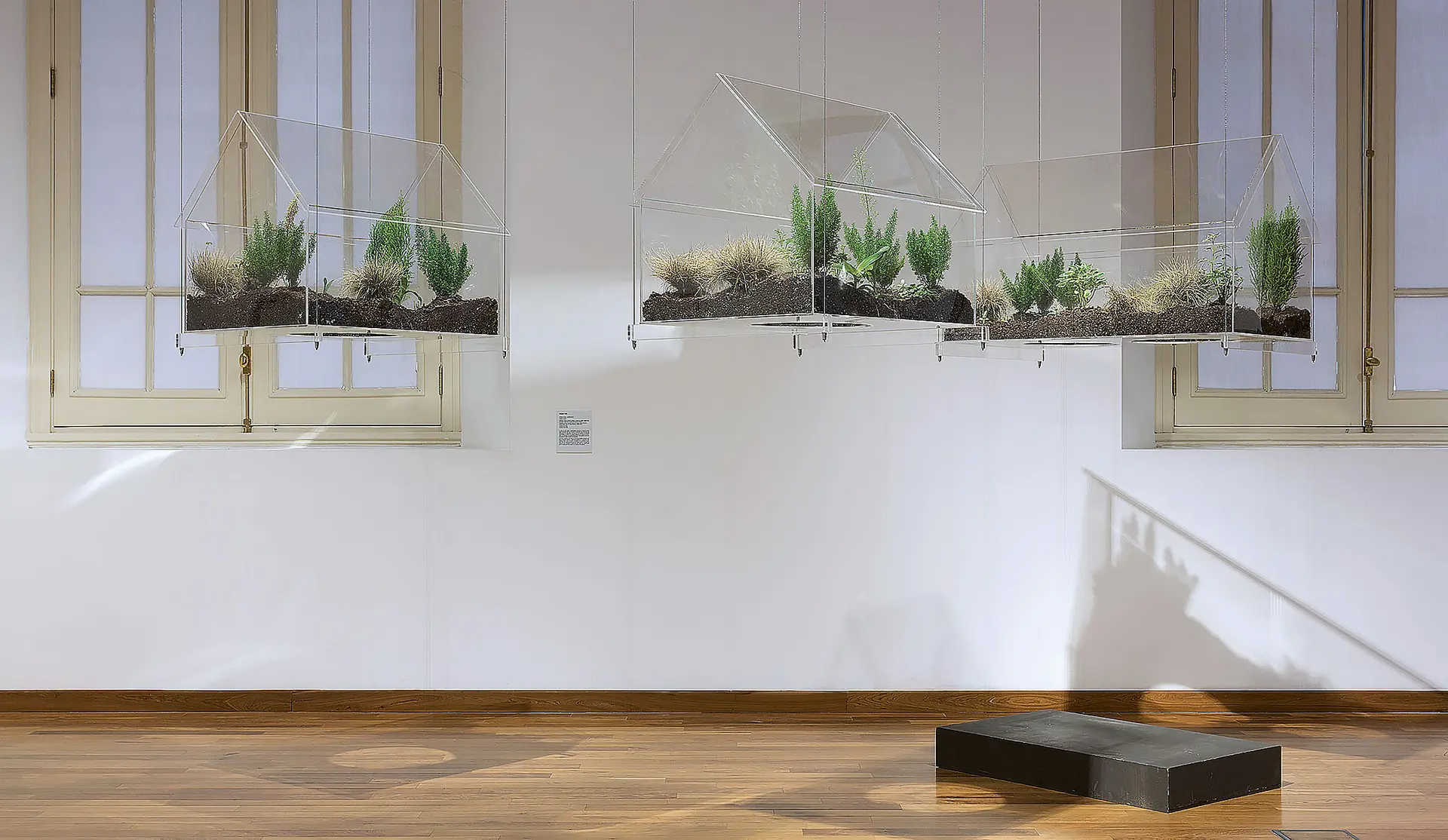
With his research in biology, Luis F. Benedit engages the relationship and the contrasts between nature and culture, while Nicolás García Uriburu deals with the contamination of the waterways by means of bottles filled with a green-looking liquid—the color of rivers and canals, like those in Venice. In this first gallery, we also encounter Vaughn Bell’s hanging gardens; Lucy + Jorge Orta’s universal Antarctic passports promoting a borderless community able to take care of the environment, Antartica World Passport; Cécile Beau’s fishbowls with rare waters, plants, rocks, and sound devices; and Número ocho, Todo va a estar bien (Number Eight, It Will Be All Right, 2007), a video by Guido van der Werve presenting the gripping image of a man walking in front of an icebreaker in the vast white expanse.
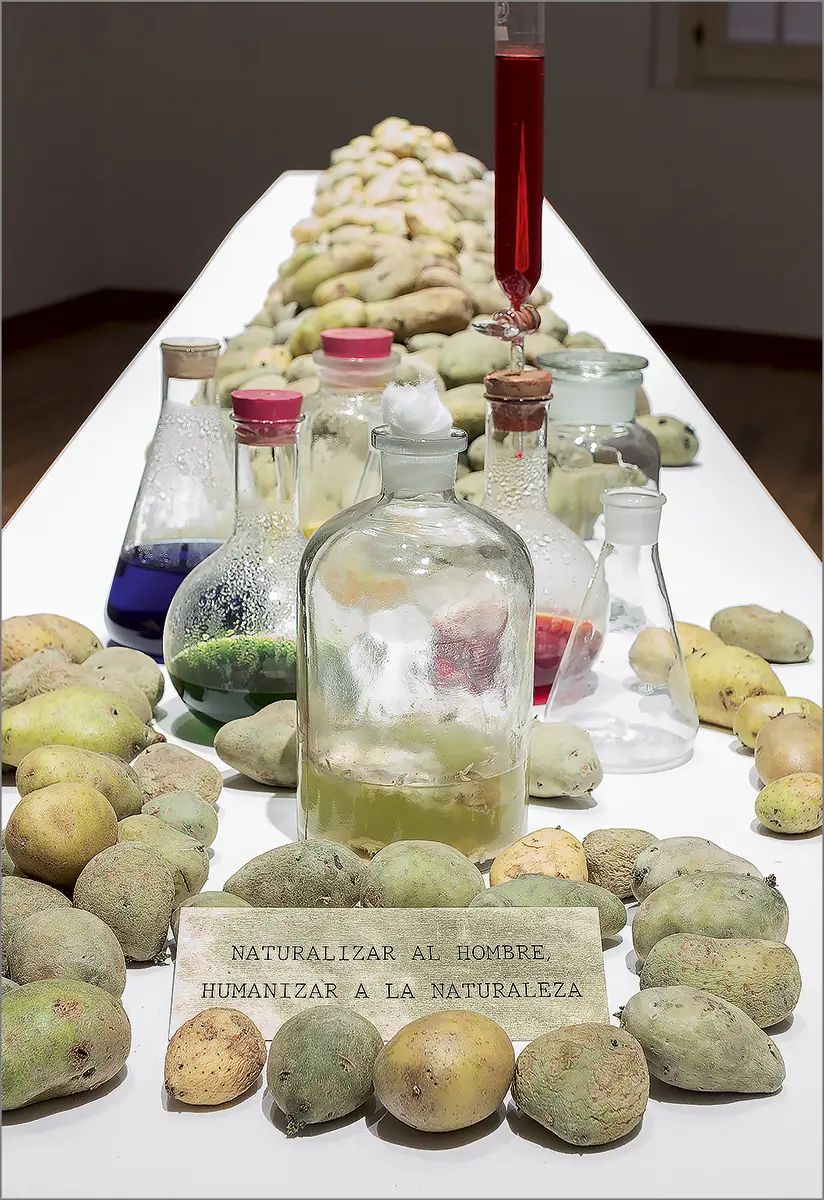
Víctor Grippo’s work occupies the Alternative Energy gallery. His installations using potatoes—a native plant to the Americas that later became a European staple—are metaphors as well as sources of energy and reflection. They also prompt us to consider the relationship between colonizer and colonized; on exhibit here is Naturalizar al hombre, humanizar a la naturaleza o Energía vegetal (Naturalizing Man, Humanizing Nature or Plant Energy, 1977).
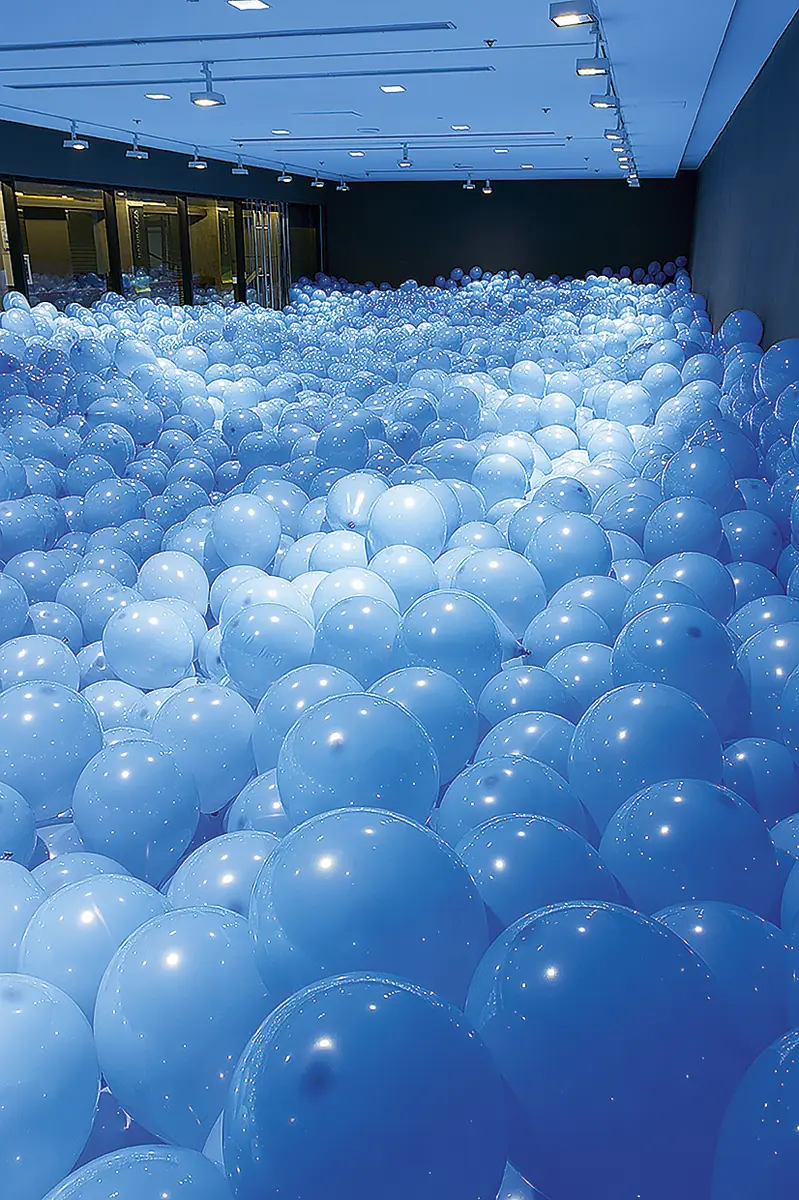
Air, enclosed in festively colorful balloons, is the material/immaterial with which Martin Creed works in Half the air in a given space. Creed’s intervention occupies half the gallery and invites the audience to play, altering our perception of the space. Visitors plunge into the work as if into the sea; for some, the reference is also to the accumulated plastic debris that is choking life in the world’s oceans.
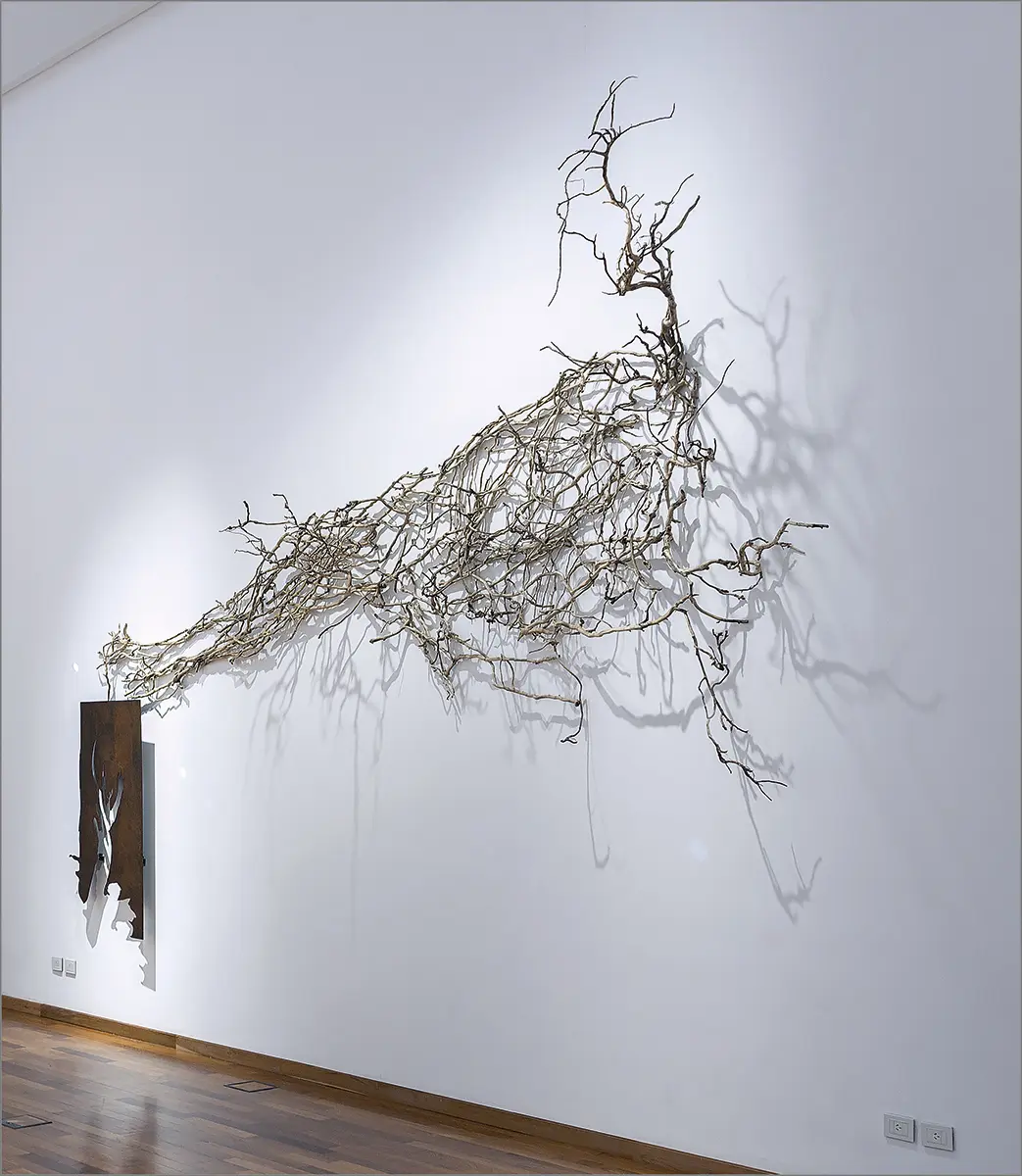
In the section titled Earth, planet, and protective mother, Fabiana Imola presents an installation of branches and seductive laser-cut stainless steel sculptural objects of different thicknesses, mimicking nature. Lucía Madriz explores—in a mandala of seeds—humankind’s connection with the natural world. In Vientos de Buenos Aires (Winds of Buenos Aires, 2017), Ricardo Pascale builds a work where the organic and the constructive coexist. Carlos Ginzburg cites Plato in his reconstruction of Tierra cúbica (Cubic Earth), originally created in 1971.
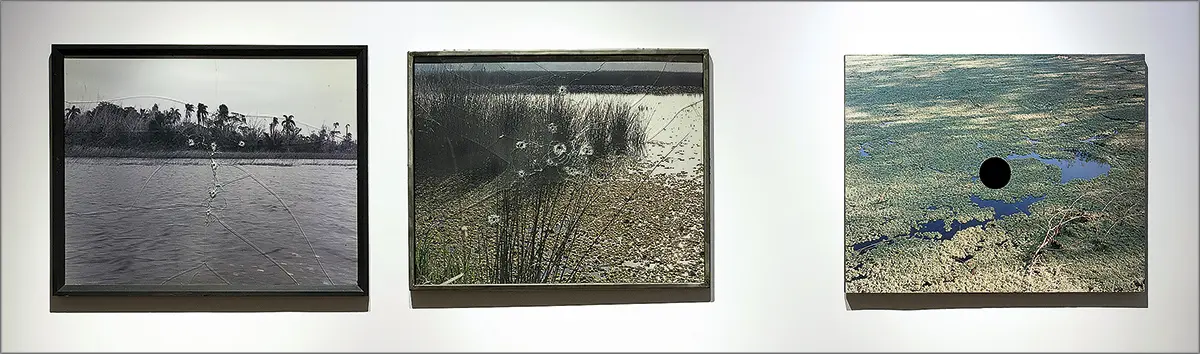
The Anthropocene space features works by Jacques Bedel, Jane Brodie, Rómulo Macció, Marie Orensanz, and others such as Oscar Bony with his Fusilamiento latino o Amazónico/Pantano (Latin or Amazonian Firing-Squad Shooting/Swamp, 1998), from the artist’s series of bullet-ridden landscapes and self-portraits. In Sebastián Díaz Morales’ existential tale—El hombre con la bolsa (The Man with the Bag, 2004), HD Video installation—we see a man carrying his belongings, walking, running, always tripping over the same rock in the Patagonian desert. In Ascension, his 2000 video, Bill Viola plays with duality. Sunlight illuminates dark waters as a fully dressed man, his arms opening cross-like, suddenly invades them. Drowning or redemption?
The Anthropocene? According to some scientists, it is the “Age of Humans”: a new geologic era of the Earth that, because of climate change, has brought the Holocene to an end. For others, the term, first used in the year 2000, is a political statement rather than a scientific idea. The concept is also debated in the social sciences and the humanities, philosophy, and history. In our region, critic and curator Alfons Hug put the term into circulation at the Biennial of the End of the World (2011), and the art world promptly adopted it as its own.
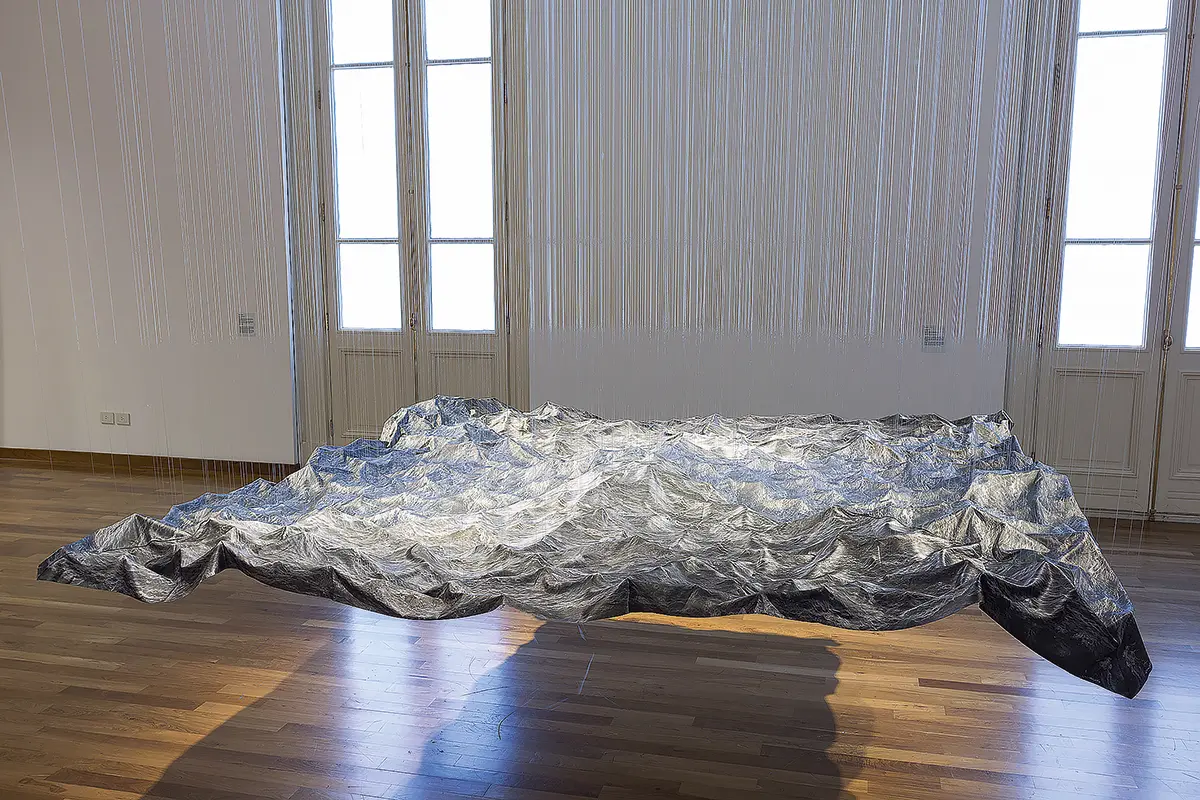
The proposal and ideal in Living Together bring together Valeria Conte Mac Donell, Miguel Harte, Leandro Katz, and Gabriel Orozco. Is it possible to coexist? The elements are about to overflow the agitated seas printed on the canvas—hanging from the ceiling by fishing lines—of Miguel Rothschild’s El diluvio (The Deluge, 2015); they are about to explode in Ana Mendieta’s Volcán (Volcano, 1979), which uses a geological structure to emphasize a certain ecological undercurrent and highlight the feminist eruption/irruption in the society of its era.
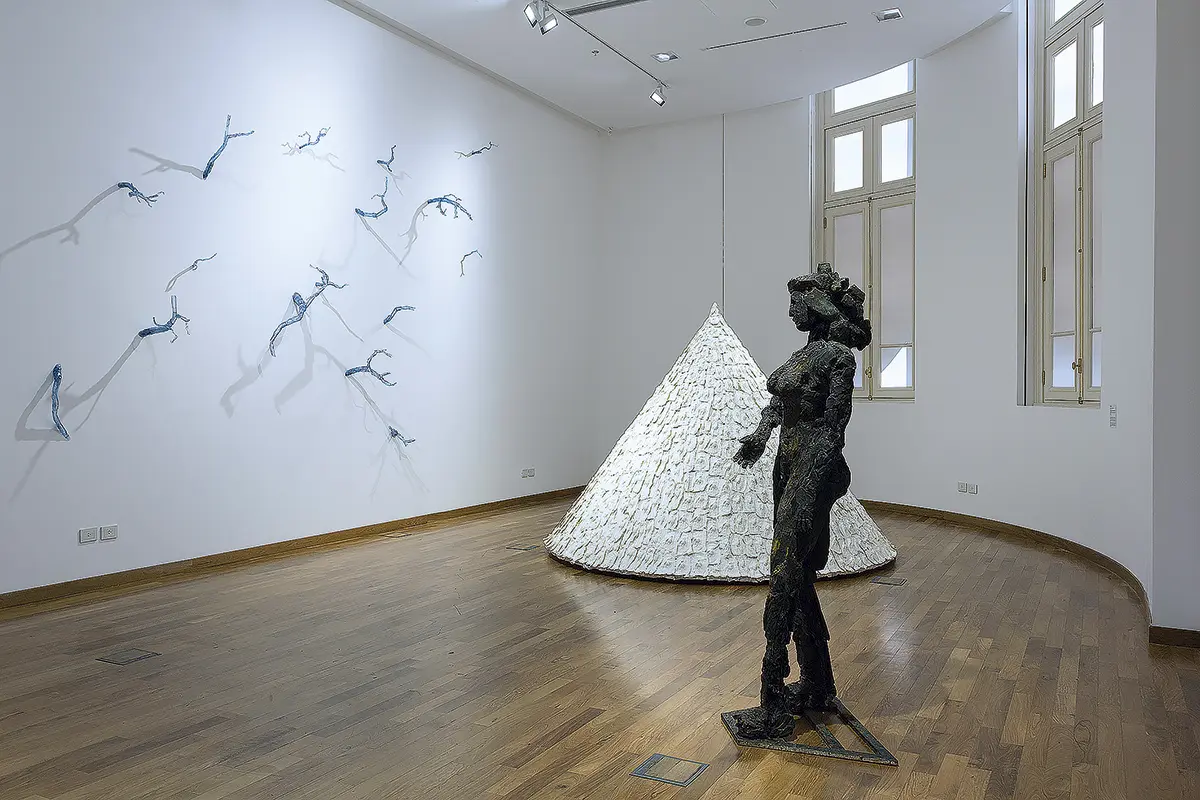
The section Footprints of Man focuses on the consequences of urban growth, of megacities, in works by Margarita Paksa, Vicente Grondona, Pedro Tyler, and Rimer Cardillo, with molds of birds clashing against glass-walled buildings and car windshields, arranged into a pyramid shape that resembles an anthill (cupí, in the Guarani language): Cupí de Buenos Aires (Buenos Aires Cupí) underscores man’s excessive meddling in nature.
The two galleries devoted to Dystopias hold Nicola Costantino’s El verdadero jardín nunca es verde (The True Garden is Never Green, 2016)—a dramatic sculpture and painting installation with 3D printing and depictions of the artist and some colleagues, inspired by Hieronymus Bosch’s The Garden of Earthly Delights—and Gabriel Valansi’s La premisa de Pompeya (1:32), (The Pompeii Premise, 2017), where a detailed 32:1 model of a drive-in movie theater—its audience watching a projection of nuclear tests—announced his skepticism (and the end of civilization?).
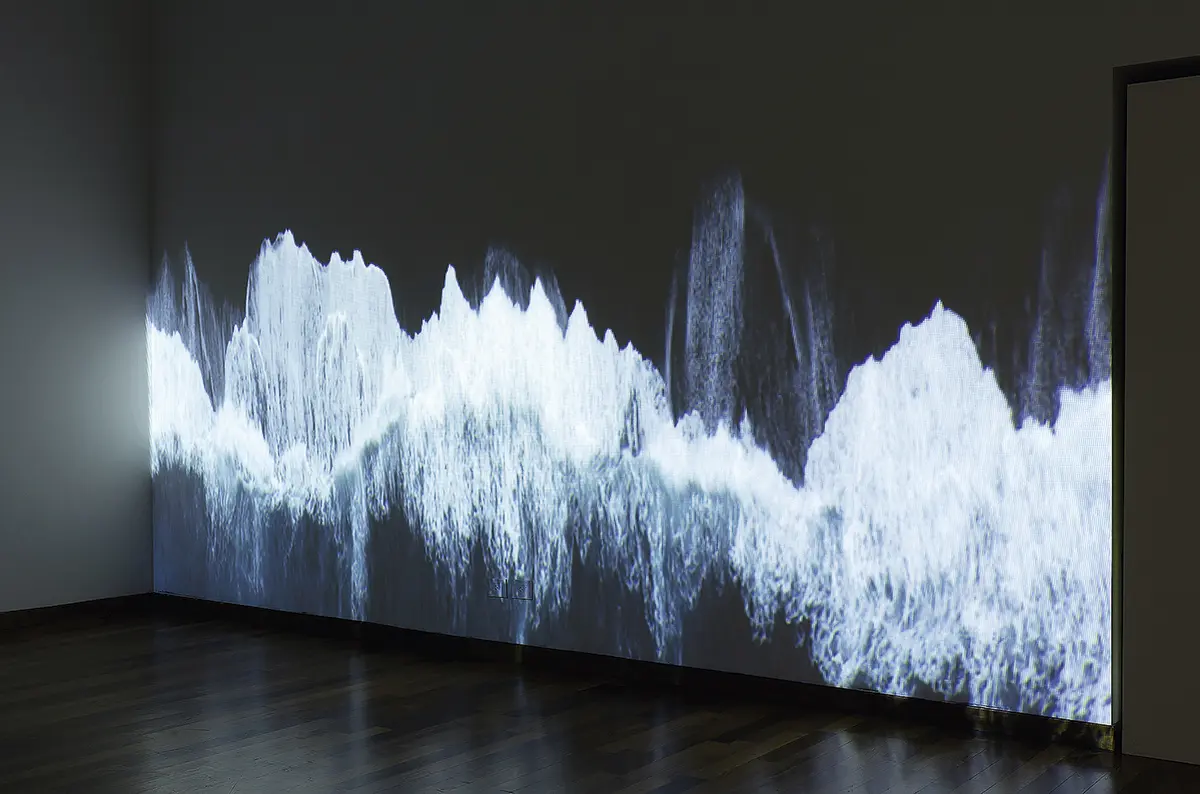
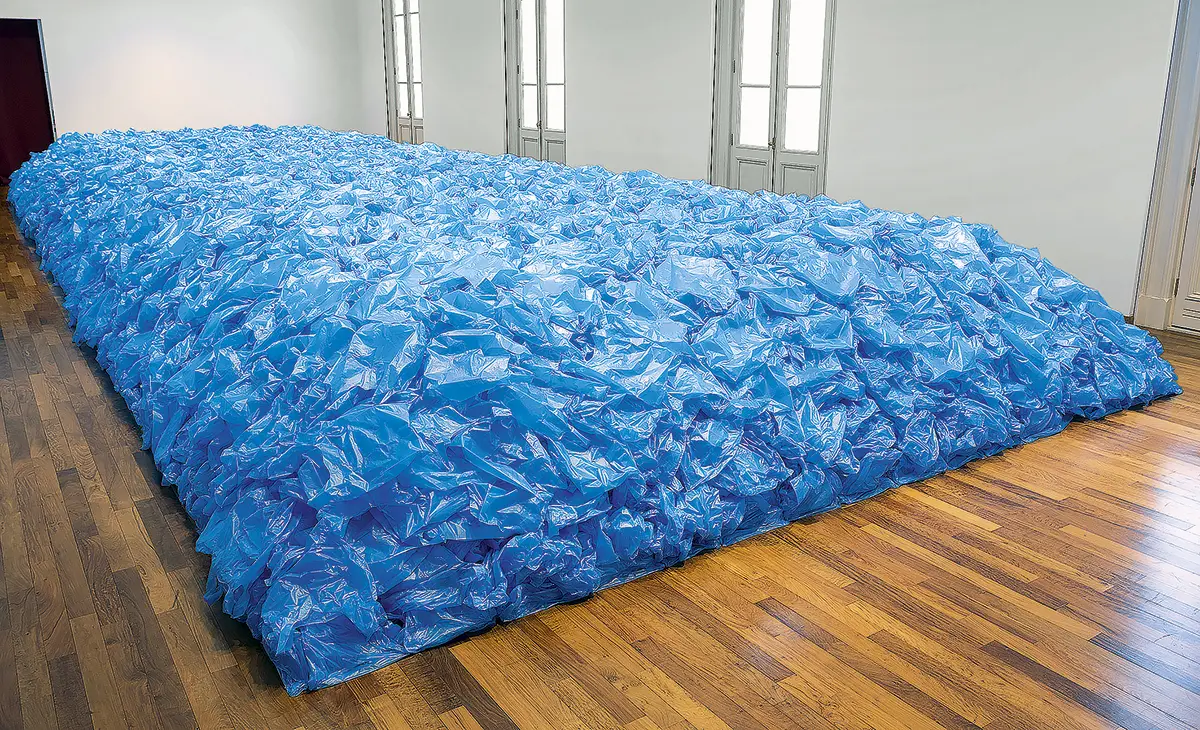
In the Water section, we see the waterfall, drip, be illuminated “like the fleeting course of existence” in Silvia Rivas’ visual and sound work in HD digital video Transcurso y urgencia (Time Passage and Urgency), from her series Notas sobre el tiempo (Notes on Time, 2000-2007). Jean-François Boclé uses a “sea” of blue plastic supermarket bags to recreate the (polluted) Atlantic Ocean and critique consumerism. In the HD video La Mer (1991/2014), Ange Leccia projects, vertically, the uninterrupted crashing of waves on the shore; the result is a beautiful vista that suggests frozen mountains and, at times, also the zigzagging lines of an electrocardiogram.
The show is presented in the context of the Year of Renewable Energy, and after its closure, many of the recyclable elements used by the artists will be sorted by “environmental cooperators” to continue their paths of recycling and the cycle of sustainability. The majority of the works on exhibit—which denote great understanding and compassion—could stand alone in any context, but as part of Naturaleza. Refugio y Recursos del hombre they are deeply inspiring.
*Courtesy: CCK Press.
VICTORIA VERLICHAK