
“Not only an intertwining of parts but also tears and patches, distances and approaches in the fabric that Nicolás Franco presents us with.” His artist colleague Eugenio Dittborn wrote these words about Nicolás Franco’s work. Fabric. It could be a good way to approach Franco’s art. As if his works in two dimensions were skins, membranes that suffer and put their suffering on display as they are stretched, tortured, hung from a museum’s wall. Yes, it is a good approach. Also a painful one.
The protagonist raises a hand to his head, closes his eyes firmly, with seeming effort, as though threatened by a sudden bout of migraine caused by memory. Violent, traumatic memories are then represented by a sequence of intercutting photo stills, low-angle shots, incoherent details, and outsize enlargements. A visual collage lasting no more than two seconds, yet sufficient to provoke a sudden reaction. This is how the reminiscence of a violent event is to be visualized according to the language of the film; it is, for instance, what Christopher Nolan does in his film Memento (2000), whose protagonist is prodded towards remembering by the conjured-up images of his wife’s murder. There have been, however, rebellious filmmakers who proposed different ways to prompt a terrifying evocation. I am thinking (hand duly raised to my head) of Stanley Kubrick in The Shining (1980), with his long slow-motion sequences and open shots, or David Lynch’s similar solutions for his dream sequences.
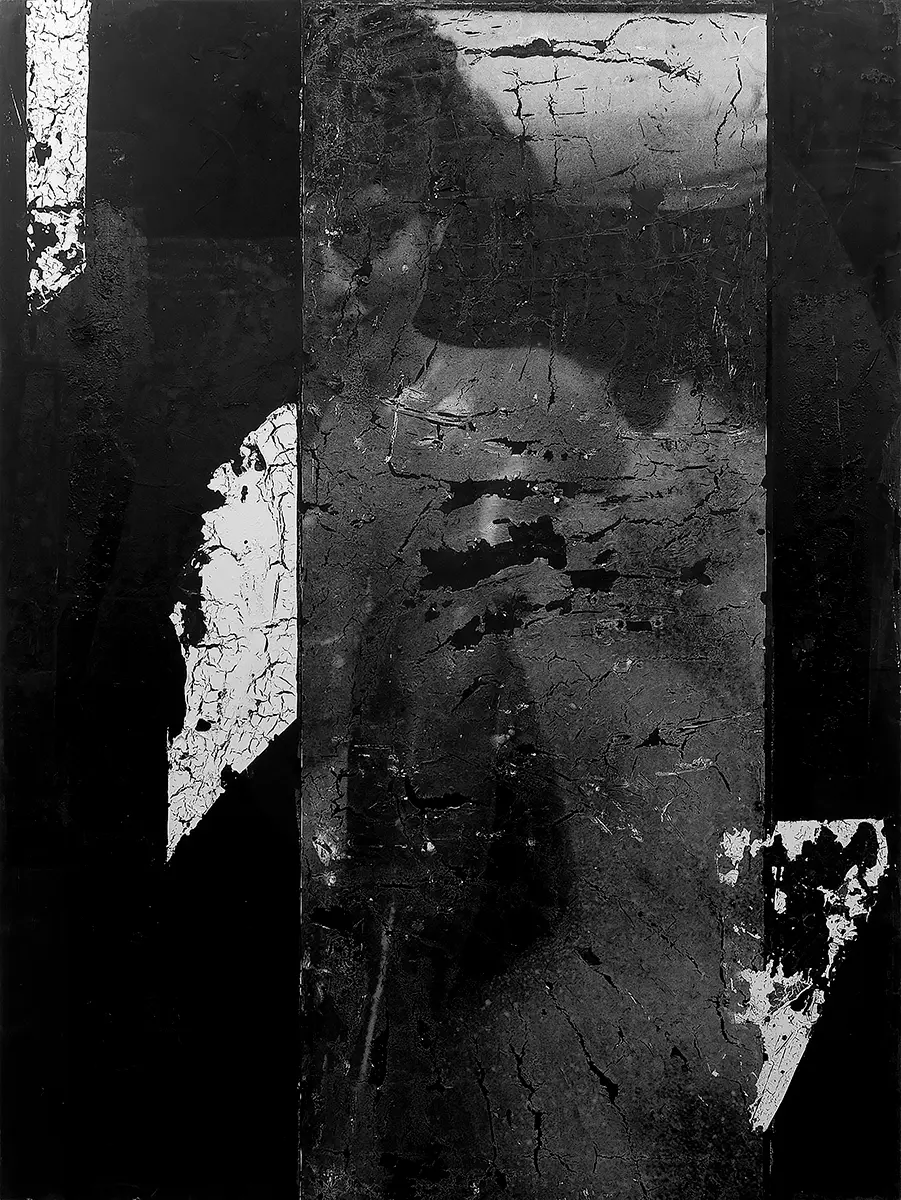
We are talking about technique. In 2010, Nicolás Franco began to work with digital monotypes. An engraving that produces a single print can be the result of many layers of work: “An image is printed on a piece of industrial plastic. The ink in this print doesn’t dry, it remains latent; this allows the image to transfer into different materials. In these transfers of information from one support to another, accidents occur, rips and tears, cracks and pieces of information that become unstuck.”1 That year was an important landmark in Franco’s evolution, as he found an effective and pliable vehicle for conceiving images: “I found tools that then derived in other tools.” The photographs with which the artist works contain violence, ardor, and fury in a latent, recondite, and furtive form. For someone interested in finding coherence between form and content, between what he wants to express and the way to express it (“to join the referent to the procedure,” is how he describes the operation), finding a process like that of the digital monotype can be a veritable revelation.
Distortion
Another important, perhaps foundational moment for Franco was the culmination of his Psychobuildings (2005), a visual work inspired by artist Martin Kippenberger’s 1988 book of the same title, which featured innocent black and white photographs of architecture. Yet there is something in those images, something that is there—or perhaps that isn’t there—and emits a chilling background noise, an air of suspense, an abrasive texture. Nicolás Franco brought that feeling to a visual format, building a video collage of clips from more than one hundred suspense and horror films, all in search of that which is not there. The use of a subjective point of view inverts roles: the victim becomes the perpetrator and the perpetrator becomes the victim. In the same way, in which some video games—for instance, the Doom (1993), Duke Nukem (1991), or Resident Evil (1996) sagas—introduce the first-person player who walks along hallways, explores vacant lots, and enters attics while tensely expecting an enemy to appear at any point, Psychobuildings is able to transform a walk around the various interior and exterior architectural spaces into a horror movie, one that, as the description of Franco’s work has it, “does not speak of architecture, but of violence.”
“I am interested in the photographic distortion of images in suspense films,” Franco says. Psychobuildings marks a turning point in his career (similar to the discovery of monotypes in 2010). Franco returned to his native Chile in 2011 after finishing graduate studies in Visual Arts at De Ateliers, in Amsterdam, and a sojourn in Madrid. His return did not translate into a period of productive doubt until what he was searching for appeared where it wasn’t. Psychobuildings made it possible, again in his own words, “to envision a line of work where the central phenomenon was distortion, or the torsion of shapes, dominated by black and white, by the use of non-artistic materials and found images from film and photography, and by astonishment.”
Astonishment
I did not hide my surprise from Franco when I asked him about his emotional state as he worked in his studio. “Tension.” Rather than enjoyment, concentration, or creative absent-mindedness, what he feels is stress. “I do not really trust the ideas, the work kind of has to create itself. That implies moments of uncertainty. The process is difficult because there are times when things just don’t work.” Understanding Nicolás Franco’s art and the creative process involve mistrusting ideas—and images—and letting oneself be “stressed” by them. When things do work, Franco’s art produces precisely that wonderment in the viewer, an outburst that has the artist himself as to its first witness—or victim: “It has to do with astonishment. It is great to do something that astonishes even yourself.” The fact that the artist mentions that word, “astonishment,” so often—in Spanish, asombro—merits some consideration of its etymology.
In Spanish, the prefix a- means “next to” or “proximity,” but it may also indicate its opposite: “without.” Sombra, meanwhile, means “shadow,” the dark projection of the image of an opaque body as it intercepts light. Thus, two possibilities obtain asombro as the proximity of a shadow, or as something that dispels shadows. In the first instance, asombro, astonishment, has to do with the proximity of/to something that frightens us. In the second instance, it is what takes us away from that shadow, like a light that brings us metaphorically “out of the dark,” enlightening and freeing us from ignorance.
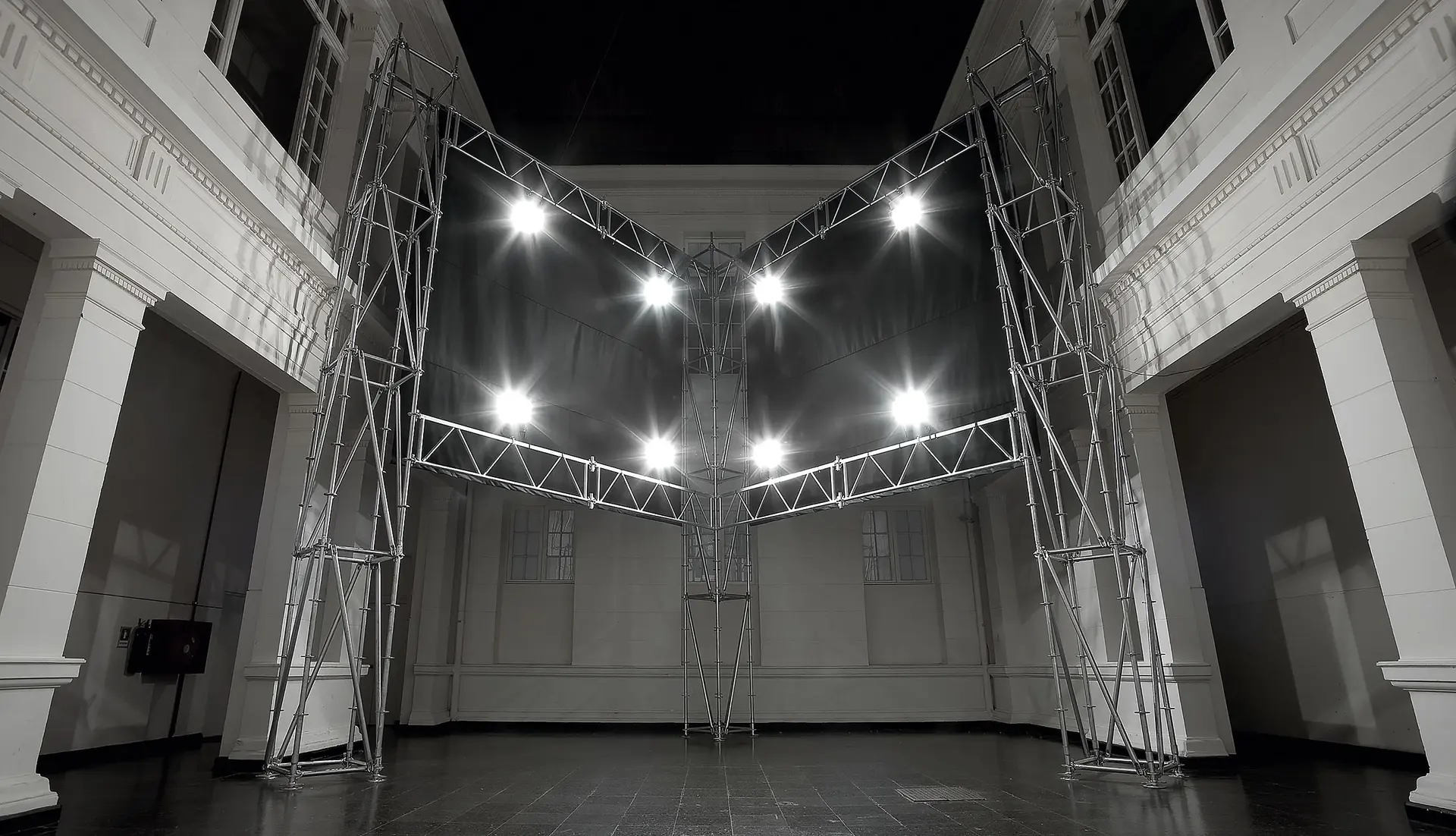
Both meanings apply in the case of Franco’s work. The materials and the way in which they coexist generate a new reality that both sheds light on things and frightens us. For an almost literal example of this, we can look at Metal drawing/Género negro (Metal Drawing/Black Genre, 2009). It is a tower of lights split in two, a broken metallic structure supporting two large black tarps from which eight powerful floodlights shine towards the audience. This is the “negative” of Dora García’s Luz intolerable (Intolerable Light, 2004), which sought to blind its viewers. Género negro does the opposite; it was to illuminate its audience, introducing it into the very essence of shadowiness by means of a label taken from the world of cinema, the género negro (the Spanish term for noir films and hardboiled detective fiction) that encompasses thrillers, suspense, and crime movies. However, work like Unknown/Twin girls (2010) seems intended to frighten us, or at least to make us uncomfortable as we confront the repeated image of a woman whose eroticized smile and gaze invite us to come closer, to join her/them in the tub, appealing to our consciousness and our unconscious and attracting us as if by the physical effect of the large magnets placed at the center of the photographic image. We have no doubt that the twins’ sexual promise is a trick, yet we can’t avert our gaze.
Magnets. These unusual elements appear in several of Franco’s works, and they have a dual function: to hold a two-dimensional work and to add a visual reference. The image’s “attractive” charge is obvious in a scientific sense, but its introduction is due to a fortuitous event. In 2008 Franco was absorbed in a sound-art work, Obituario (Obituary), based on interviews with different people who described the moment of the greatest danger they had experienced in their lives. This work was accompanied by a photographic transfer with which the artist wanted to “play.” In it, the magnet appeared as a dialectical possibility in response to the intention of bringing photography into three-dimensionality. Later, in an exhibition at the D21 gallery, the magnets became a point of reference.
To understand Franco’s use of unorthodox materials we may need to look back to his Spain years, when he was in contact with the standard-bearers of the New Basque Sculpture movement (Jon Mikel Euba, Txomin Badiola, and Asier Mendizabal, heirs to Jorge de Oteiza and Eduardo Chillida), as well as to the artist’s fixation with elements taken from his immediate surroundings as raw materials for his installations. In other words: those Basque artists work in a region where the metallurgy and wood-products industries are dominant, and their work naturally reflects it. The idea is to keep identity, tradition, and local conditions insight in the creative process while exercising a contemporary gaze. This takes us to the question that Franco posed to himself upon returning to Chile: What is Chilean identity? Any answer will be, at the very least, confounding, and other possibilities emerge from this imprecision. If the outside world does not provide clear anchors, we must look inside, no matter how dark, deep, or ungraspable it is. Perhaps in that abyssal dimension, we will find that original artistic anxiety: the quest for the sublime as that which cannot be named (“The sublime appeals, rather, to a negative ontology, which does not prevent the following absurdity from being expected from the arts: that they bear sensible witness of something that is missing from or exceeds the sensible; the name does not matter, it is the unnamable”).2
The Science of the Mind
In 2004 I was working as a reporter for Televisión Española (Spain’s public broadcast corporation) in Extremadura. The cameraman and I traveled to a town in Las Hurdes to cover the news of a young woman’s suicide. We were welcomed with a hail of stones. When their fury subsided, I asked the townsfolk why, and they said it wasn’t an attempt to protect the privacy of their family members: the people of that town rejected cameras because of the memory of Luis Buñuel’s 1933 film Las Hurdes remained alive for them seventy years later.
Nicolás Franco encountered Dalí’s and Buñuel’s short films as a young man, and later he read the Aragon-born filmmaker’s autobiography, Mi último suspiro (My Last Sigh, 1982). Although several decades passed between these two approaches to Buñuel, Franco’s fascination with his imagery remained intact. It served him as a sieve for meditations on the representation of violence, the ethics of images, and the contemporary world’s visual saturation. In Tierra sin pan (Land Without Bread), a 2015 show at the Centro Cultural de España (CCE), Franco dialogs with Buñuel in two separate instances: La imagen y su doble (The Image and Its Double) and Registrar los detalles de un gallo blanco (Recording the Details of a White Rooster). The complexity of this exhibition allows us to identify some of the resources with which the artist has worked and continues to work.
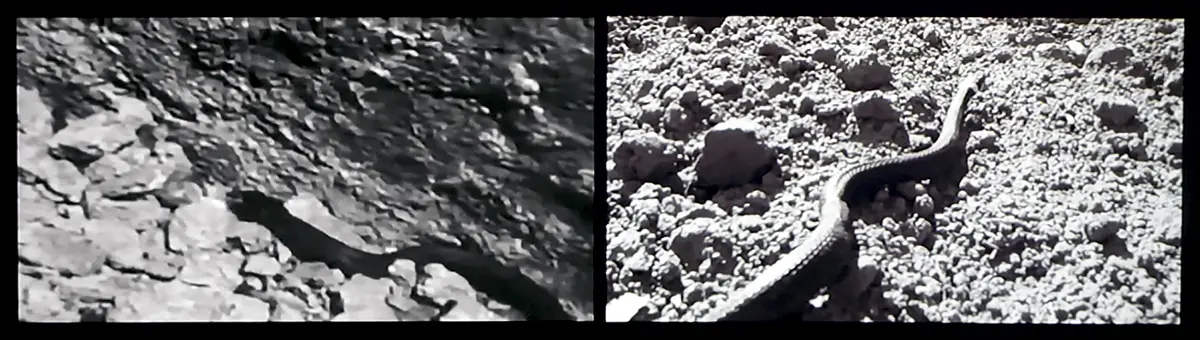
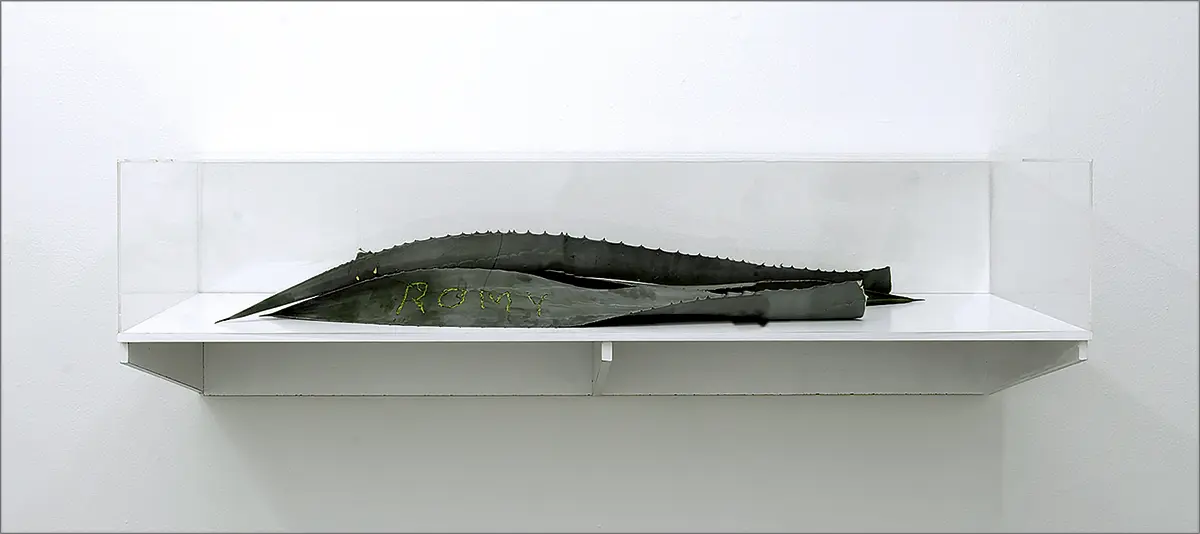
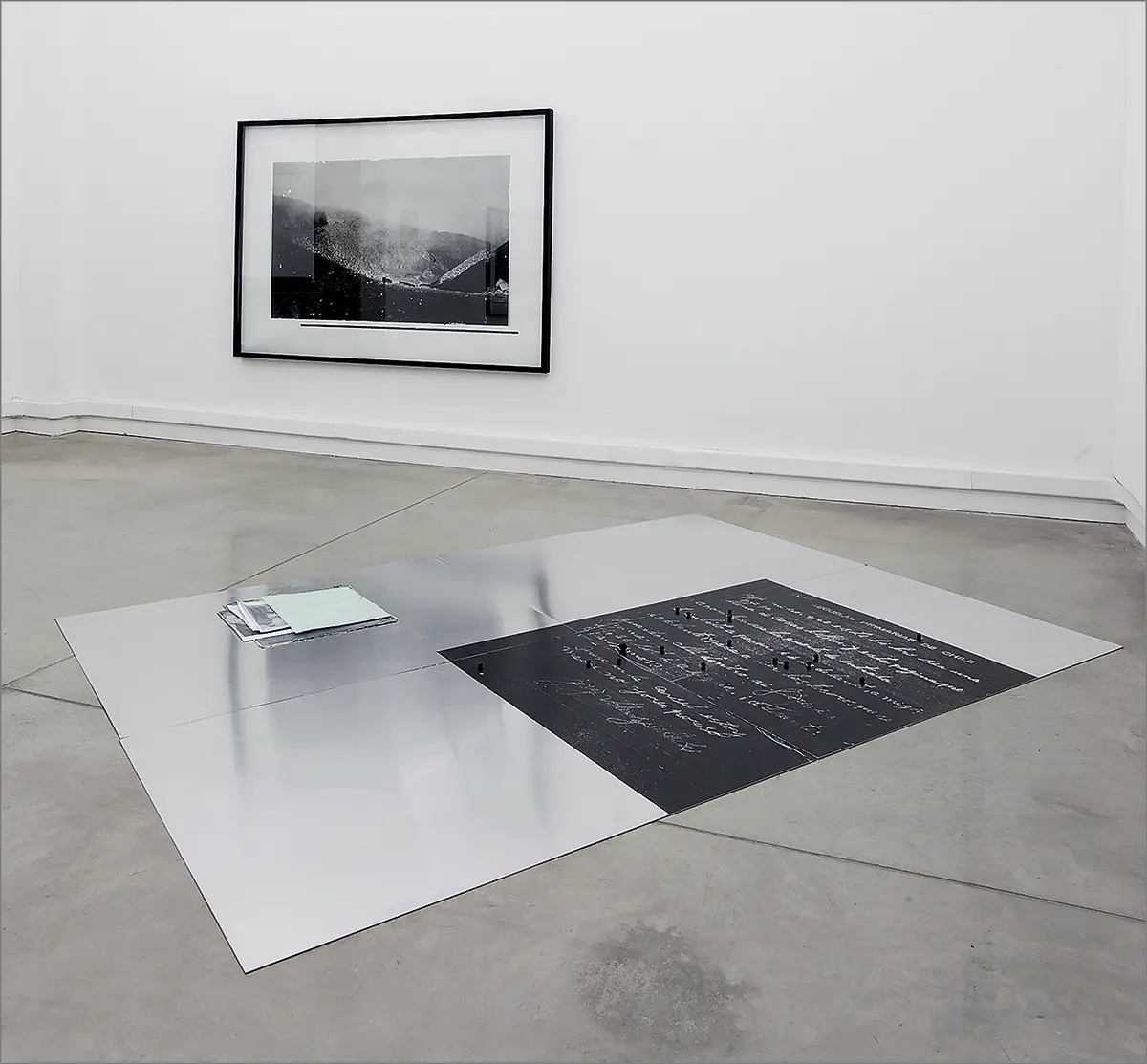
The projection La imagen y su doble sets two sequences from Buñuel’s documentary against unintended replicas found in virtual platforms such as YouTube and Vimeo, produced in places like Nepal, Papua New Guinea, Mexico, Ecuador, Lebanon, Kenya, or Nigeria. This projection is accompanied by photographs of stills (i.e., photographs of photographs) arranged directly on the floor. Other objects become central, like a tooth—acquired in Borneo—on a lightbox; a Paraguayan horn “tattooed” with the phrase "Life’s a state of mind;" and some agave leaves with an unsettling inscription: Romy. Aspects of surrealism are reused here to generate a sensation, an emotion: we must not search for logic or a narrative, just as Buñuel did not intend to approach “the truth” in his documentary film but to generate “a truth”—all of which seems in sync with the current moment of Trumpian post-truth.
In another space at the CCE we encountered tables with photo stills from Buñuel’s documentary and pieces of wood holding quotes from the original screenplay, like “the only luxury to be found in this country of misery and suffering is in the churches” and “here, famished children are also taught that the sum of the angles of any triangle is equal to two straight angles.” This assemblage reminds us of the one used by Goya in his The Disasters of War (in its tone, the nature of its images, and its textual rawness), and it confronts the power of images with the power of words. On exhibit in the same space are two videos of mountain landscapes and the flapping wings of a white rooster.
Cut in Pieces
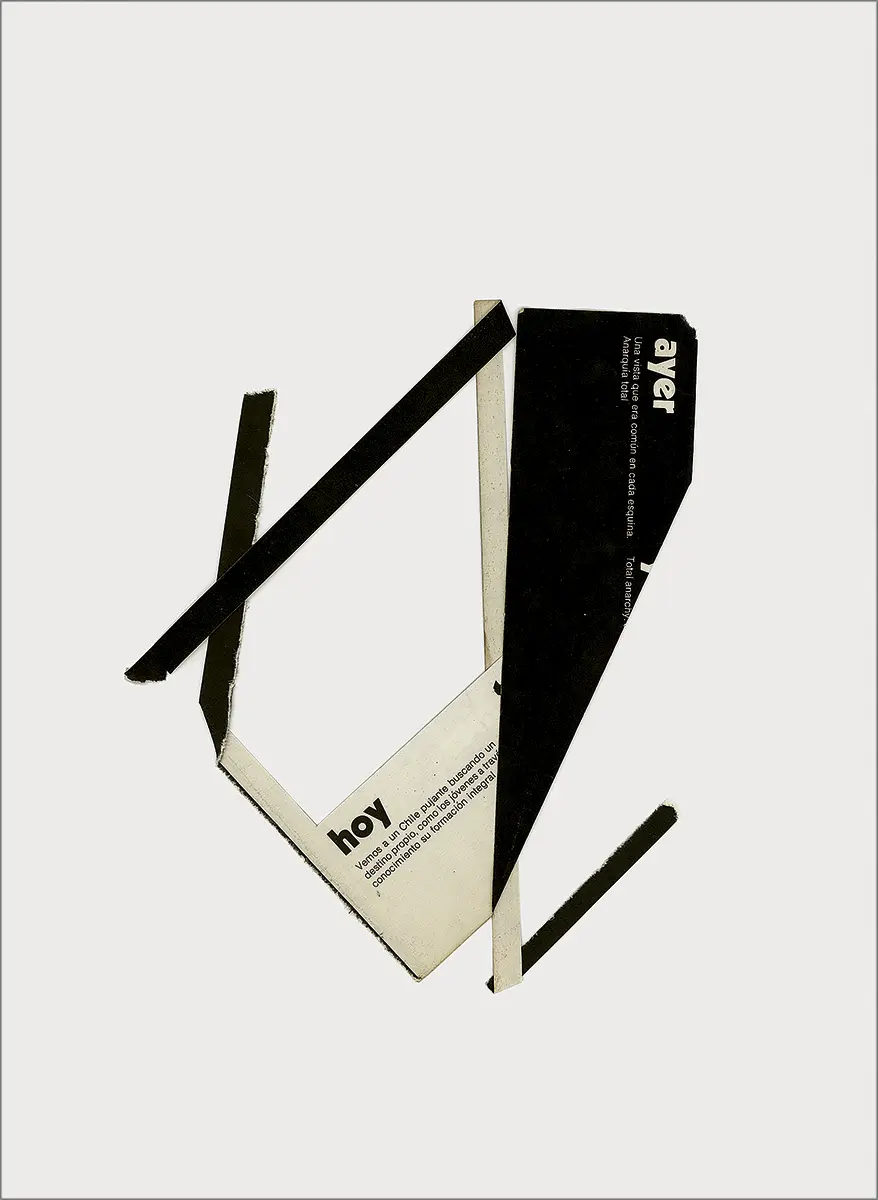
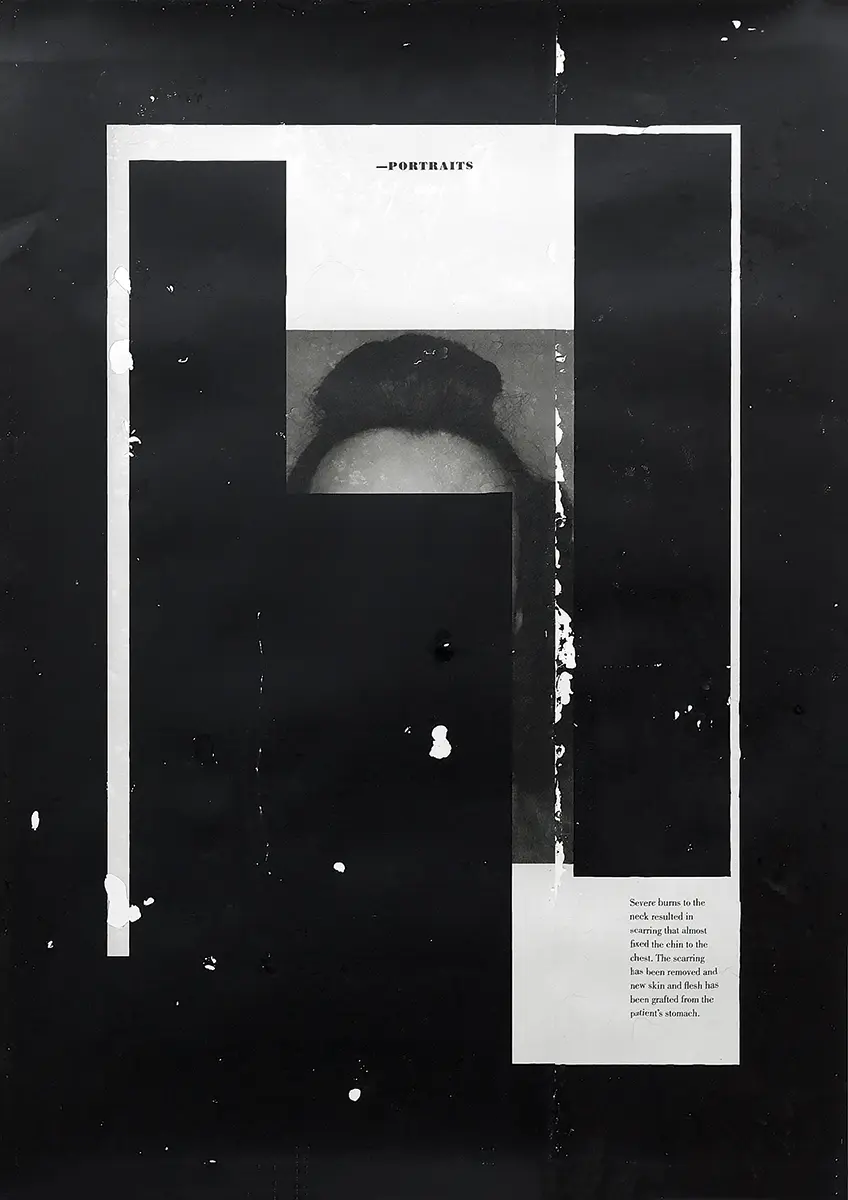
Let’s consider again Franco’s modus operandi, his method to generate works of art, which will perhaps provide an instrument to interpret his oeuvre. Ayer y hoy (Yesterday and Today, 2013) focuses on a propaganda publication of the Chilean dictatorship; Cortado en pedazos (Cut in Pieces, 2014) is based on scientific publications about eye lesions suffered by soldiers in WWI; Circa (2014) uses letters written by Chacal de Nahueltoro, the murderer of his wife and his five children.
Writer J. G. Ballard nourished his work by reading texts on orthopedic surgery and traffic accidents and recommended books on optics, transcriptions of airplane black-box recordings, or the yellow pages of the Los Angeles phone book. His ultimate goal was to “deal with reality as if it were fiction.”3 In the search for or the recreation of abjection by means of the fragmentary, the residual, the damaged, the cut in pieces, one can approximate a global understanding, just as Ballard concluded: “a car accident, with the many wounds it causes, reveals humanity’s true nature. It should not provoke, then, any macabre fascination, nor its opposite (whoever is interested in the subject is obviously a pervert).”
Objective Coincidences
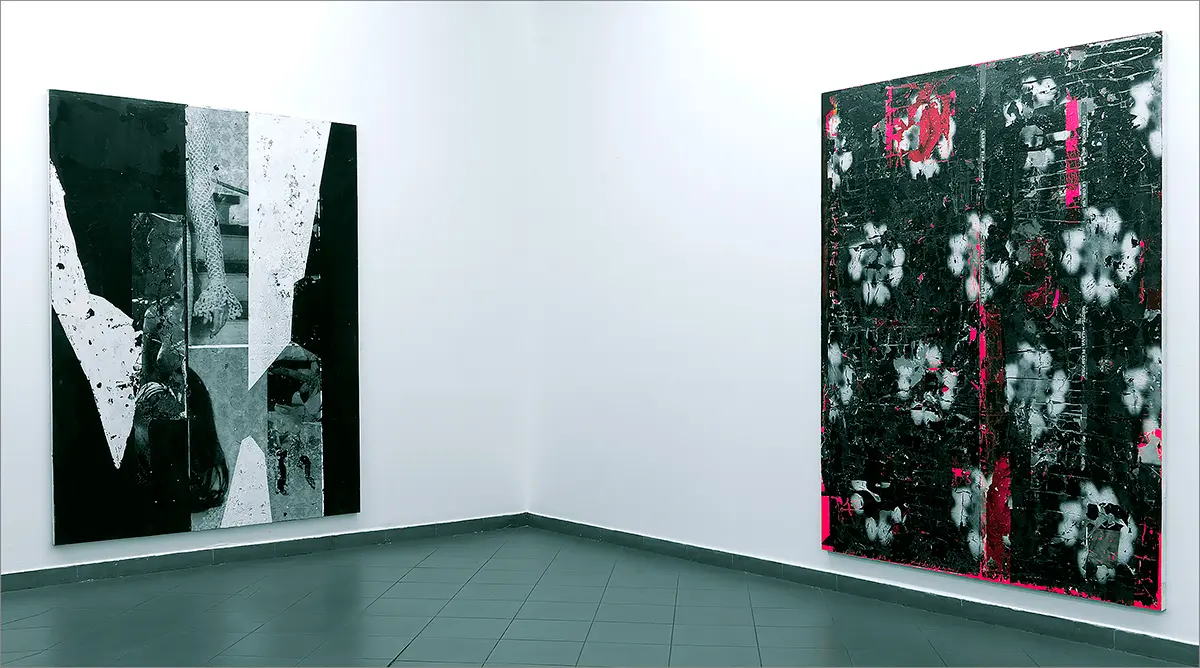
To conclude this atomized guide to visualizing the astonishment of Nicolás Franco, we can introduce the concept of hasard objectif (“objective coincidence” or “objective randomness”), conceptualized by André Breton on the basis of prior conclusions by Engels. The random, the arbitrary, and the fortuitous do not appear by magic: they are to be sought. And so is the color green in Franco’s most recent works (City of Women, 2017), where, again, several layers of photographic material superimpose on large linen fabrics to generate kinds of paintings made with no brush and reminiscent of the artist’s colorful early pictorial works, made during his time in the Netherlands. Twenty years after those initial adventures, Franco is determined: “I feel ever closer to that. One ends up doing always the same.” And why is it that one wants to see again what one has already seen?
NOTES
1. Text in quotes comes from personal conversations with the artist, in Santiago de Chile in April 2017.
2. Lyotard, J. (1992). The Inhuman. Palo Alto: Stanford University Press.
3. J. G. Ballard, Para la autopsia de la vida cotidiana. Conversaciones, Ed. Caja negra, 2013.
JUAN JOSÉ SANTOS
Art critic and curator. Profesor of the University Diego Portales and UNIACC.