
A place was forgotten by nature itself; space where Rafael Milani (São Paulo, Brazil, 1989) presents his series titled Amazonian Tales, thirteen photographs inspired by the homonymous work by Brazilian author Inglês de Souza published in 1893.
Through images with almost oneiric textures, Rafael Milani captures the condition of the Amazon region as a place that is hard to understand and apprehend. The literary origin of the project is latent in the combination of reality and fantasy. We observe human silhouettes appearing among trees, the disconcerting presence of a seal that appears to be observing us from underwater—as if the photographer accompanied the seal while it was swimming—a few herons that we cannot tell whether they were drawn on a screen or are real, and a little monkey that appears to be isolated from the things happening around it.
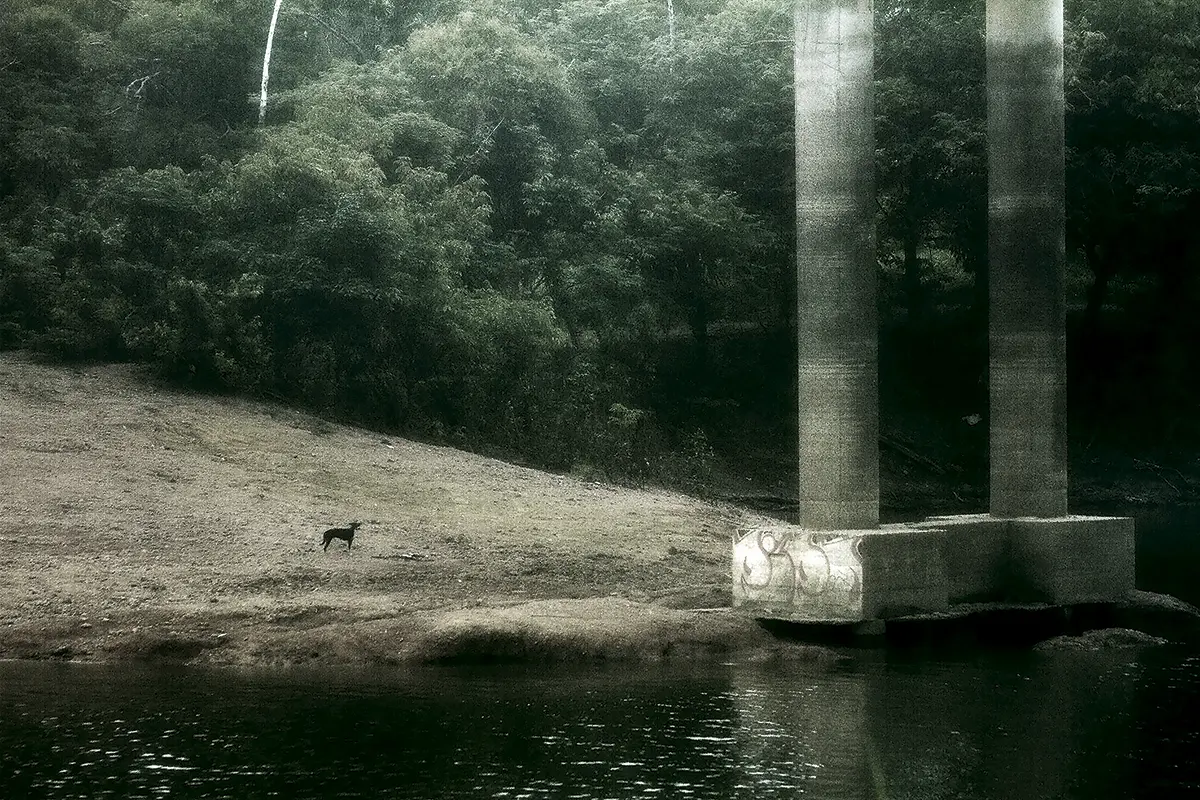
All the photographs are intentionally confusing; their colors and boundaries blend with the context. There is something sad and heartbreaking about them, but also fascinating: Where do all these animals live? What is this place that does not look like a forest, a beach, or any other recognizable ecosystem? One of the most compelling photographs is found in one of the corners of the exhibition room: it shows the silhouette of a dog in the distance, under what appears to be an enormous concrete bridge or industrial structure. There is nothing around but vegetation. It is a place abandoned by any other presence. Even the very photographic gaze seems impossible. Has the photographer actually been there? Where was the picture taken from? How did the artist manage to get to this place?
The project was born from a call organized by Trasatlántica, a platform that brings together works by Latin American artists. In 2006, it organized the first call for the Acciona Photography Award centered on the environment and sustainability, which invited all photographers to capture realities that reflected a commitment to, and protection of, the natural resources and biodiversity in Latin America. Rafael Milani won that first edition because of the evocative nature of his proposal. Other exhibition projects by Milani include solo exhibitions at spaces like the Museu da Imagem e do Som de São Paulo, and group exhibitions in venues like the Museu da Arte Moderna da Bahia and the Fundação Hansen Bahia.
As we continue our walk through the images of stalking animals, we observe crocodiles lying on the bank of a body of water near what appears to be a waterfall, but once again we cannot tell for sure because of the blurry rendering. The lighting is grayish, ambiguous, and muted, and there are no signs that suggest a time of day. Ants are also present, along with an owl. And, suddenly, there is a map as well.
The project also addresses the mythical past of the Amazons. It is not only an actual physical territory, but one also often fictionalized in literature, culture, and the collective imaginary. When the Western world entered into contact with it, through the explorer Francisco de Orellana, it opened a pathway to a world populated with stories and characters that heightened the friction of colonial history. This richness is present in its very name, the Amazons—which refers to the Thracian tribe of women warriors that fought alongside Achilles—in literary works like Macunaíma by Mario de Andrade, and in all kinds of cultural productions that always combine different traditions. "Tupí or not Tupí," Andrade would write in his mythic anthropophagous manifesto. The Amazon River runs across eight different countries and it is the largest freshwater river system on the planet. Interestingly, it also contains an entire universe of mythical gods, anacondas, conquistadors, tribes, and stories built in the West and combined with local stories.
Born in Óbidos, in the Brazilian northern state of Pará, the author of Contos Amazônicos (Amazonian Tales), journalist, writer and professor, Inglês de Souza (1853-1918) is an exponent of the so-called Brazilian Naturalism. His works combine reality and fantasy, a characteristic that is also present in other authors of his time, like Euclides da Cunha and his 1902 novel titled Os Sertões (translated in English as Rebellion in the Backlands). In these works, the land is yet another character that appears to speak a language of its own, limiting the relationship between the human condition and the environment. The extreme, the wild, the border-defined, is not only part of the landscape but also an argumentative structure.
This same idea is present in the project by Rafael Milani. The fascinating thing about the exhibition is corroborating the manner in which, amid the era of globalization, climate change, “liquid modernity,” and Google maps, the world continues to be, to a certain extent, unexplored and unknown. And inexplicably marvelous.
ANA FOLGUERA