
As is the case for many contemporary artists from Latin America, Ramiro Martínez Plasencia (México, 1963) initially decided to go into architecture, and indeed completed the architecture program at the Instituto Tecnológico de Estudios Superiores in Monterrey. Along the way, however, he came to realize that his true vocation was the visual arts, and in 1988 he was accepted into the Masters of Visual Arts program at UNAM’s Academia de San Carlos. In a few years, Martínez went from being a recently graduated architect to teaching in the arts programs at such institutions as UNAM, Universidad de Monterrey, Arte A.C., and the MARCO museum, and his work began to be exhibited in group and solo shows held mostly in Mexico and the United States.
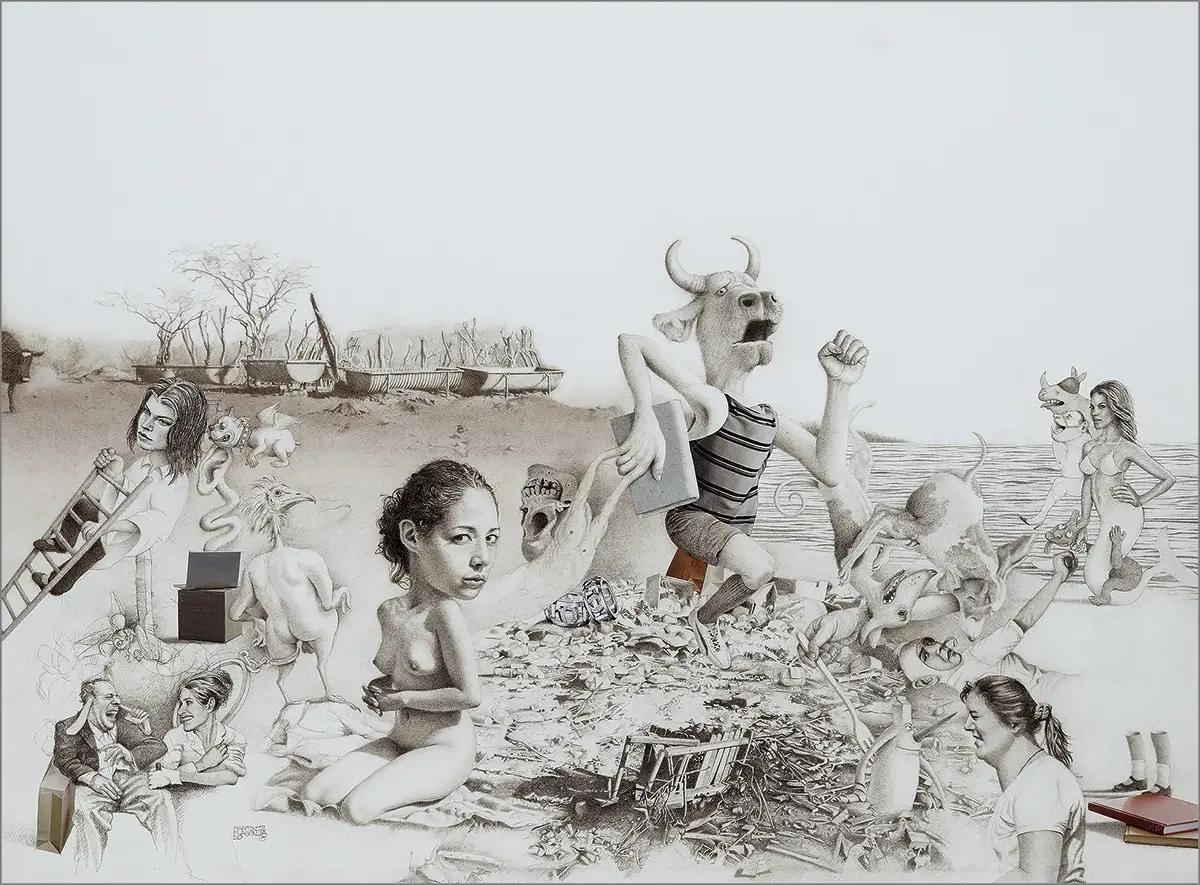
Martínez’s latest exhibition is Reparaciones domésticas (Domestic Reparations, 2017), at the Mexican Cultural Institute in Miami. Sponsored by Mexico’s Culture Secretary through its National Program for Art Creators, this show features sixteen medium-format works in various mixed techniques that combine watercolor, drawing, and collage. The first thing to note in Martínez’s art is its exactness and precision, the masterful academic craftsmanship with which the artist plans and executes it. The proportions, the compositional aspects, and the spatial distribution in these works speak of an artist who is interested in the visual poetics of his images and articulate them carefully in the key of a naturalistic-tinged realism. Martínez’s narrative method juxtaposes a variety of visual genres. Many of the works in the show interweave vignette techniques borrowed from book illustration (El caballo verde, The Green Horse, 2016), panoramic landscape layouts from the pictorial tradition (Réquiem, 2015), and even image-fusion strategies used in filmmaking (Naufragio, Shipwreck, 2015). This is why motion associated with events of everyday human life is, explicitly or implicitly, omnipresent in these works’ visual dynamics; everyday life in a human (yet de-humanized) world, the narrative of which seems to take place inside a TV studio set of a film soundstage where the artist’s characters move around or coexist with objects and things in the manner of movie props. Such theatrical overtones are articulated, both in interior scenes and in exterior narratives, with the landscape as their backdrop.
Martínez’s works extend an ironic gaze over the adult world, its obsessions, likings, and desires, and also its ghosts. This gaze is also connected to the imagination of childhood, to the memories and impressions that marked the artist’s education, feelings, and sensibility in those years. The characters are inspired by comic books and cartoons, or low-budget B movies and noir films. They all come together to shape fantastical stories where a real-maravilloso effect (roughly, “marvelous-real”) results from the high contrast between realism and invention: realism in the way reality is represented and codified, invention via the permanent presence of animals and things in human roles. Realistic representation is denatured and distorted by a disruption of the human body and its inscription in imaginary spaces, which contaminate it and reinforce the fantastical aura of the works. This happens, markedly, in Los espías (Spies, 2014); Toro mecánico (Mechanical Bull, 2015); and El laberinto de Vredeman (Vredeman’s Labyrinth, 2016). These works are immersed in an atmosphere that is more sub-real than surreal if we think of sub-reality as an expansive narrative that takes more from memory than from dreams. Sub-reality is a kind of narrative mechanism that builds its stories on the basis of real codes of meaning that are, nevertheless, articulated within a world made fantastical by the invention. In the context of this inventive realism, the key element in the narrative representations included in this exhibition seems to be randomness, rather than the interpretation of dreams.
Ramiro Martínez Plasencia’s Reparaciones domésticas reveals an artist fascinated, above all, by the visual manifestations of mass culture—a mass culture that is permanently shaped by new representations mediated by consumerism and the technological advances of the digital revolution. Martínez’s works, melding as they do naturalistic realism with the proverbial invention, depict popular culture as subject to large-scale socio-cultural shifts. Of particular importance among these shifts is the way in which the imagination of childhood comes to percolate into the sensibility of the adult world, and vice versa—the way in which the world of adults has come to be colored with the representations of childhood.
DENNYS MATOS