
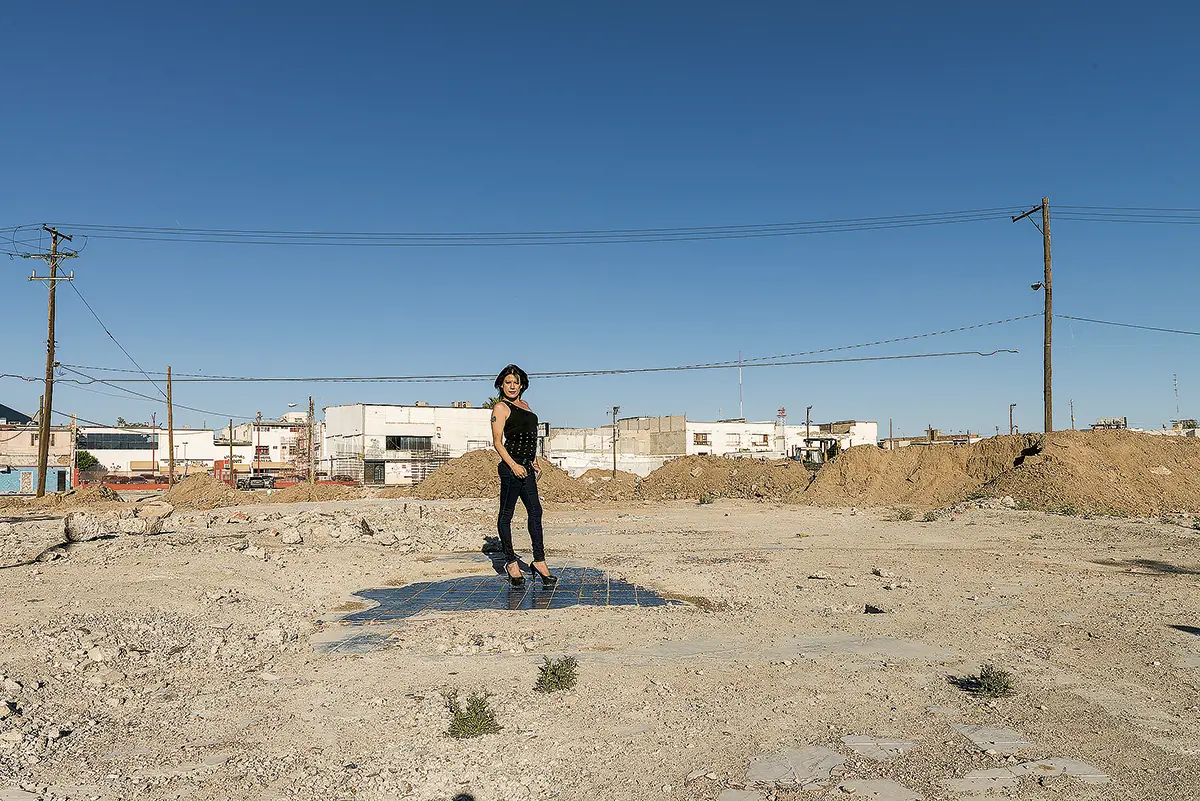
The first work we encounter upon entering the dark exhibition space is Tal vez la mataron por placer (Perhaps They Killed Her for Pleasure). A voice-over through a set of headphones narrates the story of Karla La Borrada, a transsexual woman and prostitute who lived and was murdered in Ciudad Juárez, Mexico. Martina, a friend of Karla, narrates the strange circumstances surrounding her friend’s death. A life-size photograph shows the victim staring back at us with self-confidence and showing no signs of concern. In the black and white image, Karla is in the middle of a plot that used to be the site, before gentrification took over the area, of one of the multiple clubs in which she worked.
The narration continues: “They took her next to a wall. They had been inhaling ‘agua celeste.’ There, they hit her with a rock until her face was disfigured.” A block of granite has been placed on the floor next to Karla’s photograph. The first contact with Dance Floors, the exhibition by Teresa Margolles at CentroCentro in Madrid, Spain, is very powerful. A death certificate displayed on the wall describes the circumstances of Karla’s death along with the date when the brutal murder took place: December 22, 2015.
In recent years, Mexican artist Teresa Margolles (Culiacán, Sinaloa, 1963) has been focusing on crimes committed against women in Ciudad Juárez. Given her background as a medical examiner, Margolles’s interest in exploring violence and death has marked her work. In 1990, she founded the artistic group Proyecto SEMEFO (Forensic Medical Service). The group relied on the use of body fluids, forensic objects, and even bodies to create their artistic productions that approached violence in Mexico. From then on, her artistic trajectory has been defined by denouncing hate crimes against women and the inaction of the government. In 2009 she created one of her most important works for the Venice Biennial: ¿De qué otra cosa podríamos hablar? (What Else Could We Talk About?), in which she used the blood spilled during the war against drugs in Mexico. Margolles has presented her work in spaces like the Museum für Moderne Kunst, in Frankfurt, the Venice Biennial, the Los Angeles County Museum of Art (LACMA), and the Museo de Arte Moderno, in Mexico City, among others.
Dance Floors is part of the exhibition program The Exaltation of Being. A Heterodox Gaze curated by Alberto García-Alix within the PhotoEspaña festival. It is an exhibition that also occurs at the same time as the World Pride event celebrated in Madrid during the month of July.
The story of Karla is followed by a series of portraits of transsexual prostitutes in other destroyed sites where once stood other nightclubs where prostitution was offered. With the intention of freeing the downtown section of Ciudad Juárez from this type of activity, the authorities have destroyed many of those spaces, through a process of degradation in which the violence between drug cartels and real estate speculation also play a role.
The photographs could not be any more compelling: marginalized figures made invisible by society standing on the ruins of consumerism and entertainment. The credits list the following establishments: Club Hollywood, Bar La Cruda, El Extranjero, Las Vegas, Mona Lisa, Nancy, La Madelon, Irma’s, and Virginia’s. All names that transport us to a distant and exotic imaginary: neon-flooded movie sets full of color and unreal environments. The very exhibition as a whole supports this idea: dimly lit spaces, the red mockup on the floor, and the compartmentalization of the rooms. These photographs combine relative happiness, echoes of music by Juan Gabriel, and vestiges of a certain nocturnal atmosphere. All that is left with the arrival of daylight is the body of evidence: violence perpetrated on bodies in the process of transformation, the desolation of the empty spaces—condemned to become mere dumping sites—and the silence about the crimes fueled by male-chauvinistic violence.
Devices placed in a corner introduce the sound space in the exhibition. It consists of sound recordings documented by Teresa Margolles in places where crimes have been committed against transsexual prostitutes. The installation is very dramatic because the absence of violence is precisely what underscores the invisiblization of the murders. We hear birds, cars passing by, conversations in the background; everyday life in a Ciudad Juárez unencumbered by the deafening silence. Paradoxically, only crime, blood, and violence shed light and make visible the reality of women in Ciudad Juárez.
ANA FOLGUERA