
William Cordova intersects the traditional historical line with the drawings, photographs, constructions, mixed media, prints, and writings that result from his research and travels. Born in Peru in 1971, Cordova learned about traveling at an early age. He lived in Miami, Houston, Chicago, and New York, studying art in the latter two cities.
Titled Smoke Signals. Sculpting in Time, in this third solo exhibition by Cordova at the Sikkema Jenkins & Co. gallery, in New York, the relationship between cultures and mementos is presented, previewed, and revealed through architectural references. Cordova concurrently evaluates primitive cultures and current visions; from the former, he transcribes certain rhythms and natural materials applied to oil paintings, collages, embossing techniques, and mixed media. For William Cordova photography can be expressed through several mediums: Polaroids, videos, and digital photos represent approaches that reflect an interest for that which is current. His installations reveal a willingness to try unconventional combinations that, above everything else, can successfully convey his inquiries.
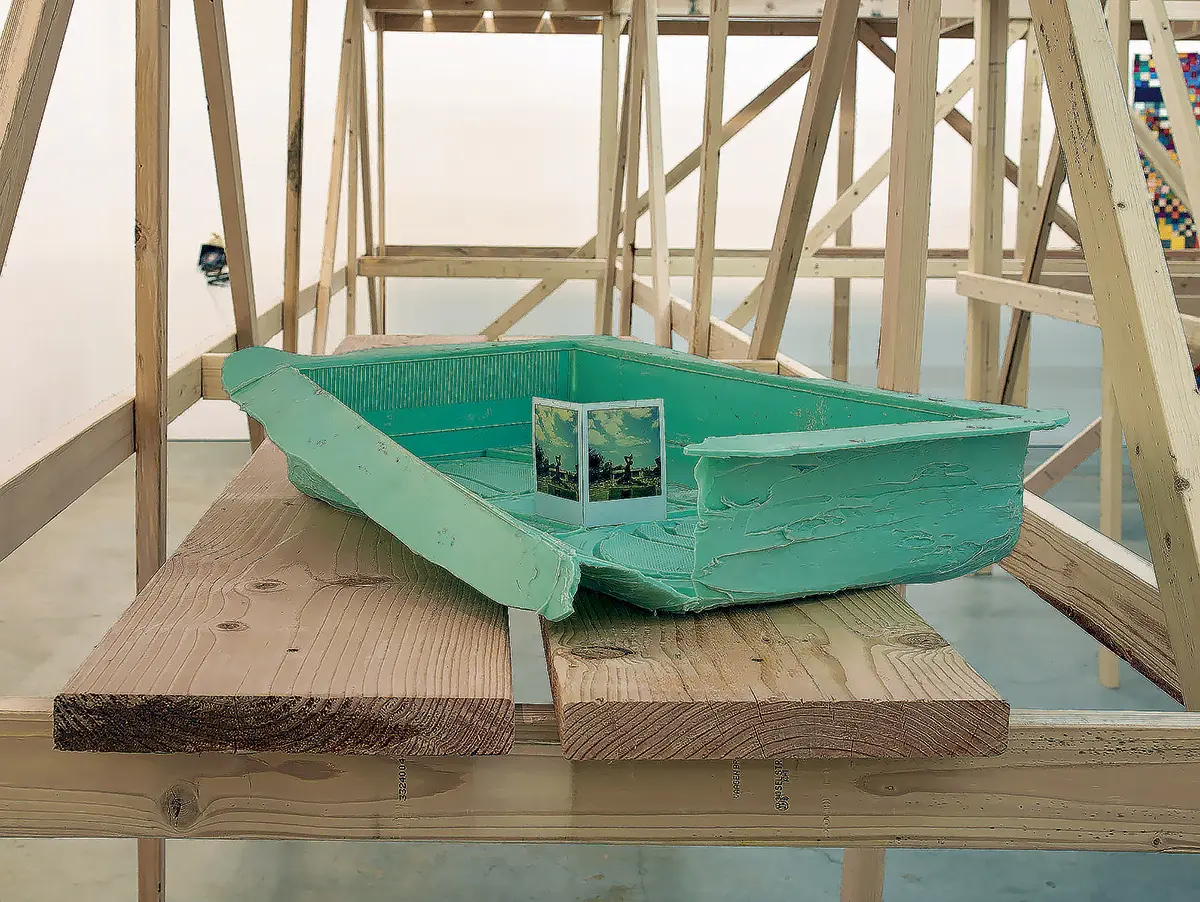
Symbolically speaking, the spiral shape of the installation in this exhibition projects physicality and spirituality. Of large dimensions, it consists of untreated wood scaffoldings and occupies the central space in the main exhibition hall of the gallery (It should be noted that the installation here is connected to another one from 2016 titled Much Wider than a Line, which Cordova created for the SITE Santa Fe Biennial in New Mexico). In this work, Cordova condenses concepts by Buckminster Fuller and Frank Lloyd Wright, by the transcendentalist philosophies of the Aztecs, as well as by Asian and Andean architectures. These concepts and philosophies, along with archeology, are subtly manifested through referenced vestiges. To those of you who may feel wary about this temporary and odd combination or who simply believe it to be ridiculous, I inform you that it does work aesthetically at a high level, presenting viewers with original and enriching visualizations from many angles. Hanging on the wall are paintings like Estrategias (Strategies, 2015-16), mostly consisting of intense reds and beiges oils on paper and collages using car images; and Eroica III (spatial and ideological terrane) (2016-17), a mixed media collage measuring 77 x 80 inches (195.6 x 203.2 cm), reminiscent of the textile weaves of ancient pre-Columbian civilizations. Watching these works through the installation inverts the space-time relationship. William Cordova overcomes the ancestral traditional gaze or the utilization of such types of essences. He integrates new pre-Columbian imaginaries from Peru and visualizes them from the perspectives of the personalities above mentioned.
The works on paper are diverse. Some of his series are only represented by a fraction of their works. The use of embossing or intaglio confirms that Cordova creates prints and, therefore, that he also delves into the graphic experience. The word “sculpture” is immersed in those same principles already mentioned that Cordova cares for and treasures. They are three-dimensional signals well-guarded in the title of the exhibition: Smoke Signals. Sculpting in Time. The work Sin Título (San Martín de Porres o Papa Candelo) [Untitled (Saint Martin de Porres or Papa Candelo), 2014-15] is a piece made with recycled cardboard and treated with coffee and a coat of varnish. An interaction between a base-box that supports a turntable, various photographs, and a letter on a stretch of wood that creates a sort of shelf, is titled Physical Graffiti (or Synthesis We Knew About) and condenses the sound part of the installation. With these two works, Cordova asserts the anti-academic posture that he also ratifies in other pieces. Both the 2016 piece Untitled (Transmissions), created with feathers, a hairband, stone and wire, and the work Sin Título (La Vida Secreta de las Plantas) [Untitled (The Secret Life of Plants)], in which Cordova uses a silicon mold and several Polaroids, charge with meaning elements that serve other functions. A shelf with six Polaroids allude to the cosmos, round forms, and the shape of a soccer balloon, among other things; only a single photograph out of the six included attends to a contemporary social documentary.
In an adjacent exhibition room, several pedestals are used to display and support monitors that show videos. In this manner, visual technology is incorporated as another of the chapters covered by Cordova. Smoke Signals: Sculpting in Time summarizes the extreme relationships between a certain type of Indigenism, some architectural principles, design, video, and music. The show incorporates several visual art disciplines into a process resolved with flawless elegance. At the same time, there is the matter of the smoke signals, one of mankind’s oldest forms of communication.
GRACIELA KARTOFEL