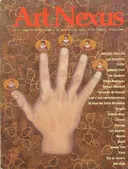
The recent retrospective of work by Rebecca Horn in New York transformed the Guggenheim Museum into a science fiction laboratory. The large concrete spiral became an enormous funnel, which, over a period of more than three weeks, offered, rather than works of art, a variety of experimental foci that have a direct relationship to the artist’s creativity, but which at the same time and ad infinitum acquire a new meaning with each new spectator. It is basically through this constant dialogue that Horn proposes the “finiteness” of mankind. Indeed, the communication principle is one of the basic concepts that are evident throughout her career. From her early works, which she designed in the solitude of a hospital room as an extension of the body in its attempts to reach the “other” and to establish communication, up to her impressive installation in lead tubes (The River of the Moon, 1992) which extended along all the ramps of the Museum up to the ceiling, thus connecting all the spaces together, we sense the need for active intercommunication, which reflects the desire to know the external world through personal experience. But desire and communication are only the fundamental elements of an implicit project that is present in all her work. This project, which is of a very contemporary philosophical kind, may be seen as an epistemological proposal different from that developed by classical Western thought up to the nineteenth century and different too from the cognitive paradigms which subsequently resulted in the emergence of modernity. Horn can be placed between the two poles, neither of which she totally rejects, and her proposal, at a time of deep historical questioning, encompasses highly meaningful forms of knowledge.
If we look back at the system governing classical, rationalist knowledge (fifteenth-eighteenth centuries), we find an order of nature based on representations of what man considered to be things themselves.2 By means of these series of representations (words, diagrams, maps, symbols, etc), man established a systematic knowledge of the outside world. It was a world which, through language, assumed a natural order, an inherent unity, an unbreakable linear character, a world which is the domain of “man” and in which man is sovereign. In this way, language materialized perceptions, conceptualized desires, explained sensations, labelled and ordered everything that surrounds us. Thus, through representations, we manage to possess the truth of the world. It is here—in language as a common discourse for representation and things—that we find the intersection between nature and man; but apart from this intersection, it is “man” who...