Spaces of memory: immemorial love
I was still panting from my trip across New York City when my spirits suddenly lifted as I entered the Museo del Barrio. Outside, the grey silhouettes of the buildings, the penetrating noise, the motionless shapes of the dispossessed pierced the mind like a nail. Inside, the floor, the walls, the ceiling—the entire space of the Museum—was transformed into a place of warm and festive celebration: The House of Us All,1 an anthology of environments by the Puerto Rican artist Antonio Martorell. Hanging in the doorway, there was an enormous calligraphic board with the words: “In times of want, the Museum provides houses for the imagination”. The full visual reverberation of this sentence echoed throughout this museum, now made into a house. To visit its rooms was to relive intensely one of those journeys through space and time which we used to take when we were children, hidden in some solitary corner, dreaming with our eyes open.
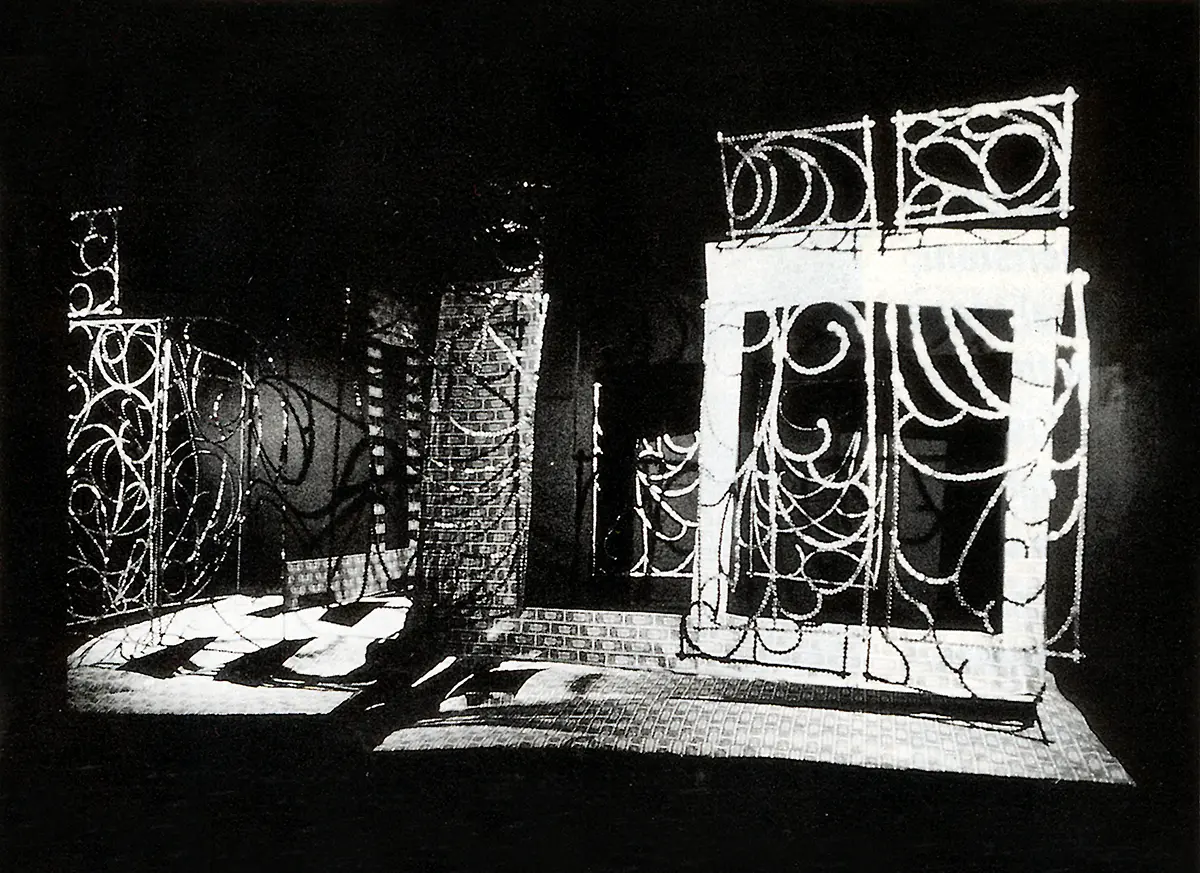
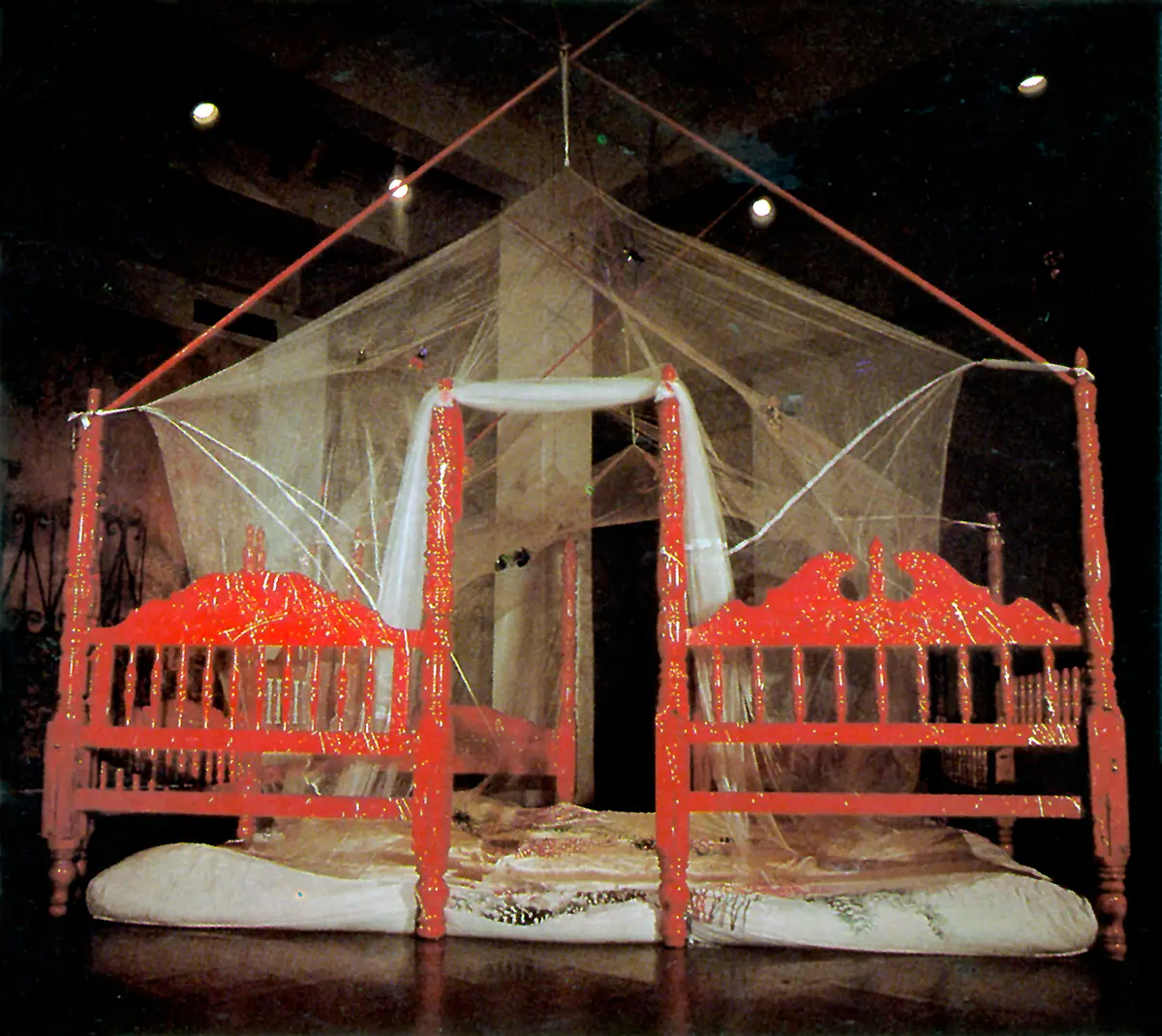
Thus, in anticipation of our desire to restore ourselves from the hustle and bustle outside, there was an enormous bed-house (Kamikaze, 1989), covered by a white mosquito net, which welcomed us into the “house” of the imagination. With its floating walls, which allowed us to enter into the soft mattress of ferns and house plants, it seemed to bring back the memory of childhood on some island now trapped in the net of the almost inaccessible transparencies of the mind. The bed was perhaps that of our grandmother, the nanny; a place shared at siesta time with brothers and cousins. It was, too, the marriage bed of our parents, which remained in the album of the great marriage... Enormous silhouettes, conjured up out of the perfumed vein of the wood, covered the walls with sheets of paper, inviting us to enter. They are family members, and friends halted in time in the pictures of the family album: ghosts caught in the railings, fleeing from memory and so entering the house of everyone. Nearby was The Great Silk Tree of Ponce (1991), an expressionist elegy to the centuries-old tree, now converted here into a house drawing. As I stood under its enveloping shadow of paper, I seemed to see its twisted trunk and long tentacles gripping hold of my childhood nightmares—the nightmares which seemed to take hold of us, vomiting out the eleven thousand virgin curves of the twisting road from San Juan to Ponce, as we fell victim to a feverish vision of invasion by trees in human forms.
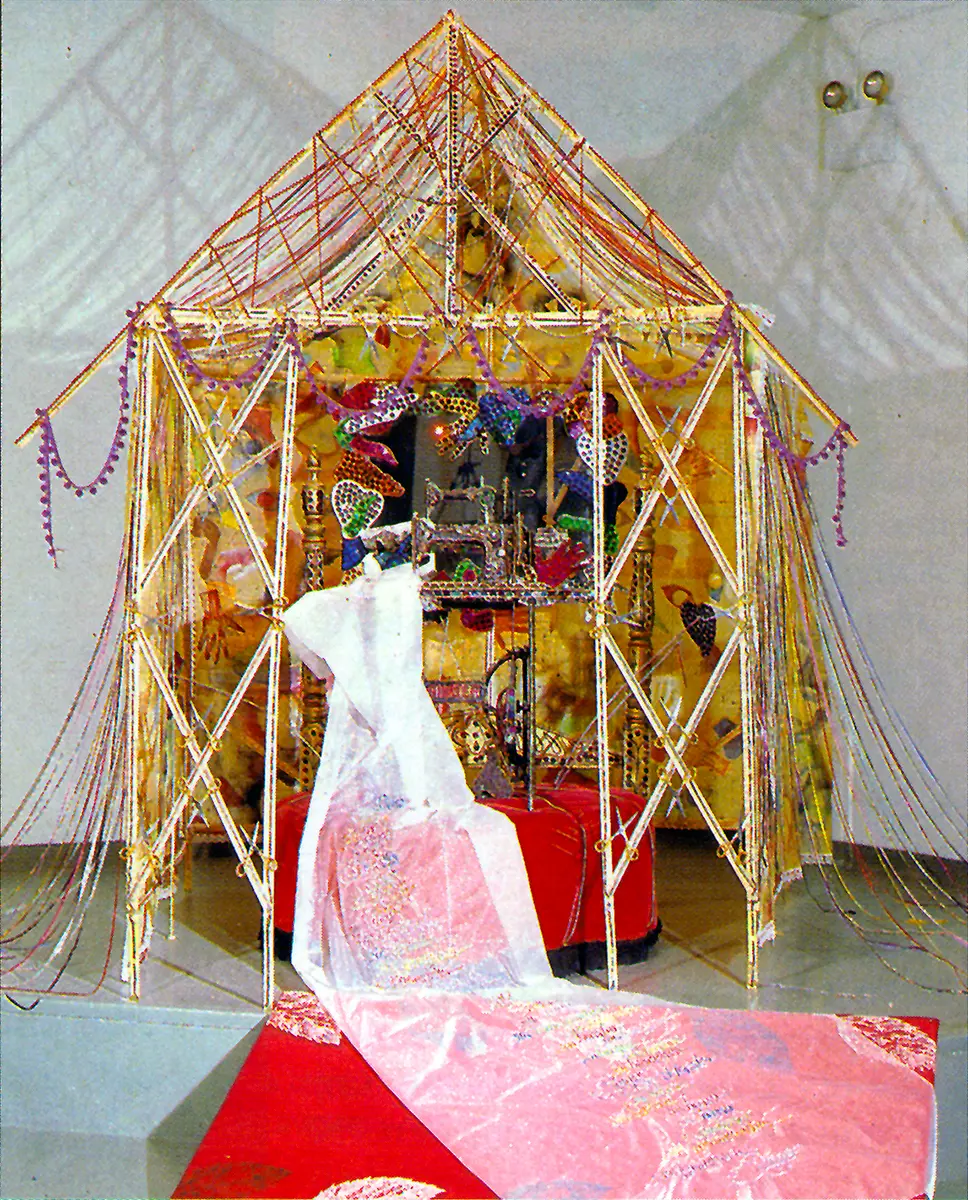
Little by little, Martorell led us into spaces which were a kind of springboard for a journey back to our memories of some amnesic island. On one side of the Great Silk Tree, there was a huge pincushion: its red velvet was like the heart of a delicate structure with simple walls. The ceiling was overflowing with strings of sequins, lace, garlands, bands, and picot. Then there was the central monument of those afternoons after school: The Singer House (1991), recalling how mother and the neighbors used to sew for us the dresses we used for parties, whilst Radio Bemba blared out the latest disputes amongst family and friends. It was a noisy piece of equipment, here transformed into a machine that spat printed words out on the long, virginal veil of the bride. A veritable paronomasia in silk thread embroidered on cristallet...Singer...Sin-her...Sing-Sing...Sin-si: From without hieroglyphs to without (sin) hierarchies to without (sin) German and without heretics. And in the center, a soft commotion, with the floating paper reminding us of the “Rilkehaus”, the age-old grotto of the Letters to a Young Poet, the sanctuary of so many adolescent yearnings transformed into an artistic creed. It was a house-letter made with paper and words, an interior flight towards all those of us who are the adoptive children of the German writer, towards our youthful passions, towards a book in which we first explored the country of the imagination.
But there were two environments that disturbed the magic of memory. The Green House, the first of these, had a kind of floating ceiling made up of three thousand dollar bills and adorned with arabesque railings made of coins... a bitter taste of recent visits to the island. An island that has been mortgaged, shut in, and inert as it faces the status quo of an uncertain future. Further on, the contagious rhythm of the salsa and bolero in the voices of Daniel Santos, Tito Rodríguez, and Cheo Feliciano took us into a tunnel of closed time in the snout-like form of a plane on a night flight. We are now in The House in the Air (1992). In this installation, the images seemed to become words, forming a fine calligraphic superimposition over the story of The Air Bus by Rafael Sánchez. Armchairs, chairs, seats recuperated from some collective eviction became the occupants of this house suspended in the air: it was simultaneously a plane, a bus, and a bordello. It is here, in this space, that the windows in the form of mirrors returned our glance, showing us what we are: the memory-filled inhabitants of a country in mid-air, in some kind of ethereal transition. A nation forever suspended like a point between two seas, our uncertain destiny caught between two cultures, two spaces, and two dimensions of time.
More than the time of forgetfulness, a community of memory
“I already have the little house which I always promised you... ”
Rafael Hernández
With these houses of memory and imagination which the artist carries within him,2 Antonio Martorell set out to conquer New York, in a kind of reversed colonialism. His environments are spaces captured by the imagination, dimensions which are neither physical nor historical, but which derive from his capacity to awaken and nurture our imagination, taking it step by step towards the vitality of a shared past. The house is used to activate this meaningful process: the house —the home— is the great refuge of our childhood, the safe and sure sign of our day-to-day life, providing shelter for the solitude which comes and goes. The house is also the first place where we begin to give value to life, to imagine and to dream, the place where our memory is anchored.
Both the structure and the subject of the house allow Martorell to work his environments as a space enclosing both autobiographical and collective elements. And then, of course, The House of Us All is also the little house which the song promised us, almost like a kind of vocalized place, modulated with a kind of rustic accent, which is part of all Puerto Ricans; an emblem-house of the popular triumph of the 1950s, transported to New York by all our immigrants. The House of Us All is therefore a space that opens up onto the collective memory of the island, with each installation in the show giving a sense of unity to the artist’s very personal constructions. It is a mordant kind of unity which differs radically from the unauthentic, uncritical cynicism which is characteristic of so many artists who have chosen to work with installations. Each of Martorell’s installations is a “bricolage” of autobiographical references, some taken from his earlier work, which are interwoven with the images of the homeland itself. Then there is the part which the spectator, in his or her yearning, will bring to each of these works. The Singer House is an example of this: it is simultaneously a homage to the seamstress-mother and a symbol of inequality, so many of whom worked in factories or out of their homes in New York. In the same way, the railings that shut in family relatives and friends in the Family Album are an up-to-date comment on the state of siege that afflicts the artist’s compatriots as a result of the high rates of criminal activity on the island. The elements in the Catalogue of Objects are the pathetic survivors of a way of life which is very much our own, and which is now disappearing in the modernizing development of the metropolis. The dollar bills in The Green House are a symbol of both protection and attack: without doubt, the house of hanging words is a very caustic metaphor of a nation that is being totally uprooted.
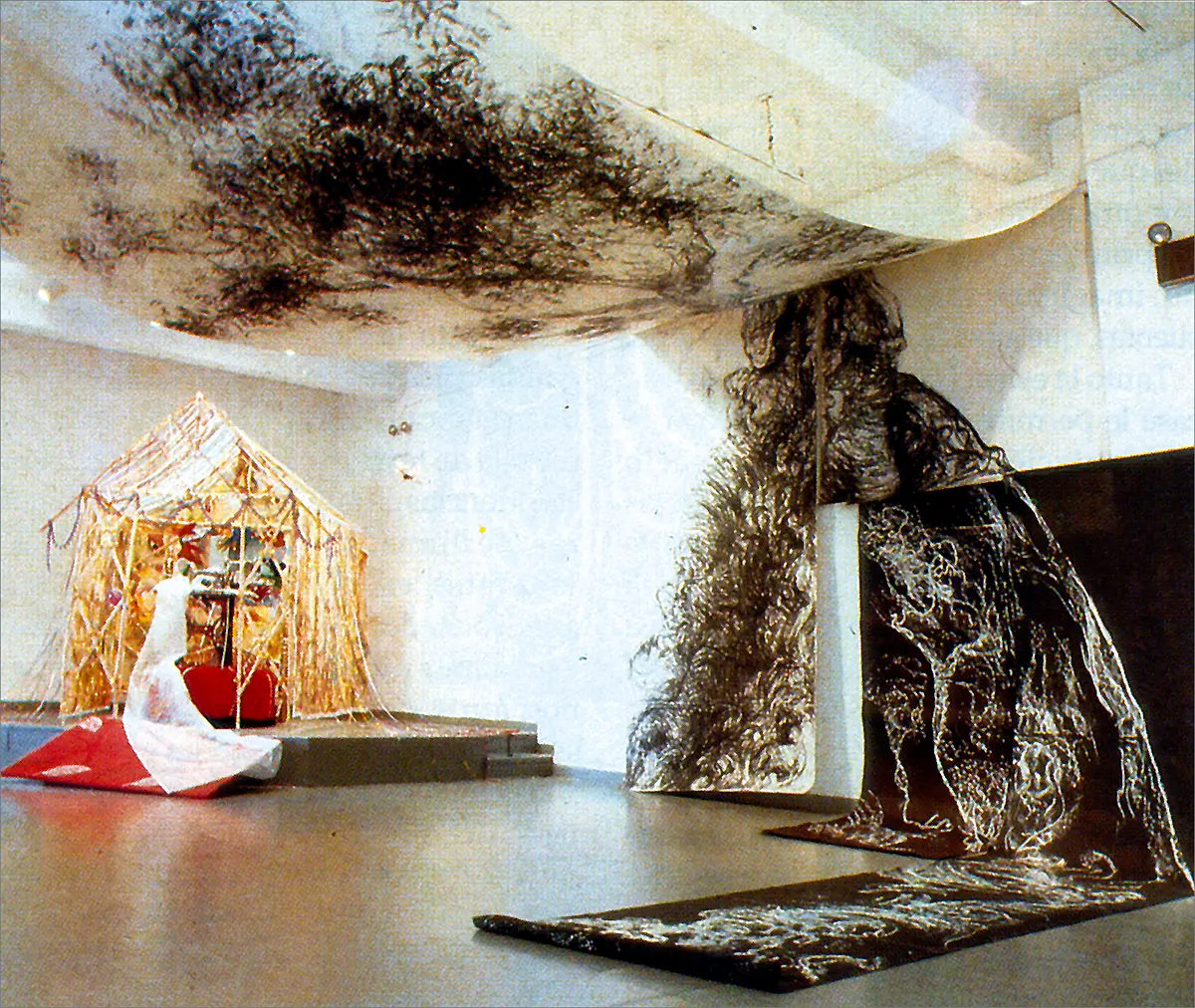
The social metaphor encompassing Martorell’s houses is based on a hybrid aesthetic which is totally Caribbean: a mixture of textures, sequins, metals, chromatic stridency, the smells of perfumed wood, and the heady rhythm of salsa and rum. It is an exuberant and sensual fusion of Hispanic, Afro, and autochthonous elements. As we have already said, Martorell did not simply “place” his objects around the edge of the Museum, but “disrupted” every inch of space, filling them to the brim in a frenetic delirium. In this way, the act of creation reflects one of the characteristics of the Puerto Rican spirit: the decoration of the home and the domestic environment, the dressing up of both the body and the senses. The objective is to give a personal stamp to every single object in every single nook and cranny in a kind of coquettish parade of the collective self. Thus, in Martorell’s houses, baroque elements fuse with popular ingredients and vice versa, both of which seem to be at the limits separating art from melodrama and bad taste.
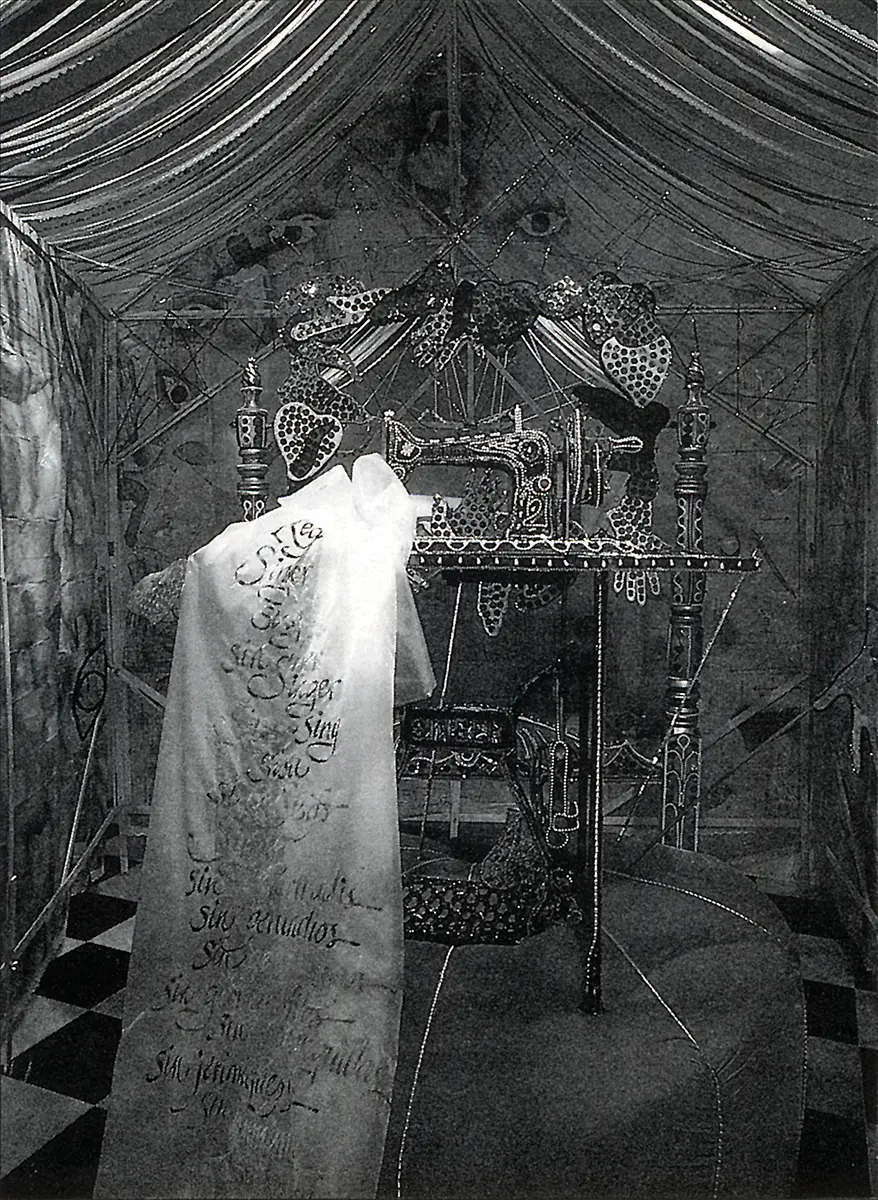
Martorell also incorporates the collective reference into the actual production of these installations, in a gesture that is at once participatory, insolent, and playful. Each of his installations is the production of teamwork, involving relatives, friends, acquaintances, and strangers, all of whom, as in some moment of family drama, turn up to help the artist in his laborious task of rescuing images from their shared memory. It is, therefore, no surprise that the subtitle of the show was Martorell and Friends. By means of an eloquent dialogue of hands and voices, unusual elements are incorporated into the creative process in a random sort of way, as something fortuitous and unexpected. The artisan’s hand is present everywhere, in the ways the prints have been folded, in the expressionist linework of The Great Silk Tree of Ponce, the letters embroidered on the bridal veil, as well as in the drawings, insects, railings, seats, garlands, and decorations which are omnipresent in these installations. The overall impression is like a distillation of sensibilities, of visions and emotions which once absorbed into the work seem to return to the communities which originally created them.
The raw material of this search is the re-signification of the everyday objects which Martorell recuperates from ordinary life. They impress us by their evocative powers as our mind plunges into a network of references in color, texture, and inscription. They are objects which function as a structure of sentiment and, indeed, sentimentality. They are fragments filled with references to our collective being, echoes drawing us back towards heartfelt memories. In some cases, this re-signification process transforms certain elements from pop art. For example, in The Green House, Martorell uses the paradigm of the dollar bill, a favorite motif of Warhol and the New York pop movement of the 1960s. However, whereas they used the dollar as an icon of modern culture, Martorell devalues it and makes it just another element of decoration, fusing it into the structure of his work, mocking and satirizing it.
Martorell’s houses are celebrations of this sense of being part of a collective memory and imagination, which is the hallmark of the Puerto Rican character. Like the boleros of Daniel Santos, these festive creations are based on verbal and gestural exaggeration in an attempt to say who and what we are. The artist is not interested in any local narcissism or socio-anthropological investigation, but in establishing a vital contact with meaningful elements from his cultural environment. His aim is to affirm a sense of identity by projecting absolute values and a relative vision of the world. From the post-modernist standpoint, such a project might be considered romantic and even anachronistic. Yet its validity is reaffirmed in the political context of Puerto Rico, the last colony in this part of the hemisphere, where identity is woven in a fabric that has to be tacked and stitched every day in the Singer house. The Singer house, which is the house of us all.
To speak of the con/sensualism of Martorell’s environments is to see them as vehicles of critical sensuality. They guide the spectator towards a set of common and personal references, an ongoing dialogue with the identity and heritage of the past. Through the critical act of restoring lost memory, each of these installations allows the spectator to decipher “meaning” within this web of references. Seen this way, the consensus is the mixing of references that end up, here, placing the levels of meaning one on top of the other. The houses of Antonio Martorell, in the final analysis, take us back to a home and a world whose identity belongs to a different kind of contemporary time and space: that of the Caribbean tradition in which the new and the old, the popular and the erudite, the modern and the post-modern fuse together every day. The suspended space and the arrested time invite us to a fiesta, which is a celebration of all our senses and which takes us beyond the flatness of contemporary superficiality. With memory and imagination, this artist has deconstructed his conceptual elements and created, in a ludic and never evasive consensual act, the house of us all.
NOTES
1. The House of Us All: Antonio Martorell and His Friends, exhibition of environments and supporting objects by Antonio Martorell at the Museo del Barrio, New York, October 1992-January 1993. An attractive bilingual catalogue was published with texts by Susana Torrela Leval, Antonio Martorell, Luis Rafael Sánchez, and Celedonio Abad.
2. The House of Us All was a synthesis of the series of three exhibitions presented by Antonio Martorell in April 1992, first at the Casa del Libro in San Juan and then in the Cultural Center of the University College of Cayey and the Ponce Art Museum.
MARI CARMEN RAMÍREZ