
This recent exhibition by the Venezuelan artist Francisco Bugallo was the result of an ambitious and profound project focusing on Bugallo's solid artistic career, which has been characterized by his seriousness and mastery of painting. For a number of years, Bugallo has been using images from the history of Western art, which he reinterprets in his now definitive style. Works by Leonardo, Uccello, Botticelli, Velázquez, Ribera, Goya, and Ingres, amongst others, form part of the iconography that Bugallo has been developing over the years. A large selection of these works was presented in 1990 in the Museum of Fine Arts; another show followed at the Sofia Imber Museum of Contemporary Art in 1993. Last August, the main room of the same institution was the setting for Bugallo's large pictorial installation entitled Image and Semblance, in a show curated by Adolfo Wilson.
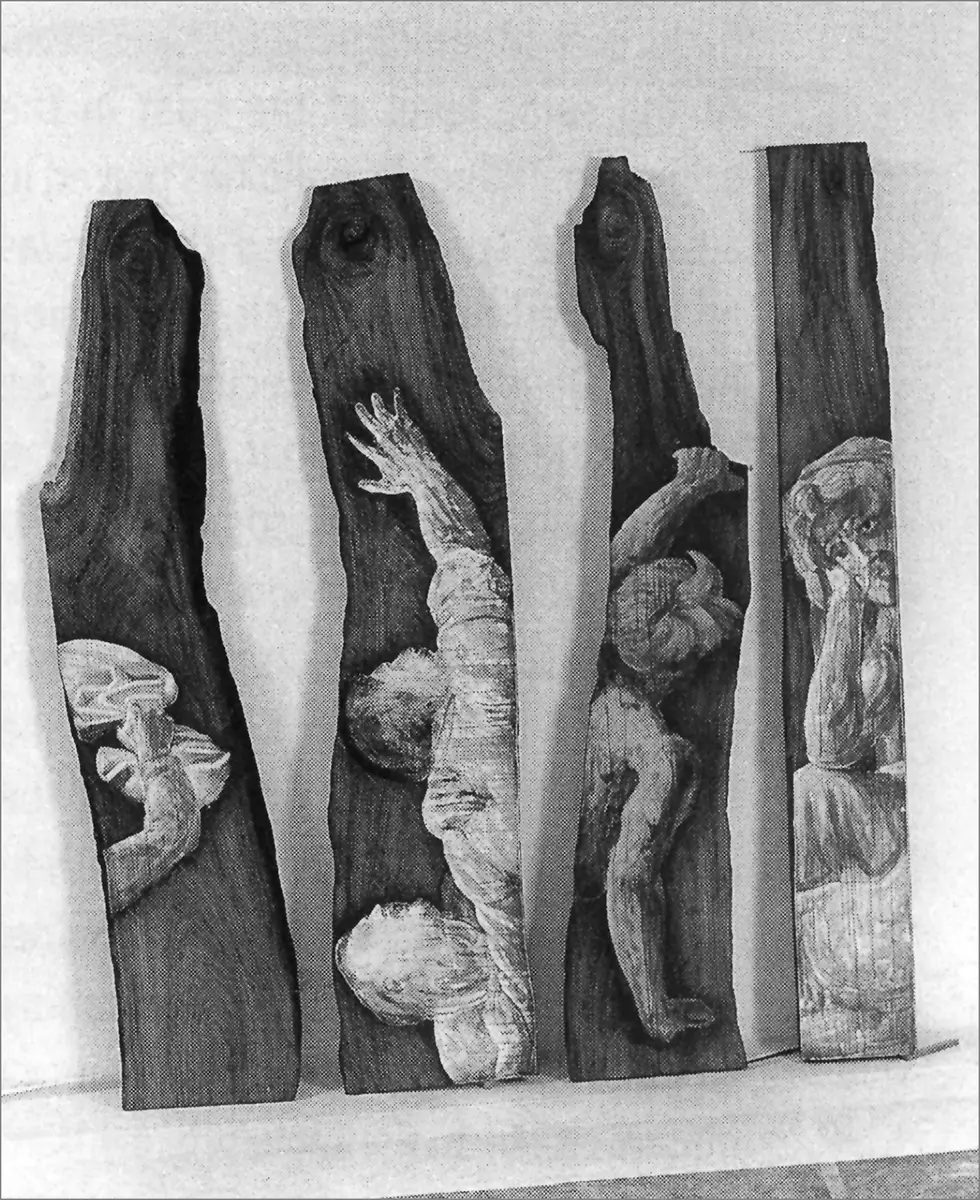
This installation takes as its references The Raft of the Medusa (1817- 1820) by Théodore Géricault and Hans Holbein's Dead Christ (1521-1522). The work presents three moments or stages in which the spectator in one way or another inevitably has a number of experiences. First, is the experience first taking in the scale of the monumental canvas in Bugallo's reinterpretation, on an exact scale (491 cm x 716 cm), of Géricault's picture. Then comes the experience of moving between the wooden boards which depict the fragments of the bodies of the figures in the picture followed by the discovery, in a dark and separate space, of the suspended body of Christ, painted against a brilliant gold background.
Bugallo has faithfully reworked essential aspects of both masters in his own very contemporary language. Given the multiple references of an installation such as this, I shall merely indicate a few examples. On the one hand, the theme that motivated Géricault's picture: is the critical and exasperating situation of the 15 survivors of the Medusa, a vessel that suffered a shipwreck due to the irresponsibility of the French Government which allowed an incompetent person to act as captain. This picture, which caused a scandal at the I8I9 Salon, depicted a real and recent event and made the public intensely aware of what had happened.
The state of despair, terror, desolation, and hope that each person reveals at a critical moment of the shipwreck (with another boat visible on the horizon) is captured in an exceptional manner on this enormous canvas, with the situation being concentrated in the foreground. Bugallo takes up the human drama in itself and decontextualizes it (the almost monochromatic figures appear virtually as silhouettes against a light-colored background); the sea disappears, along with the vessel, and the event remains suspended in a kind of timelessness and limitless space. However, the spectator could walk around the room and see the wooden boards, which were fragments that Bugallo collected from a fallen rain tree. On these boards, he painted fragments of the same bodies which can be seen in the picture, forms that can be recomposed - like in a puzzle -to make up a new version of The Raft of the Medusa. The spectator can experience the shipwreck a posteriori, through the material and bodily remains of the raft and the persons who occupied it. Géricault is known to have studied human anatomy with fragments of bodies that he examined in the morgue. Something similar seems to be evoked in Bugallo's boards.
On the other hand, the element of hope, represented by a boat on the horizon, is eliminated in Bugallo's version. At the same level as the boat in the original painting, Bugallo has placed in a separate space, behind the canvas and marked out by panels, his version of the Dead Christ, executed on the same scale as the original. In this case, the body is not in the tomb, but in a golden atmosphere, suspended outside time and space. Hope, in this new version, is to be found in Christ, but the fact that He is dead emphasizes the sense of sadness and impotence.
As Marta de la Vega rightly points out in her text, Bugallo is attempting to go beyond anecdotes in his copies of masterworks. In the same way, he transcends his own virtuoso pictorial skills when he reconfigures an extreme human situation; in this case, fear and the survival instinct, by bringing us, the spectators, face to face with our most primary feelings. He invites us to enjoy with real pleasure his love for painting in its most sublime expression.
SUSANA BENKO